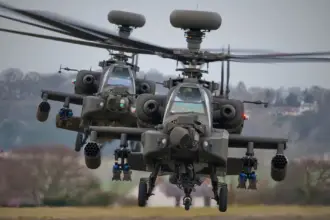


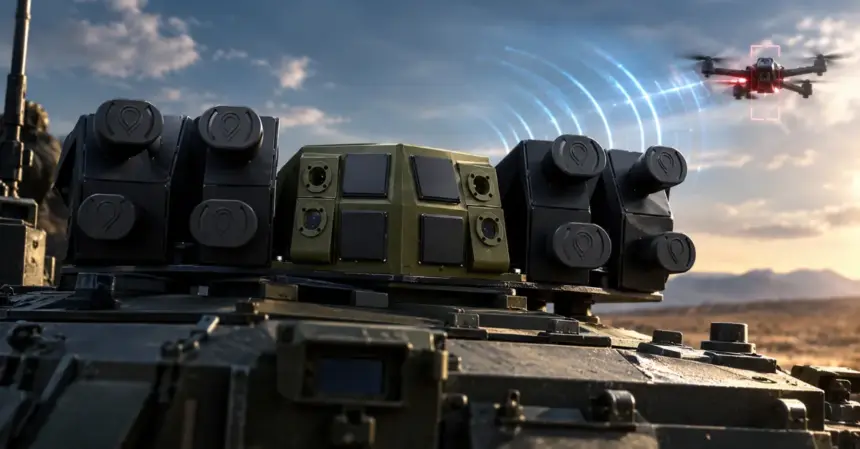
The announcement is modest in form, but it touches one of the most pressing tactical problems facing armies today. It also comes with a caveat: so far, the system has only been shown in stationary tests.
A threat that has become central on the battlefield
Not so long ago, the FPV (first person view) drone was a hobby and racing device. Armies have repurposed it. A craft costing a few hundred euros, flown through a headset or a screen, can crash into an armored vehicle worth several million.
That economic asymmetry explains the interest of military staffs. The war in Ukraine has turned these machines into a routine tool of precision attack, against vehicles and infantry alike. According to several analysts, they are now among the leading causes of materiel losses along the front line. I deliberately stick to that formulation, because figures vary from one source to another and remain hard to verify in wartime.
Countermeasures have multiplied, sometimes in makeshift form: wire cages and grilles over turrets, jammers, shotguns, nets. Each has its limits. Jamming loses its effectiveness against fiber-optic-guided drones, which radio waves cannot reach. Passive protections add weight to vehicles and do not cover every angle.
What ThirdEye Systems presented in Baku
It is against this backdrop that ThirdEye Systems unveiled IronWeb. Here is what is known, and what is not.
- Established: the system was presented at ADEX 2026 and aims to protect armored vehicles against FPV drones.
- Established: it has only been demonstrated in stationary tests.
- Missing: no demonstration on a moving vehicle has been presented.
- Not publicly documented: performance figures (detection rate, reaction time, false-alarm rate), any customers, and a deployment timeline.
IronWeb’s operating principle does not appear in the information available to me. I would rather say so than infer it from the product’s name. The company or the exhibition’s organizers will be able to clarify it.
A company rooted in computer vision
ThirdEye Systems is not a newcomer to defense. Founded in 2010 according to specialist databases, the company has been listed on the Tel Aviv Stock Exchange since 2021. It specializes in AI-based object recognition using thermal and visible-spectrum sensors.
Its best-known product is MeduzaX, a passive optical drone detection system. It offers 360-degree scanning and performs edge computing. Processing therefore happens as close as possible to the sensor, without going through a remote server, which reduces reaction times and dependence on communication links. “Passive” means the system observes without emitting a signal. It is harder to locate than a radar, which matters on a battlefield where electromagnetic emissions attract fire.
The company states that its systems are used by the Israel Defense Forces and other customers. The uses cited are counter-UAS operations, border security, critical infrastructure protection and search-and-rescue missions. These claims come from ThirdEye itself. I have not found detailed independent confirmation, which is common in a sector where contracts often remain confidential.
On the ownership side, the Israeli business press has reported that the UAE’s EDGE Group took a stake of about 30 percent for $10 million, announced in early 2025 and confirmed in January 2026. The deal fits into the defense rapprochement between Israel and the United Arab Emirates since the Abraham Accords.
IronWeb, ThirdEye Systems veut protéger les blindés des drones FPV
👉 https://t.co/EXPy16Aml7
L’annonce est modeste dans sa forme, mais elle touche l’un des problèmes tactiques les plus pressants des armées actuelles #drone #Israel #IronWeb #ThirdEyeSystems #dronesFPV #militaires pic.twitter.com/W7aRLQdtIo— Silicon Valley (@SiliconValleyMa) October 2, 2026
Why a stationary demonstration is not enough
The caveat about stationary tests is not a mere formality. Protecting a moving armored vehicle is a much harder problem than protecting one that is standing still.
A moving vehicle vibrates. Its optical sensors must therefore stay stable, which is no small matter for a system built on imaging. The background changes constantly, with trees, buildings and reflections, and the AI has to pick a tiny target out of that scenery. Dust, smoke and changing light degrade sensor performance. Finally, an FPV drone approaches at high speed, sometimes flying low and using terrain for cover, which leaves very little time to detect, decide and react.
Any system offered in this field must therefore prove several things:
- reliable detection at the actual speed and altitude of an attack drone;
- a limited number of false alarms, since a system that reacts to birds or debris quickly becomes unusable;
- operation in degraded conditions, at night as well as in dust;
- integration on the vehicle, with its constraints of weight, power supply and maintenance.
A showing at an exhibition stand is a normal stage in the commercial cycle. Contracts are generally signed after trials on a firing range, then in operational conditions.
A crowded market, competing approaches
IronWeb arrives in a very active market. Defense manufacturers, start-ups and armed forces themselves are looking for an effective answer to light attack drones. Approaches fall into two broad families. So-called non-kinetic means disrupt the drone’s control or navigation, notably through jamming. “Kinetic” means destroy or stop the craft physically, with munitions, nets or other effectors.
The active protection systems already proven on armored vehicles, including those developed in Israel, were originally designed against rockets and anti-tank missiles. Adapting them to targets as small, slow and numerous as FPV drones raises cost and design difficulties. An interceptor priced higher than the drone it neutralizes does not solve the economic equation, however effective it may be.
That is precisely what observers will watch with IronWeb: the cost of each neutralization and the ability to cope with swarm attacks.
A presentation in Baku, regional stakes
The choice of ADEX is not incidental. The exhibition, held in Baku, presents itself as one of the main defense industry events in the region. Its organizers announce, among other things, armored vehicles, unmanned systems and counter-drone technologies.
Azerbaijan has long maintained close military cooperation with Israel, which is among its arms suppliers. The country itself made intensive use of drones during the fighting in Nagorno-Karabakh. Presenting an anti-drone system in this setting therefore follows a coherent commercial and diplomatic logic.
Beyond the Azerbaijani case, the issue concerns every army with armored fleets. Many find that their fleets were designed for threats that are no longer the only ones, and protection against small drones is becoming a purchasing criterion in its own right.
What to watch
Several signals will show how serious IronWeb is in the coming months:
- publication of test results on a moving vehicle;
- announcement of a first customer or an evaluation program with an army;
- details on the operating principle and the cost per engagement;
- the company’s ability to integrate the system on existing armored platforms.
It would be premature to see IronWeb as a definitive answer to the FPV threat. It would be equally unfair to dismiss a product from a company that already masters passive optical detection. The real question lies elsewhere: can this detection capability, proven on fixed positions, be transposed to an armored vehicle racing over rough terrain, under fire?
FAQ
What is IronWeb?
IronWeb is a protection system presented by Israeli company ThirdEye Systems to defend armored vehicles against FPV drones. It was unveiled at the ADEX 2026 exhibition.
Has IronWeb been tested in real conditions?
Not at this stage, according to available information. The system has been demonstrated in stationary tests, and no demonstration on a moving vehicle has been presented.
Who is ThirdEye Systems?
It is an Israeli company founded in 2010, specializing in AI-based object recognition using thermal and visible sensors. Among other products, it develops MeduzaX, a passive optical drone detection system.
Why do FPV drones worry armies so much?
They are cheap, hard to detect and capable of precisely striking very expensive targets. Fiber-optic-guided models also escape radio jamming.