
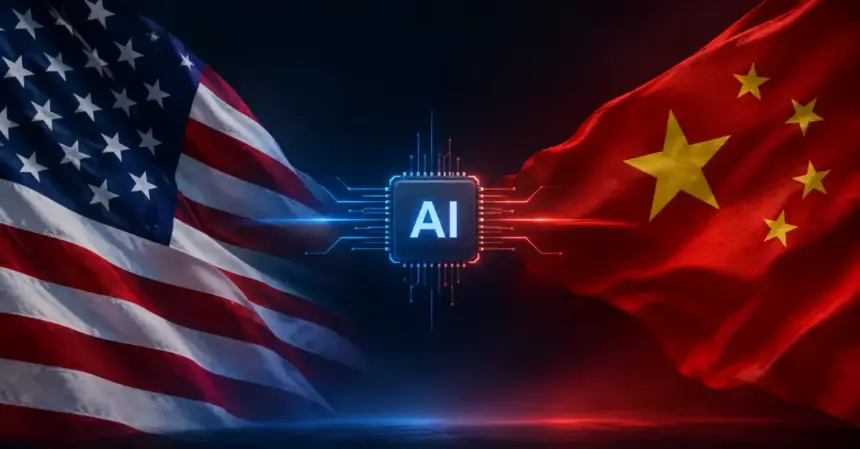
For years, Moroccan economic diplomacy has rested on a simple idea: never close a door. A security alliance with Washington, increasingly dense trade and industrial ties with Beijing, and European partnerships in the background. I now wonder whether that playbook will survive the AI cold war, because artificial intelligence is turning technical choices into strategic alignments.
What Washington is about to ask
On August 14, Reuters revealed that a draft letter from the US State Department is addressed to the 35 signatories of the “AI Opportunity Statement,” adopted in June in Washington at the second Pax Silica summit. The message, as reported, is unambiguous: taking part in the American ecosystem while also joining the rival framework backed by Beijing could become incompatible. The letter says that signing the Pax Silica declaration is not a mere subscription but a commitment, and urges countries to “choose deliberately.”
I want to be precise about what is actually known. Reuters could not establish when the letter would be sent or whether its text would change. The State Department declined to comment on what it called purportedly leaked internal documents. According to the reporting, China is not named in the text, which targets “duplicative” initiatives.
Pax Silica, what are we talking about
Pax Silica is a US-led initiative launched in December 2025 with seven countries: the United States, the United Kingdom, Japan, South Korea, Singapore, Australia and Israel. Its purpose is to secure the supply chains of AI: semiconductors, critical minerals, energy and computing capacity. According to ITIF, a US think tank, it had 25 signatories of the declaration by August 2026, while 35 countries had signed the separate text on AI opportunity.
The framework is non-binding. That matters, because it explains the American method: with no legal sanction available, the lever is exclusion from the club and its benefits, notably access to shared investment projects and industrial cooperation mechanisms.
On the other side, China launched an international AI cooperation organization in July, described by state media as based in Shanghai. Beijing promotes its open models there. Reuters also reported that Chinese authorities were weighing restrictions on foreign access to their most advanced models, which tempers the image of a fully open offer.
Kazakhstan, the first test case
The most telling example is Kazakhstan. Presented by Washington in June as the first Central Asian country to join Pax Silica, it then also joined the Chinese organization. A supplier of critical minerals playing both sides is exactly the scenario the American initiative wants to prevent. So far, no sanction has been reported.
I draw two lessons from this. First, American pressure is real, but its enforcement remains uncertain. Second, resource-rich countries, Morocco among them through its phosphates and its battery and cobalt potential, hold bargaining power that mere technology consumers do not.
Morocco’s singular position
In this configuration, the Kingdom has several assets and several vulnerabilities.
On security and defense, the link with Washington is long-standing: major non-NATO ally status, a free trade agreement in force since 2006, and joint military exercises such as African Lion. On industry, Chinese groups have settled in automotive, batteries and components, building on Morocco’s role as an export platform toward Europe and the United States. On digital sovereignty, Rabat has promoted an “AI Made in Morocco” strategy and signed a memorandum of understanding with France’s Mistral AI in September 2025, which shows a desire not to depend on any single bloc.
And as an exporter, the free trade agreement with the United States makes compliance with American rules a concrete economic interest, not only a diplomatic one. That is what makes the subject delicate. Batteries produced in Morocco with Chinese capital and destined for American or European markets can run into ever stricter rules of origin and security requirements.
Where the red lines lie
If the rivalry hardens, I believe the Moroccan debate will have to focus less on “for or against” than on perimeter. To my knowledge, the United States has not asked Morocco to break with China. The real question is which sectors must remain shielded from any dependency. Four areas seem to me a priority:
- public and administrative data, including government cloud hosting
- defense and security systems
- telecommunications, notably next-generation mobile networks
- critical infrastructure: energy, water, transport and finance
In these sectors, choosing a cloud provider, a chipmaker or an AI architecture amounts in practice to choosing an ecosystem of standards, software updates and maintenance. A supplier that controls these elements holds a lasting lever, and that is what both the Americans and the Chinese are seeking.
Several possible readings
Analysts do not agree. For supporters of the American line, technological alignment is the logical counterpart of a security alliance, and it opens access to advanced chips, capital and the major cloud players. For critics, it exposes middle powers to decisions taken in Washington, such as export controls, that they do not control. On the Chinese side, the argument is of an offer less politically conditioned, with adaptable open models, even if access to them could be restricted over time.
A third path is emerging: European and regional diversification, with Mistral, Europe as a normative partner and local computing capacity. It reduces dependency without eliminating it, since chips remain at the heart of the chain and that chain is largely dominated by players close to the United States or its allies.
A shrinking freedom of choice
My conviction is that the question is not choosing between America and China, but how long Rabat can still decide for itself. That margin is preserved through an explicit doctrine: defining sensitive sectors in advance, imposing data sovereignty requirements, demanding reversibility in contracts, and keeping several suppliers wherever possible. Assumed ambiguity remains defensible; ambiguity that is merely endured does not.
Morocco has historically made its ability to talk to everyone an asset. The AI cold war does not cancel that, but it raises its price. It remains to be seen whether the American letter will be sent, in what form, and above all whether it will be enforced.
FAQ
Has Washington officially asked Morocco to choose?
Not to my knowledge. The draft letter reported by Reuters targets the 35 signatories of the AI Opportunity Statement, and I could not confirm that Morocco is one of them.
Does Pax Silica legally bind its members?
No, the framework is non-binding. The lever is exclusion from the coalition and its benefits.
Can Morocco work with both powers?
Today yes, and it does. The difficulty lies in sensitive sectors, where security or origin rules could limit dual dependencies.
What can Rabat do to keep its room for maneuver?
Define a clear technology doctrine, diversify its suppliers, build local capacity and leverage its assets, notably its mineral resources.