

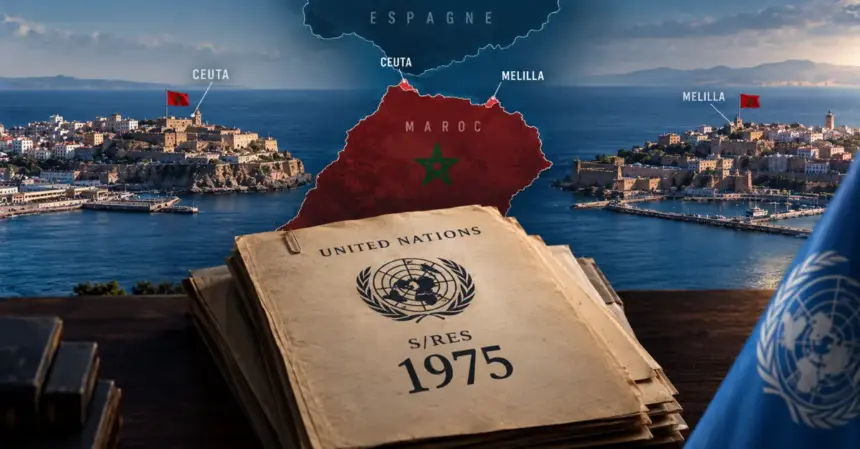
In January 1975, Morocco formally brought the case before the United Nations Decolonization Committee, requesting that the two North African cities be added to the list of non-self-governing territories, with the declared support of the Organisation of African Unity and the Organisation of Islamic Cooperation. Fifty-one years later, as migration issues and tensions around Ceuta once again dominate Spanish headlines, this dossier archived at the United Nations has become a diplomatic flashpoint between Rabat and Madrid once more.
In digging into this dossier, I went back to the original archives from that period — and what they reveal is more nuanced than a simple clash between two national narratives.
A fifty-year-old un dossier resurfaces
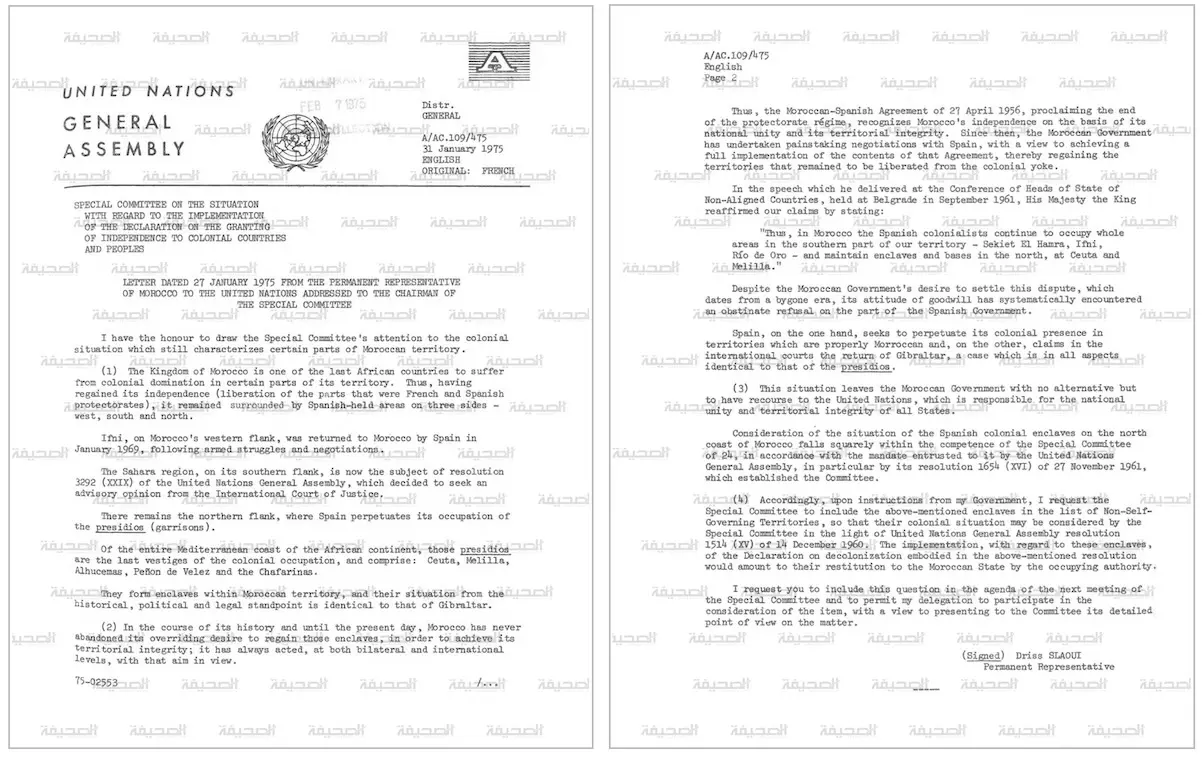
It all begins on 27 January 1975, less than nine months before the Green March. Morocco’s permanent representative to the UN wrote to the chair of the Special Committee on Decolonization — the so-called “Committee of 24” — with a formal request: that Ceuta, Melilla, the Rock of Vélez de la Gomera, the Alhucemas Islands and the Chafarinas archipelago be treated as colonial territories on the same footing as Gibraltar.
This letter, registered under reference A/AC.109/475, was part of a broader diplomatic strategy that Rabat was pursuing on several fronts at once at the time, with Western Sahara then before the International Court of Justice in The Hague. The claim over the northern enclaves was therefore not an isolated move, but another piece on the same territorial chessboard.
What the moroccan letter says
In its letter, Morocco described the two cities as the “last vestiges of colonial occupation” on Africa’s Mediterranean coast. The central argument rested on a direct comparison with Gibraltar, a British territory already listed at the time among the UN’s non-self-governing territories. Rabat stated it had “never renounced” its right to recover these territories as part of completing its territorial unity.
Madrid responds without delay
Spain did not leave the request unanswered. On 12 February 1975, in a letter referenced A/AC.109/477, Madrid categorically rejected the Moroccan position. Ceuta, Melilla, Alhucemas, the Rock of Vélez de la Gomera and the Chafarinas were presented there as an integral part of Spanish national unity, and the Moroccan move was described as an attempt to undermine the country’s territorial integrity.
Two irreconcilable legal positions thus landed, as early as spring 1975, on the desk of the same UN committee.
Support from africa and the islamic world
This is where the dossier took on an international dimension. Two regional organisations gave explicit backing to the Moroccan request:
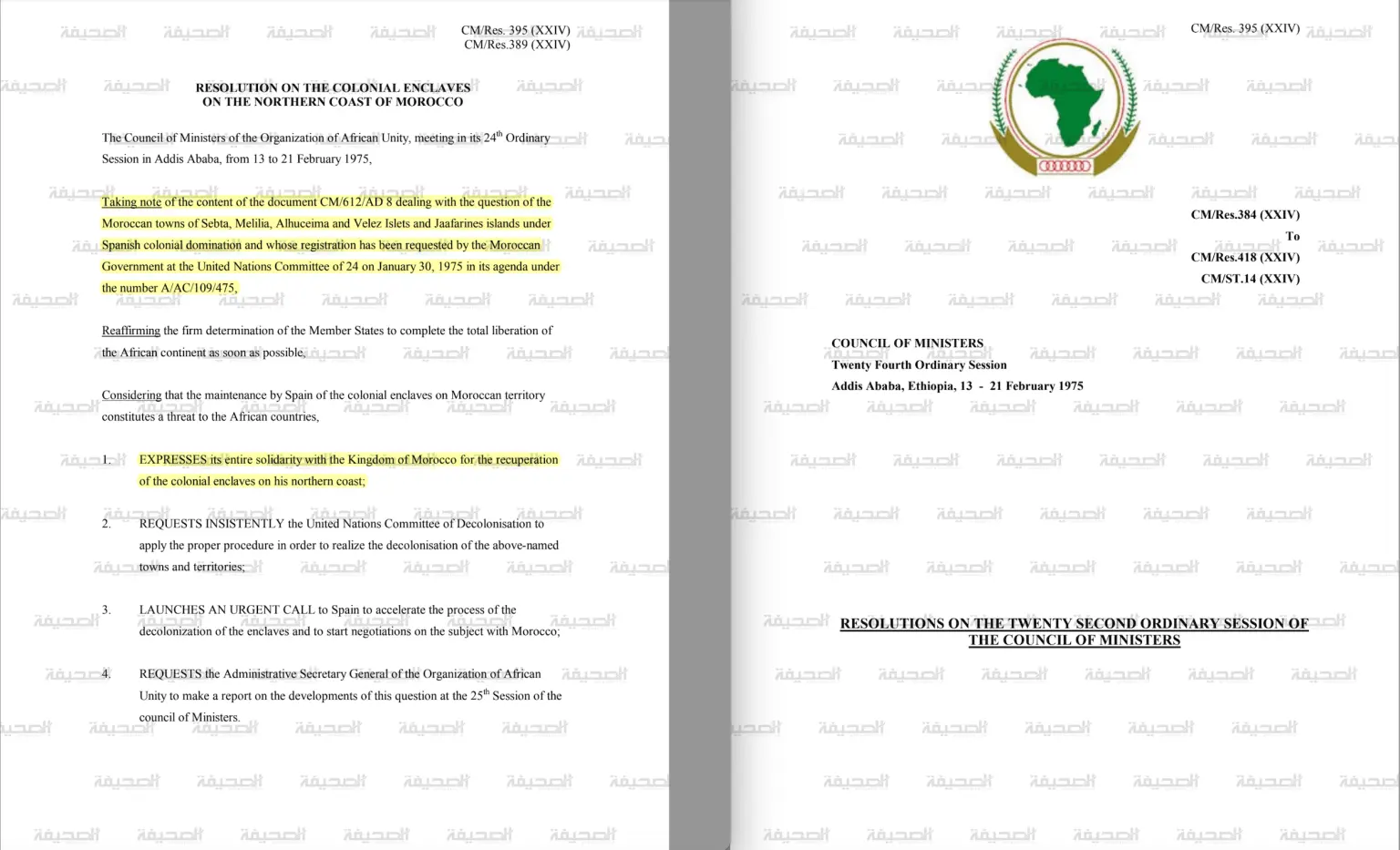
- The Organisation of African Unity, at its 24th session in Addis Ababa (13-21 February 1975), adopted a resolution expressing “full solidarity” with Morocco and calling on Spain to open negotiations.
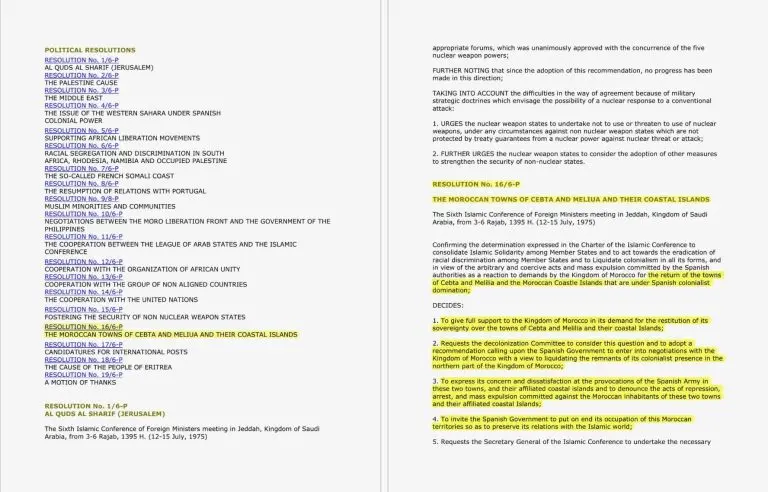
- The Organisation of Islamic Cooperation, meeting in Jeddah in July 1975, passed resolution 16/6-P, giving full support to Morocco’s request to recover sovereignty.
On paper, this dual backing represented a considerable base of support within the multilateral bodies of the time.
Why the un never settled the question
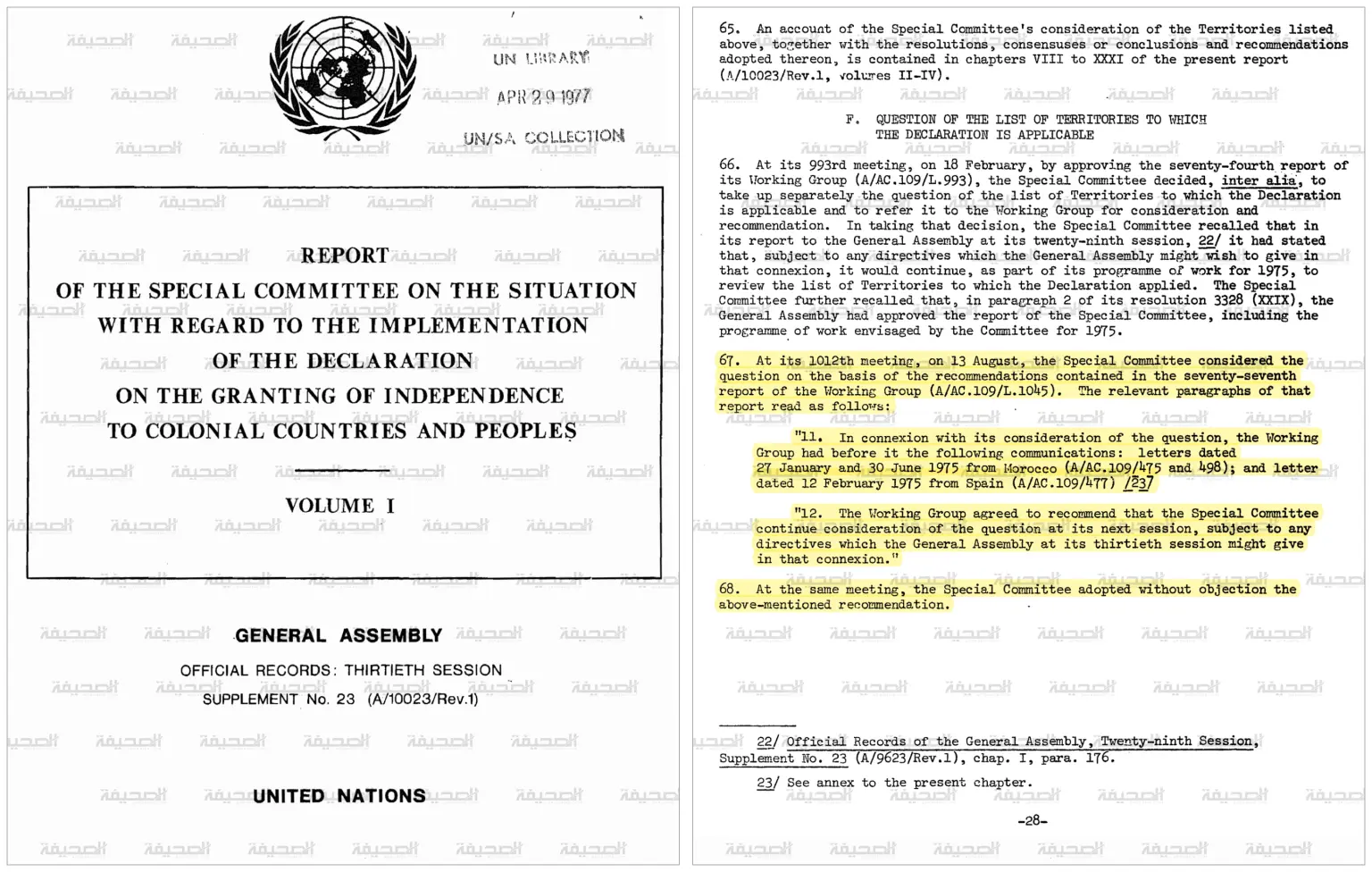
This is where the story needs nuance, because the archives also reveal the limits of this diplomatic push. On 13 August 1975, the Committee of 24 did review the Moroccan correspondence and the Spanish reply, recommending that it “continue consideration of the question” at its next session — wording that fell well short of actually listing Ceuta and Melilla as non-self-governing territories.
And what followed confirmed that limit. Through the summer and autumn of 1975, international attention shifted almost entirely to Western Sahara: the International Court of Justice’s opinion, the UN’s visiting mission, and finally the Green March in November. The Ceuta and Melilla file was never revisited with the same intensity. More than half a century later, the two cities still don’t appear on the UN’s list of non-self-governing territories — a list on which, by comparison, Gibraltar remains the only European territory listed.
The backing of 84 countries across the African Union and the Organisation of Islamic Cooperation was never, on its own, enough to shift the UN’s formal position. Another interesting wrinkle: Algeria, often seen as closest to Moroccan positions on other regional issues, has consistently backed the Spanish position on Ceuta and Melilla, describing them as “borders inherited from colonialism.”
A dossier still very much alive in 2026
If this piece of diplomatic history is resurfacing now, it’s no accident. Migration-related tensions around Ceuta have regularly made Spanish headlines this year, and the question of the two cities’ status has never really left Moroccan political discourse, even as Rabat now favours a bilateral approach over the UN route it took in 1975.
What stands out, looking back, is how consistent both positions have remained over half a century: Morocco has never dropped its claim, and Spain has never entertained giving ground on what it regards as a matter of national sovereignty. Between these two red lines, the UN has confined itself, in 1975 as since, to taking note without ruling — a non-decision that, in diplomacy, often amounts to the status quo.
Frequently asked questions
Are Ceuta and Melilla on the UN’s list of non-self-governing territories?
No. Despite Morocco’s 1975 request, the two cities have never been added to that list, unlike Gibraltar.
What is Morocco’s claim to Ceuta and Melilla based on?
Rabat regards these territories as colonial enclaves on its own soil, with their return presented as a condition for completing the kingdom’s territorial unity.
What is Spain’s official position?
Madrid maintains that Ceuta and Melilla are an integral part of Spanish national unity, a position it has defended before the UN since 1975 and has not changed since.
Did the 1975 dossier lead to anything concrete?
The Committee of 24 reviewed the correspondence and decided to continue examining the question, but never reached a formal decision on the two cities’ status.