
A score of 76.15 out of 100 marks a recognition that fits into a broader pattern already visible across several other international indices in recent months. I’ve followed geopolitical and security-related rankings touching this region for years, and this one deserves attention precisely because it cuts against the image still too often attached to the African continent on these questions.
This result didn’t come out of nowhere. It slots into a string of favorable rankings for Rabat, spanning peace, cybersecurity, and national reputation, that point to a coherent governance strategy rather than a statistical fluke.
What the Global Public Security Index 2025-2026 actually shows
The report was unveiled on September 10, at a press conference held ahead of the 5th edition of the Global Public Security Cooperation Forum in Lianyungang, in China’s Jiangsu province. China’s state news agency ECNS carried the main findings of the index, which this year covers 62 countries.
That scope is far from trivial: it represents close to 83% of the world’s population, over 75% of global land area, and nearly 87.5% of global economic output. In other words, this isn’t a niche study confined to a handful of capitals, it’s a sample that carries real geopolitical and economic weight.
China topped the ranking with 84.62 points, a result that will surprise no one familiar with the weight Beijing places on this kind of indicator internationally. The average score across the 62 countries came in at 72.56 points, a slight increase from the previous edition. Against that backdrop, Morocco’s 76.15 points takes on real significance: it sits comfortably above the sample’s global average.
A narrow club of 20 “high-performing” countries
The report’s authors didn’t simply publish a raw ranking of 62 lines. They singled out a group of 20 countries judged particularly strong in public security governance, an exercise that goes beyond a raw score and likely folds in qualitative criteria around institutional resilience. Morocco made that list, and it’s the only country from the entire African continent to do so.
That’s the detail that gives the ranking its symbolic weight. Out of 54 African nations, not a single other one made this select group. I read that less as a statistical coincidence than as recognition of how the kingdom has structured its security apparatus over roughly fifteen years, combining international cooperation, intelligence capacity, and territorial coverage.
Why the Lianyungang forum matters
The Global Public Security Cooperation Forum isn’t a minor fixture on the diplomatic calendar. Its 5th edition brought together senior law enforcement officials, representatives from the United Nations and Interpol, along with diplomats and experts from around the world. The stated goal: discuss emerging forms of transnational security threats, from organized crime to digital risks and trafficking to terrorism.
This kind of forum often serves as a showcase for Chinese diplomacy, which has multiplied initiatives around global security in recent years, running parallel to its own trade routes. The fact that Morocco was singled out in this particular setting says a lot about how Rabat is now perceived by partners well beyond its traditional sphere of influence in the Mediterranean and West Africa.
Several structural factors explain this recognition, in my view:
- Dense international security cooperation, particularly with the European Union on migration and intelligence-sharing
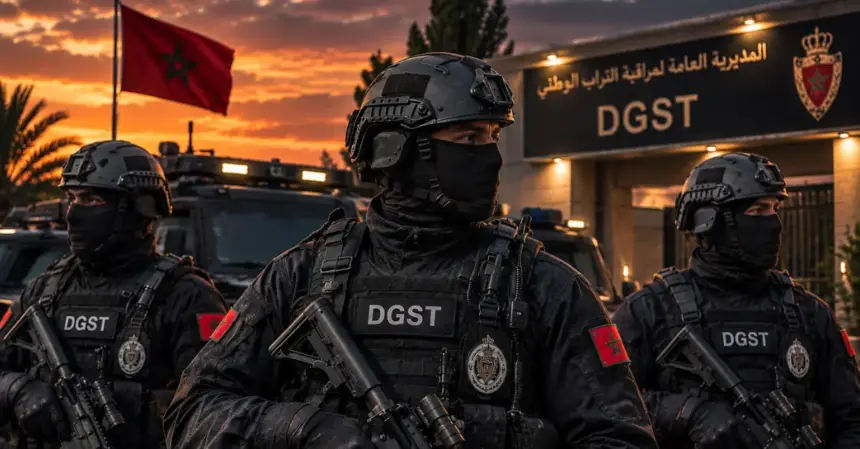
- A proven institutional architecture, with bodies like the DGST or the BCIJ regularly cited in international counter-terrorism reports
- Territorial coverage by law enforcement that limits ungoverned zones, unlike many regional neighbors
- Sustained investment in training and equipment for domestic security services
One more piece in a string of strong rankings
What stands out most is that this result isn’t arriving in isolation. It adds to a growing pile of favorable rankings published in recent months, painting a consistent picture rather than a one-off spotlight.
The kingdom climbed 20 places in the Global Peace Index 2026, published by the Institute for Economics and Peace (IEP), an Australian organization known for the rigor of its methodology. It now ranks 65th out of 163 countries, making it the 7th-ranked African nation and 4th in the Arab world on this measure. A twenty-spot jump in a single edition isn’t a minor statistical wobble, it signals a measured, perceived improvement across several combined indicators: crime, political stability, relative military spending, internal tensions.
Other recent rankings have also highlighted Moroccan progress on adjacent fronts, notably cybersecurity and what analysts loosely call “national reputation,” a fuzzy but increasingly scrutinized concept that investors and rating agencies factor indirectly into their country-risk analysis.
What this actually changes
For a country betting heavily on tourism appeal, foreign investment, and hosting major international events, starting with the 2030 World Cup co-hosted with Spain and Portugal, this kind of ranking isn’t just another line in a press release. It weighs directly on institutional investors’ decisions, on insurance premiums applied to international operators, and on public perception when people choose a travel or business destination.
My take, after following several of these security rankings over the years: their accumulation matters more than any single publication. One strong score in isolation could reflect a particular methodology or a one-off geopolitical bias. Convergence across several institutes, with very different methodologies and sponsors, Chinese on one side, Australian on the other, is much harder to wave away.
The caveats worth keeping in mind
It would still be careless to present this ranking as an unqualified stamp of approval. The Global Public Security Index remains an index produced in a setting where China occupies a central position, both as the forum’s host and as the country topping the ranking. A degree of geopolitical framing inevitably creeps into the exercise, and it would be naive to ignore that entirely.
That doesn’t disqualify the Moroccan data point on its own, but it does call for cross-checking against other sources, which is exactly what the comparison with the Global Peace Index allows, an index produced by an institute with no ties to Beijing. The fact that both point toward a positive trend strengthens the credibility of the overall signal, even though the methodologies and scales aren’t strictly comparable.
FAQ
Is Morocco really the only African country on this list?
Yes. According to the Global Public Security Index 2025-2026, Morocco is the only African nation among the 20 countries judged to be the strongest performers in public security governance, out of 62 countries studied overall.
What exact score did Morocco receive?
The kingdom scored 76.15 out of 100, compared to an average of 72.56 points across all 62 countries included in the study.
Is this ranking connected to the Global Peace Index?
They’re two separate studies, produced by different institutions. But they point in the same direction: Morocco also climbed 20 places in the Global Peace Index 2026 from the Institute for Economics and Peace, ranking 65th globally, 7th in Africa, and 4th in the Arab world.
Who published the Global Public Security Index 2025-2026?
The report was unveiled on September 10 at a press conference ahead of the Global Public Security Cooperation Forum in Lianyungang, China, and was reported on by China’s state news agency ECNS.