


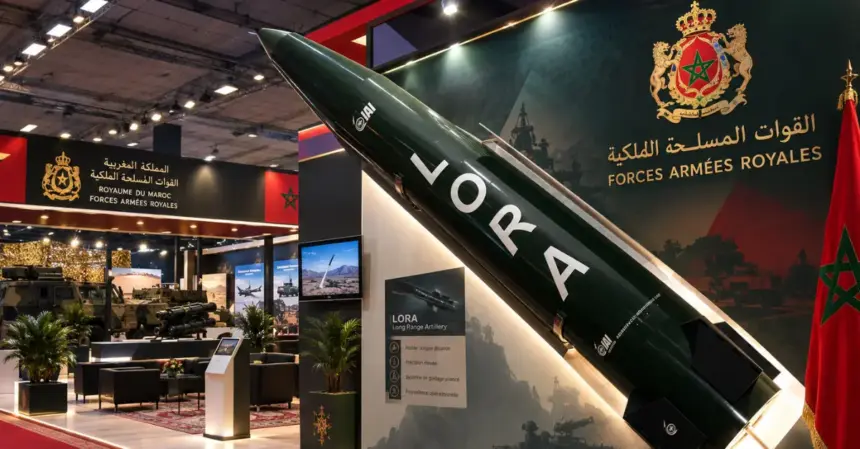
Israel Aerospace Industries has confirmed it will display its precision surface-to-surface ballistic system at the Marrakech Air Show, running 7–10 October 2026, and several specialist outlets report Rabat’s interest in integrating it with the HIMARS launchers it expects from Washington. With an advertised reach of up to 430 kilometres and a CEP of ten metres, LORA would hand the Royal Armed Forces a deep-strike capability they have never held.
Let me state the caveat most viral posts skip: as things stand, no Moroccan order has been announced. But the recent trajectory of FAR procurement makes the hypothesis worth taking seriously.
What we actually know about this file
Go back to the source, because that is where the story gets decided. In late August, IAI announced it would bring three headline items to Marrakech: the LORA missile, the Heron MK II MALE drone and the OPAL-NG battle management system, explicitly aimed at the defence and security needs of Morocco, Africa and the wider region. The manufacturer named no buyer, no contract value, no quantity and no delivery schedule.
What lit up social media was a familiar media chain reaction. South American defence outlet Zona Militar connected LORA’s Marrakech appearance to the Moroccan HIMARS file in mid-September 2026, while explicitly noting that no public information supports the existence of a contract. Israeli business press, Globes first among them, picked up the analysis and stressed that integrating LORA would push Morocco well beyond the 300-kilometre ceiling of HIMARS munitions.
In other words: a commercial showcase, an analyst’s reading, then an echo chamber. None of that is illegitimate — most major arms deals begin exactly this way — but you need to read the label.
LORA by the numbers, without the marketing gloss
Here are the manufacturer’s own figures, the ones IAI puts on the table:
- Operational range: 90 to 430 kilometres depending on firing configuration
- Accuracy: stated CEP of 10 metres, GPS/INS guidance with terminal correction
- Mass and dimensions: 1.6 tonnes, 5.2 metres long, 624 mm diameter
- Propulsion: solid-propellant rocket motor, quasi-ballistic and heavily manoeuvring trajectory
- Impact angle: 60 to 90 degrees, well suited to hardened infrastructure
- Logistics: sealed canister, no preventive maintenance, four rounds on a standard 16-tonne flatbed truck
- Reactivity: strike possible in under ten minutes from the firing decision, per IAI
The company lists air bases, command posts, rocket-launcher batteries, air-defence systems and fortified military sites as representative targets. A naval variant is offered as well, requiring only a modest deck footprint.
That last point deserves a pause. A missile fired from an unprepared position, with no heavy maintenance tail, changes the logic of employment entirely: you are no longer defending a fixed battery, you are tracking an ordinary truck that melts back into the landscape after the salvo.
Why the HIMARS and LORA pairing draws so much attention
The Moroccan HIMARS file, by contrast, is thoroughly documented. The US State Department approved in April 2023 a sale of 18 M142 HIMARS launchers, 40 M57 ATACMS missiles and several dozen GMLRS guided rockets, for an estimated $524.2 million.
The timeline sharpened this summer. A US Army contracting document dated 11 May explicitly lists ten HIMARS bound for Morocco within the support programme for American fiscal year 2027, with the remaining eight launchers expected around 2028. Converging military sources point to a first batch arriving as early as the first quarter of 2027, with Rabat having pushed to accelerate ATACMS deliveries so the munitions are ready before the launchers themselves.
What HIMARS already delivers
HIMARS tops out near 300 kilometres with ATACMS, and around 70 to 80 kilometres with GMLRS. It is breakthrough artillery: mobile, air-transportable in a C-130, an aircraft the FAR already operate in numbers. Morocco has seen it work on home ground, during a tactical demonstration near Cap Drâa as part of African Lion 2025.
What LORA would stack on top
The leap is not merely quantitative. Moving from 300 to 430 kilometres means changing target category altogether. You leave the realm of supporting ground operations and enter deep strategic strike: airfields, depots, logistics nodes, command centres sitting far behind the line of contact.
A note of technical caution I wish appeared more often: the idea of a LORA “fired from a HIMARS” remains speculation. LORA comes with its own launch canister and its own carrier vehicle. Integration onto an American chassis would raise questions of certification, fire-authorisation chain and, above all, Washington’s consent to host a foreign munition on a platform under US control. That kind of marriage is not arranged at a trade show.
A Moroccan path already well marked out
Rabat is not improvising. Since the Abraham Accords, military cooperation with Israel has been built out with striking consistency. The Kingdom has taken delivery of its first Barak MX air-defence systems under a $500 million agreement signed in 2022. Elbit’s PULS rocket launcher has been operational since 2025, delivered in record time, and covers the intermediate band up to 300 kilometres.
Add Harop and Heron drones, French CAESAR guns, Chinese PHL-03 launchers, and you get a deliberately heterogeneous artillery park. This is not disorder — it is a supplier diversification strategy that shields the Kingdom from exclusive dependency and preserves diplomatic room to manoeuvre.
I also read a Nagorno-Karabakh lesson in it. Azerbaijan revealed in 2018 that it held LORA, and used it in late 2020 against a bridge on the Lachin corridor — with real-world results more limited than initially claimed. Baku fielded an arsenal almost identical to the one Morocco is assembling today. The parallel is openly acknowledged on the Moroccan side.
My read after fifteen years following these files
The real story is not LORA’s spec sheet. It is the hierarchy of ranges Morocco is building layer by layer: PHL-03 at 140 km, PULS and GMLRS beyond that, ATACMS at 300 km, and potentially LORA at 430 km. Each system covers a stratum. That is an architecture, not a collection.
That said, I stay measured on timing. A show like Marrakech exists to open conversations, not close them. And acquiring a ballistic missile, even a tactical one, is not a munitions purchase: it triggers debates over deterrence thresholds, export-control regimes and the reaction of neighbours. Algiers, investing heavily in its own anti-ballistic capabilities, will not be a spectator.
My bet, if you want one: a statement of intent or a memorandum before the end of 2027, and a genuinely operational capability no earlier than 2029. The clock of armaments is not the clock of social media.
What to watch over the coming weeks
Three indicators beat ten rumours. First, the exact configuration of the LORA on display in Marrakech: IAI has not specified the warhead or the configuration it will show, and that detail will say a great deal about how serious the offer is. Second, whether Royal Artillery delegations visit the stand, and at what rank. Third, any sign of an industrial component — technology transfer, local assembly, in-country maintenance — since IAI has named industrial cooperation as an explicit pillar of its relationship with Rabat.
More often than not, the real news hides in the industrial annex of a contract.
FAQ
Has Morocco officially bought the LORA missile?
No. No contract has been announced by IAI, the Israeli government or Moroccan authorities. The reports circulating in September 2026 come from specialist media and rest on the system’s presence at the Marrakech Air Show.
What is LORA’s actual range?
IAI states a band of 90 to 430 kilometres depending on configuration. Some European sources cite up to 500 kilometres for recent variants, notably in connection with the German naval programme tested in early September 2026.
Can LORA really be fired from a HIMARS?
Nothing confirms it today. LORA has its own launch canister and carrier vehicle. Integration onto HIMARS would require engineering work and American clearance, neither of which has ever been publicly discussed.
When will Morocco’s HIMARS arrive?
US documents place ten launchers in fiscal year 2027, with a first batch possible as early as the first quarter. The remaining eight units are expected around 2028.