

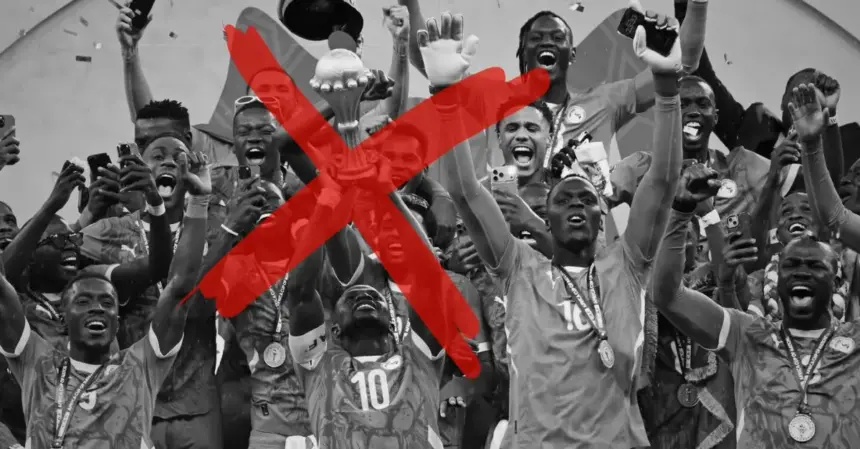
The epilogue of the 2025 Africa Cup of Nations (CAN) will be etched in the annals of African football as a landmark case of sports law and discipline. While the continent expected a celebration of pure talent on the pitch, the verdict fell like a gavel: Senegal lost everything following a series of off-field events and regulatory failures. The decision by the Confederation of African Football (CAF) to declare Senegal forfeit in the final, with a score of 3–0 in favor of Morocco, is not a simple refereeing error. It stems from a firm will to restore the integrity of the competition against behaviors deemed incompatible with high-level sports ethics.
To understand why Senegal lost everything by behaving badly during the CAN in Morocco, one must look past the emotion of the stands and dive into the legal texts. The sanction is primarily based on Articles 82 and 84 of the CAF Disciplinary Code. These articles allow the authorities to reclassify a result after the final whistle if serious infractions are found. Contrary to popular belief, the end of a match does not make the result legally untouchable. If the integrity of the meeting is compromised by deviant behavior or administrative violations, the “green carpet” (forfeit) becomes the ultimate recourse of sporting justice.
A Legal Earthquake Based on Articles 82 and 84
CAF’s decision is not a technical correction of a game fact, such as a missed offside or a forgotten penalty. It is an institutional response to a major regulatory violation. By invoking Articles 82 and 84, the disciplinary commission emphasized that the behavior of the Senegalese delegation and the incidents that occurred directly affected the fairness of the match. In modern football, athletic performance is no longer enough; it must imperatively be accompanied by scrupulous respect for the legal framework established by international bodies.
The passage before the Appeals Committee sealed the fate of the Lions of Teranga. By overturning the initial decision to confirm the forfeit, CAF’s legal experts pointed to an error of judgment in the first instance, thereby strengthening the legitimacy of the Moroccan victory. This reversal shows that the vigilance of the instances is now total. Morocco, as the host and beneficiary of this decision, sees its organizational rigor and respect for procedures rewarded with a title that will go down in history.
The Limits of the Appeal to the Court of Arbitration for Sport
Faced with this sporting humiliation, Senegal immediately announced its intention to refer the matter to the Court of Arbitration for Sport (CAS) in Lausanne. However, the hope of a turnaround is slim. The CAS does not function as a “second half” where disputed actions are replayed. Its role is strictly limited to verifying the application of the law. To hope to recover its title, the Senegalese Football Federation must demonstrate a manifest error of law, a blatant violation of the rights of defense, or an obvious disproportion of the sanction.
A crucial technical point often ignored by the general public is that an appeal to the CAS is not automatically suspensive. In other words, Morocco remains officially the African champion and can celebrate its star as long as no contrary sentence is rendered. Proceedings in Lausanne can stretch over several months, leaving Senegal in a state of agonizing uncertainty. This wait highlights the extent to which bad behavior on or off the pitch can paralyze a national team’s future for an entire competition cycle.
Reasons for a Historic Sanction for Senegal
Why such severity? CAF wanted to make an example. Behavior during this 2025 CAN in Morocco was closely scrutinized, and several factors tipped the balance toward a 3-0 forfeit. Beyond the specific facts, it is an accumulation of tensions and failures that led to this fatal outcome. Here are the key points that motivated the severity of the authorities:
-
Non-compliance with security protocols: Repeated incidents in restricted access zones involving members of the Senegalese entourage.
-
Pressure on the refereeing corps: Detailed reports mentioning physical and verbal intimidation in the stadium tunnels.
-
Use of unauthorized equipment: Suspicions regarding certain technical or medical devices that had not received prior approval from the CAF medical commission.
-
Behavioral recidivism: Previous warnings during the group stage that were not taken into account by the technical staff.
This list is not exhaustive, but it illustrates the complexity of the case. It was not a single event that caused the downfall, but a global mindset judged as “failing” by the Confederation’s observers. In football, fair play is not just a slogan on a captain’s armband; it is a prerequisite for participating in prestigious international tournaments.
Impact on the Image of Senegalese Football in Africa
Beyond the loss of the trophy, the brand image of Senegalese football has been lastingly tarnished. Long considered a “top student” and a technical leader on the continent, Senegal now finds itself at the heart of a controversy over its lack of discipline. This situation creates a dangerous precedent for future generations of players who could see their efforts swept away by administrative errors or outbursts from their leaders. The loss is therefore symbolic and diplomatic as well.
Morocco, for its part, emerges stronger from this ordeal. By managing the crisis with diplomacy and relying on the solidity of its legal case, the Moroccan federation proved its mastery of all aspects of top-level football. This administrative victory, although less spectacular than a 90th-minute goal, is the fruit of in-depth work on respecting international standards. It confirms that the Cherifian Kingdom has become an unavoidable powerhouse, both sportingly and institutionally.
Frequently Asked Questions About the Senegal-Morocco Case
Can the 3-0 score still change?
Currently, the score is final in CAF’s records. Only a verdict from the Court of Arbitration for Sport could theoretically overturn it, but the chances of success for such a request are statistically very low in international sports law, especially when Articles 82 and 84 are clearly invoked.
What are the consequences for Senegal’s next matches?
In addition to the forfeit, Senegal could face record financial fines and, in the worst case, the suspension of some of its key personnel for the upcoming World Cup qualifiers. As the team’s image is affected, some sponsors might also reconsider their commitments.
Why was Morocco declared the winner directly?
CAF regulations stipulate that if a forfeit is pronounced for serious disciplinary reasons during a final, the opposing team is credited with a 3-0 victory. This is a strict application of the scale of sanctions provided to ensure a clear outcome for the competition, even in cases of major litigation.