



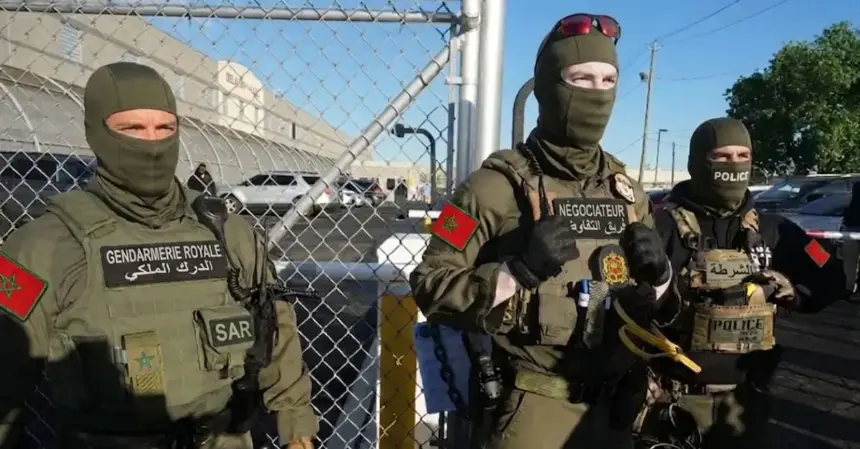
The rapid evolution of the migration landscape within the Kingdom is raising crucial questions about public safety and the maintenance of order. Many observers and citizens are now asking: should Morocco create a police force specialized in managing these complex flows? Facing unprecedented migratory pressure, particularly from sub-Saharan Africa, the country finds itself at a crossroads between its tradition of hospitality and the imperative need to protect its borders and inhabitants.
Morocco is no longer just a transit zone; it has become a final destination for thousands of individuals who entered clandestinely. This new reality brings a set of challenges, as a portion of this population, living in a state of total irregularity, does not always respect national laws. Between the illegal occupation of public spaces, incivilities, and, in documented cases, physical assaults, the feeling of insecurity is growing in several major cities like Casablanca and Tangier.
The Challenge of Illegal Immigration and Security
The management of Moroccan borders has become an absolute priority for the Ministry of the Interior. Every year, authorities intercept tens of thousands of people attempting to reach Europe, but many remain blocked within the territory. Illegal immigration poses a structural problem: how to regulate individuals who, by definition, evade official census records? The lack of legal status pushes some toward marginalization, generating increasingly sharp social tensions with the local population.
Field reports indicate a multiplication of friction points. In certain peripheral neighborhoods, groups of clandestine migrants organize into genuine lawless zones, where Moroccan law seems to struggle to be applied with the necessary rigor. Local residents testify to a rise in snatch-and-grab thefts and verbal aggressions, creating a climate of mistrust that harms national cohesion.
The most worrying aspect remains the refusal of some individuals to comply with basic rules of conduct. Respect for authority is sometimes flouted during interventions by the National Security (DGSN), leading to violent clashes. This aggressiveness, often fueled by despair or the influence of criminal smuggling networks, justifies for many the creation of a dedicated unit—a sort of border and immigration police with expanded powers.
Why a Dedicated Unit for Migration Control
The creation of a specific force would allow for the specialization of agents in dismantling clandestine networks. Currently, local police officers must manage both ordinary crime and migration issues, which disperses resources. A specialized force would have adapted training to handle the legal specificities of immigration while ensuring effective repression against those who assault citizens or law enforcement officers.
The model of an “immigration police” exists in many developed countries. it allows for rigorous monitoring of border removals and increased surveillance of hotspots where clandestine migrants gather. In Morocco, such an institution could act preventively to avoid the formation of illegal camps that quickly become centers of insecurity and unsanitary conditions for nearby residents.
-
Increased surveillance of land and sea border areas.
-
Systematic identification of individuals in an irregular situation via biometrics.
-
Dismantling networks of human trafficking that exploit misery.
-
Rapid intervention in cases of assaults committed by clandestine migrants.
-
International coordination with partner security agencies.
The Impact of Assaults on the Daily Life of Moroccans
Respect for the law is the foundation of any stable society. However, illegal immigration in Morocco is sometimes accompanied by an open contempt for institutions. Videos circulating on social media regularly show scenes of chaos where clandestine migrants assault officers or attack private property. These acts are not just isolated incidents; they reflect a loss of control that requires a firm response.
Merchants and families living near stations or transit zones express profound weariness. The massive presence of individuals without resources and without legal ties favors street delinquency. To answer the question “should there be a specialized police force?”, one only needs to listen to these citizens who simply ask to be able to move around without fear of being targeted by organized groups.
The Moroccan state has injected billions of dirhams into modernizing its infrastructure. However, if the sense of security is not guaranteed, these investments lose their value. An effective police force dedicated to immigration would restore the authority of the State in areas where it is challenged by uncontrolled flows of individuals who entered the national territory by force.
Migration Pressure Figures in the Kingdom
To understand the scale of the phenomenon, one must look at the statistics. In 2023, Moroccan authorities foiled more than 75,000 irregular immigration attempts. This colossal figure shows that the pressure is not weakening. Behind these attempts, thousands of people end up settling permanently in cities, living off aggressive begging or petty crime to survive, as they are unable to cross to the other side of the Mediterranean.
This human mass exerts unbearable pressure on public services. Hospitals and social aid, already strained, must deal with growing demand from populations that do not contribute to the system. The question of whether Morocco needs a police force becomes a question of survival for the country’s budgetary and social balance. Without strict control, Morocco risks seeing its social model weaken.
A Strategy of Firmness for the Respect of the Law
Morocco has always been a land of tolerance, but tolerance must not be confused with weakness. Illegal immigration must not give a blank check to anarchy. Those who come clandestinely and who, once there, do not respect Moroccan law, must be subject to exemplary sanctions. Setting up a specific police force would send a clear signal: Morocco is a state of law.
This unit could also collaborate with intelligence services to identify radicalized elements or common criminals hiding among migrants. National security is at stake. By better filtering arrivals and systematically deporting violent individuals, the Kingdom would protect its population and its achievements in political stability, which is unique in the region.
Integration can only happen within the framework of respecting the rules of the host country. However, current illegal immigration is often characterized by communal withdrawal and a rejection of local norms. An increased security presence that is specialized is the only bulwark against the degradation of the social climate. It is about protecting Moroccans, but also legal migrants who suffer from the degraded image provided by turbulent clandestine individuals.
Frequently Asked Questions About Police and Immigration
Why create an immigration police now?
The situation has reached a critical point. The increase in assaults committed by clandestine migrants and the blatant disregard for local laws impose a structured and professional response that only a dedicated unit can offer sustainably.
What would be the powers of this new force?
Its mission would be to verify identity, manage administrative detention centers, and organize forced deportations. It would have advanced technological means to monitor borders and intervene in urban environments against migration-related crime.
Will this reduce insecurity in cities?
Yes, because a specialized police force allows for more effective ground presence. By targeting smuggling networks and dismantling illegal squats, it dries up the source of many crimes that poison the daily lives of Moroccan citizens today.
Does Morocco have the means to fund such a police force?
Investing in security is always profitable. The cost of insecurity, damage, and pressure on public services is much higher than the operating budget of an elite unit dedicated to controlling migration flows and respecting sovereignty.