
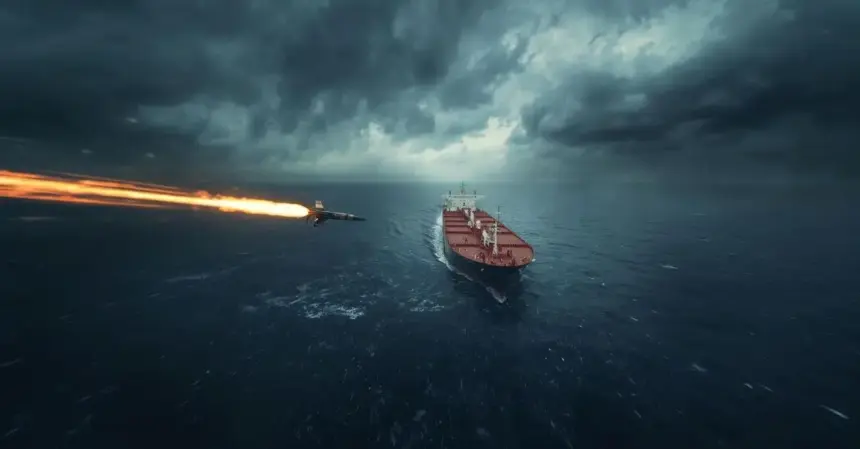
The world is holding its breath as the Strait of Hormuz faces an unprecedented paralysis. This strategic bottleneck, through which a massive portion of global oil production usually passes, has seen its flows collapse by 97%. For energy markets, this is a seismic event. The price of a crude barrel immediately soared to reach the symbolic mark of $104. In this context of international logistical suffocation, a burning question occupies everyone’s mind in the Kingdom: is Morocco ready to absorb this frontal shock?
Despite the gravity of the global situation, Morocco seems to benefit from a form of structural protection against a total supply disruption. Unlike other nations heavily dependent on a single transit channel, the Kingdom has built a resilience strategy based on diversification. While the risk of a physical shortage of fuel at the pump seems ruled out for now, the economic reality is quite different. Moroccan households are already witnessing a vertical rise in prices, testifying to the country’s vulnerability to the surge in global black gold prices.
Moroccan Resilience Facing the Strait of Hormuz
The blockage of the Strait of Hormuz could have meant a dead stop for the national economy. However, the country possesses solid safeguards. The Moroccan strategy is based on anticipating the risks of flow interruption. Authorities have ensured that strategic reserves are maintained at secure levels. For certain types of fuel, such as diesel, the country has stocks that can cover up to 100 days of national consumption. This room for maneuver is crucial to avoid panic scenes and ensure the continuity of essential services, from goods transport to industrial production.
This protection does not only come from stocks but also from the geography of suppliers. Morocco has learned not to put all its eggs in one basket. By primarily importing refined products rather than crude oil for local transformation, it has freed itself from a direct dependency on immediate conflict zones. This logistical organization allows the Kingdom to maintain a constant flow of goods, even if the logistical cost of bringing these products from more distant ports begins to weigh heavily on the trade balance.
Diversified Imports to Avoid Shortages
The secret of this resistance lies in a particularly heterogeneous list of trade partners. By turning its back on an exclusive dependence on the Middle East, Morocco has secured its rear. Its current main suppliers form a reassuring geographical patchwork: Spain, Russia, Saudi Arabia, the United States, and Italy. This dispersion of purchase sources means that if a sea route is cut, such as the Strait of Hormuz route, cargoes from the Atlantic or the Western Mediterranean continue to arrive safely, notably via the Tangier Med and Jorf Lasfar port complexes.
-
Spain and Italy ensure geographical proximity allowing for rapid rotations of tankers.
-
The United States provides an increasing share of refined products thanks to its shale oil boom.
-
Russia remains a major player for diesel, offering competitive prices despite the complex geopolitical context.
-
Saudi Arabia maintains its contractual commitments via alternative routes avoiding maximum tension zones.
This precision logistics is the result of a sector liberalization which, although criticized for its effects on prices, forced private operators to multiply storage infrastructures and long-term supply contracts with global refineries.
Impact of the Samir Refinery Closure
It is paradoxical to note that the closure of the Samir refinery in 2015, often seen as an industrial tragedy, unintentionally reinforced the country’s resilience face to a crisis like the Strait of Hormuz paralysis. At the time, Morocco mostly imported crude oil to be processed locally in Mohammedia. Today, the country imports the finished product directly. This mutation removed the industrial risk associated with a major technical failure or the shutdown of a single national production unit.
By becoming a pure importer of refined products, Morocco had to adapt its ports and terminals. This adaptation favored unprecedented flexibility. Moroccan distributors can now buy the cheapest or most available product at any given time on the international “spot” market. If a European refinery is down, they turn to an American one. This agility is today the main shield against the Strait of Hormuz paralysis, even if it directly exposes the consumer to the volatility of the Rotterdam markets.
A Spectacular Surge in Prices at the Pump
While the tanks at gas stations remain full, the wallets of Moroccans are emptying quickly. The financial impact of the Strait of Hormuz crisis is immediate and brutal. With a barrel stagnating above $104, repercussions on national prices are inevitable. The liter of diesel has crossed the psychological threshold of 12.80 DH, while gasoline is now set at 13.93 DH. For an average family or a road haulier, these extra centimes represent a considerable monthly burden weighing on global consumption.
The government finds itself facing a complex dilemma: intervene to subsidize prices, at the risk of widening the budget deficit, or let market mechanisms play out. In a country where transport directly influences the price of vegetables and basic necessities, energy inflation threatens to spread to the entire economy. The paralysis of the Strait of Hormuz is therefore not just a maritime transport crisis; it is a direct inflationary pressure hitting every home in the Kingdom.
The Challenge of Hydrocarbon Dependency
In the medium term, this crisis serves as a reminder of the urgency of the energy transition. Despite Morocco’s brilliant successes in the fields of solar (Noor complex) and wind power, the share of hydrocarbons in the global energy mix remains predominant, especially for mobility. The country remains a prisoner of geopolitical upheavals as long as its car fleet and industries depend on imported oil. The Strait of Hormuz situation acts as a warning: energy sovereignty will only be total when the country can massively move away from fossil fuels.
Progress is real, but the transition takes time and massive investment. For now, natural gas and oil remain the pillars of Moroccan logistics. A lasting crisis in the Persian Gulf could seriously slow down expected economic growth by capturing too large a share of foreign currency to pay the energy bill. Morocco must therefore accelerate its mutation towards green hydrogen and the electrification of transport so as not to remain a hostage to straits located thousands of kilometers from its shores.
FAQ on the Oil Crisis and Morocco
Why is Morocco not risking a fuel shortage?
Morocco has significant strategic reserves (up to 100 days) and has diversified its suppliers (Spain, USA, Russia). It is not solely dependent on the Strait of Hormuz route.
Why are prices rising if Morocco has stocks?
Prices at the pump are indexed to global rates. Even with physical stocks, the replacement cost of fuel is based on the current market price (barrel at $104), which is reflected in retail prices.
Would reopening the Samir refinery change the situation?
It would allow for storing crude, but it would not cancel the dependence on global prices. The current structure of importing refined products offers a geographical flexibility that a single local refinery did not necessarily provide.
What is the impact on purchasing power?
The increase in diesel to 12.80 DH and gasoline to 13.93 DH leads to higher transport costs, which eventually increases the price of food and services for the end consumer.