



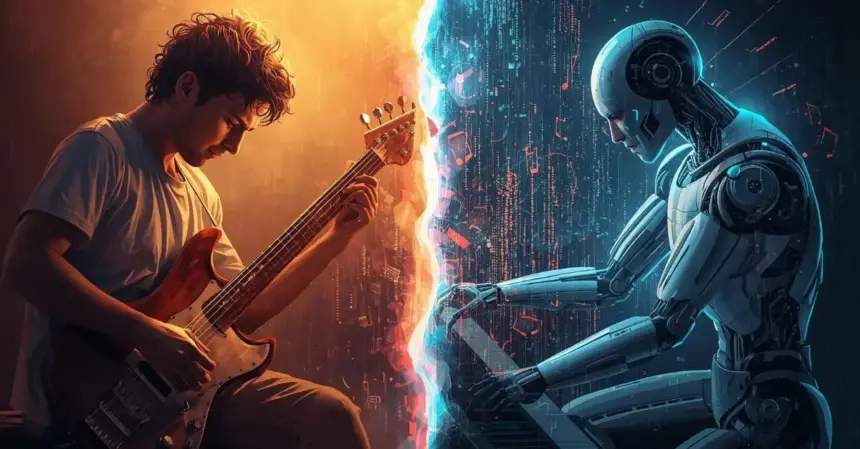
The digital revolution has often shaken our habits, but what we are experiencing today is beyond comprehension. Music could disappear quite quickly with artificial intelligence, or at least, music as we have always conceived it: a purely human, organic, and emotional art. In January 2026, the figures are staggering. On the Deezer platform, approximately 60,000 AI-generated tracks are uploaded every day. This represents 39% of total daily deliveries. In just one year, this volume has quadrupled. From Spotify to Apple Music, the invasion is global, invisible, and extremely effective.
This is no longer a simple technological trend; it is a tidal wave transforming streaming platforms into oceans of synthetic content. The era when creating a track required weeks of studio time, musicians, and a sound engineer seems to be evaporating. Today, with tools like Suno, Udio, or the latest innovations from Google Music, anyone can produce a complete song in seconds based on a simple text instruction. The barrier to entry has collapsed, giving way to an unprecedented saturation of the global music market.
The meteoric rise of virtual artists on Spotify and Deezer
Behind this proliferation of audio files lie new players: AI artists. These are not physical robots, but profiles created from scratch by algorithms or clever users. Names like Xania Monet, The Velvet Sundown, or Solomon Rey have become familiar to millions of listeners who often ignore that no human is behind the microphone. An investigation by Le Monde identified more than 400 such profiles in early 2026, already accumulating over 90 million monthly listeners on Spotify.
The success of these “digital ghosts” relies on fearsome efficiency. Their compositions are calibrated to please recommendation algorithms. They occupy relaxation, concentration, or sport playlists, where the listener seeks an atmosphere rather than an idol. However, the quality has reached such a level that a recent study conducted by Deezer reveals a worrying figure: 97% of listeners are unable to distinguish by ear a human production from a purely artificial creation. This total confusion between the real and the synthetic weakens the very status of the professional artist.
Increasingly powerful music generation algorithms
Technology has made a giant leap between 2024 and 2026. Audio diffusion models, inspired by the success of ChatGPT in text, now allow for the modeling of not only melodies but also vocal textures of incredible complexity. The Suno software has become the standard for the general public, capable of generating verses, choruses, and bridges with stunning structural coherence. AI no longer contents itself with copying; it seems to “understand” the codes of every genre, from jazz to heavy metal, to deliver a finished product ready for consumption.
The impact on the industry is massive because these tools require no theoretical skills. The user acts as a curator or artistic director. They type an instruction (a “prompt”) and choose the best version from the machine’s suggestions. This radical democratization raises the question of the value of music. If everyone can create a potential hit in three clicks, what remains of creative uniqueness? Platforms are now faced with a technical challenge: how to index and filter these millions of new tracks without stifling emerging flesh-and-blood artists?
Behind the scenes of creating an AI project like Mina.wav
To understand the flip side of the coin, we conducted a concrete experiment in collaboration with the producer LNKHEY. The latter had already distinguished himself with a viral cover of the track Saiyan, using an AI vocal clone of the singer Angèle. Together, we gave birth to Mina.wav, a 100% fictional artist project intended to test the limits of the current system. The objective was simple: create a credible single, distribute it, and observe if listeners and algorithms would take the bait.
The creative process was disconcertingly fast. We used Google Gemini to write melancholy lyrics and structure Mina’s visual identity. Then, the Suno software took over to compose the instrumental and generate a female voice full of nuances. The result is called Juste un vu. In less than an afternoon, we had a finished product, mixed and ready for distribution. This project demonstrates that technology today allows for bypassing all traditional circuits of music production.
Key steps in AI music production
Creating a track like Mina.wav requires only an internet connection and a bit of strategy. Here are the key steps that allow these fake profiles to flood the market:
-
Defining the universe: Using text-based AI to generate a storytelling, an artist name, and a consistent biography.
-
Assisted composition: Generating audio tracks via descriptive prompts targeting specific BPMs and styles.
-
Vocal cloning: Applying voice models (RVC) to give a unique and human grain to the generated melodies.
-
Distribution strategy: Passing through automated digital distributors that send the track to over 150 platforms simultaneously.
-
Algorithmic marketing: Using visuals generated by Midjourney for covers and creating clips via tools like Runway or Sora.
This automated production chain allows for testing dozens of tracks per week. If one starts generating organic listens, the creator can then focus their efforts on that specific profile. It is a purely statistical and commercial approach to art, where quantity eventually generates quality, or at least profitable visibility.
The lucrative business model of fake profile creators
One might think these tracks get lost in the shuffle, but the revenue generated is very real. AI artists succeed in capturing a significant share of the streaming platforms’ royalty pool. On Spotify, for example, the remuneration system is based on market share: the more listens you have relative to the global total, the more money you earn. By multiplying profiles and tracks, some creator networks manage to accumulate millions of cumulative streams, translating into thousands of dollars in monthly income.
This phenomenon creates unfair competition for independent musicians. A human artist might take six months to release a ten-track album, whereas an AI operator can upload ten albums a day. This supply saturation dilutes overall revenue and makes the discovery of new human talent increasingly difficult. “Stream farms,” which use bots to artificially inflate listens, are often added to this setup to maximize profits, creating an ecosystem of extremely profitable “disposable music.”
The response of streaming platforms to AI
Faced with this threat that could degrade user experience, industry giants are beginning to react. Spotify and Universal Music Group have entered discussions to protect copyright and limit the impact of content generated without authorization. The stakes are twofold: preserving catalog quality and preventing subscribers from getting tired of music they find too “generic.” However, the task is immense because detecting AI becomes more complex every day, especially when it is used in a hybrid way by real producers.
Platforms are implementing acoustic detection filters capable of spotting recurring patterns specific to algorithms like Suno or Udio. But like in the field of cybersecurity, it is an arms race. As soon as a detection method is deployed, AI models evolve to bypass it. Some experts even suggest that music could disappear quite quickly with artificial intelligence in its current commercial form, giving way to real-time personalization: music generated by the user’s AI, for the user, according to their current mood.
The future of human creation in a synthetic world
Despite this picture which may seem bleak for purists, all is not lost. The rise of AI could paradoxically restore value to authenticity. We are already seeing a return of interest in live performance, concerts, and physical formats like vinyl. AI can generate a perfect audio file, but it cannot (yet) simulate the charismatic presence of an artist on stage or the strong emotional bond forged during an improvised performance.
The artists who survive will likely be those who know how to integrate AI as an instrument, not a replacement. Producer LNKHEY explains that the tool saves precious time on thankless technical tasks, leaving more room for the overall artistic vision. Music may not disappear, but it will undergo a profound mutation, separating on one side stream consumption (background, functional music) managed by AI, and on the other “work of art” music carried by embodied human figures.
Toward ethical regulation of musical AI
The legislative framework is also beginning to adapt. In Europe, the AI Act attempts to impose transparency on content generated by machines. The idea would be to force platforms to display an “AI-Generated” label on each concerned track. This would allow listeners to consciously choose what they wish to support. The protection of the voice and image of famous artists is also at the heart of debates, to prevent digital clones from plundering the repertoire and identity of global stars without their consent.
In conclusion, while music could disappear quite quickly with artificial intelligence in its traditional form, it is also at the dawn of a new era. The challenge for 2026 creators is to reinvent their relationship with technology. Between the threat of total standardization and the opportunity for tenfold creativity, the line is thin. One thing is certain: tomorrow’s song will never be written in the same way again, and our way of listening to it is already changing forever.
FAQ on artificial intelligence and music
Will AI replace real singers?
AI can already clone voices with incredible precision, but it lacks the unpredictability and pure emotion of a human performance. It will likely replace voices for commercial projects (ads, jingles, background music), but the public will remain attached to the personalities and stories of human artists.
How do I know if a song on Spotify is made by an AI?
It is increasingly difficult. However, some clues can help: very vague or non-existent artist biographies, a total absence of social media or concert photos, and a sound production that is sometimes “too perfect” or repetitive in its structure.
Is it legal to use AI to create music?
Currently, using AI is legal, but the issue of copyright on training data (songs used to teach the AI) is the subject of many lawsuits. Legislation is evolving to protect original creators and impose more transparency on the origin of works.
How much does an AI artist earn on platforms?
Their income depends on the number of listens, exactly like a human artist. A profile accumulating 1 million listens per month can generate between $3,000 and $4,000. Some creator networks multiply these profits by managing hundreds of profiles simultaneously.