


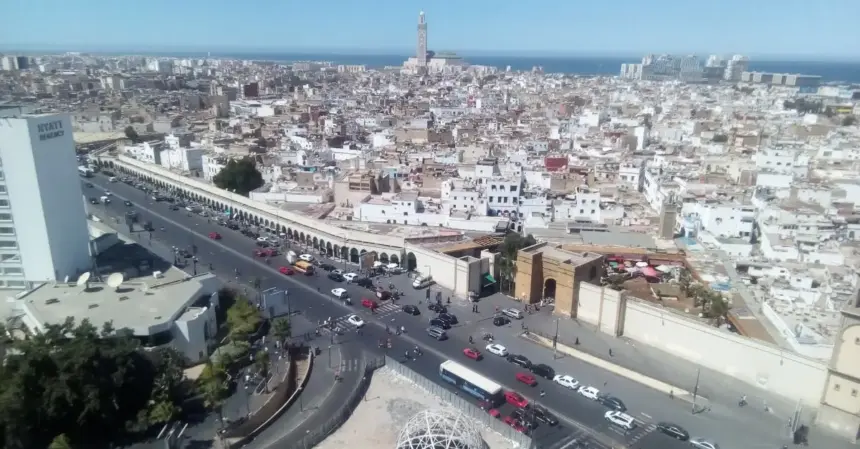
Casablanca, the beating heart of the Moroccan economy, is currently undergoing a phase of unprecedented transformation. The challenges of urban management in Casablanca are no longer merely technical adjustments; they have become existential stakes for a metropolis that concentrates nearly 30% of the national GDP. Between demographic explosions, uncontrolled urban sprawl, and pressure on aging infrastructure, the “White City” is seeking a second wind to confirm its status as an international financial hub.
A Demographic Growth Disrupting Urban Balance
Demographic pressure remains the primary driver of urban tensions. With over 4 million inhabitants, the city stretches further into its peripheries every day, such as Bouskoura or Dar Bouazza, creating massive residential zones that do not always have adequate public services. This horizontal expansion makes the management of water, electricity, and sanitation networks particularly complex for local authorities and delegated service providers.
Decision-makers face a difficult equation: how to densify the historic center while offering dignified housing in the suburbs? The “Cities Without Slums” program has successfully relocated thousands of families, but the challenge of social integration in these new neighborhoods remains. The lack of functional diversity forces residents to undertake long daily commutes, saturating road axes that are already fragile.
Land management has become the “sinews of war.” The price per square meter is skyrocketing, pushing the middle class further away from the city center. This dynamic generates a territorial divide between gleaming business districts like Casablanca Finance City (CFC) and peri-central areas that suffer from a glaring lack of green spaces and local community structures.
The Impact of Rural Exodus on Public Services
The metropolis’s attractiveness continues to draw populations from all regions of the Kingdom. This constant flow requires permanent adaptation of educational and health infrastructures. The municipality must juggle often limited budgets to meet an increasingly demanding population in terms of quality of life and administrative responsiveness.
The Necessity of Integrated Urban Planning
To respond to these issues, the Urban Master Plan (SDAU) attempts to redefine priorities. It is no longer just about building housing, but about creating viable ecosystems. The challenge is to move from curative management—where emergencies are repaired—to preventive planning capable of anticipating the needs of the next twenty years.
Major Stakes of Sustainable Mobility
Navigating Casablanca is often a daily challenge. Chronic traffic jams on Zerktouni Boulevard or the El Jadida road testify to the saturation of the road network. The vehicle fleet continues to grow, while the public transport offer, though significantly improved, still struggles to cover the entire urban territory fluidly.
The deployment of tramway lines marked a historic turning point in Casablanca’s mobility. By connecting peripheral neighborhoods to the center, this mode of transport offered an ecological and punctual alternative. However, permanent works for network extensions (lines T3 and T4) and the arrival of the High-Level Service Bus (BHNS/Busway) create temporary friction zones that test the patience of commuters.
Pillars of the Urban Travel Plan
To transform mobility, the city relies on increased multimodality. The idea is to allow a citizen to switch from the train to the tramway, then to the bus, with a single transport ticket. This vision requires perfect coordination between various actors like ONCF, Alsa, and RATP Dev. Here are the priority axes for this transformation:
-
Massive extension of the dedicated lane transport network (Tramway and Busway).
-
Creation of “park and ride” lots on the outskirts to relieve pressure on the city center.
-
Improvement of light signaling and intelligent traffic management.
-
Development of secure bike lanes to encourage soft mobility.
-
Renewal of the bus fleet to reduce the carbon footprint.
The Problem of City Center Parking
Finding a parking spot has become a “national sport” in Casablanca. The management of public space is a major point of friction here. The introduction of parking meters and regulation by local development companies aims to rationalize the occupation of the streets, but resistance from informal parking guards and the lack of underground parking complicate the situation.
Waste Management and Ecological Urgency
Urban cleanliness is undoubtedly the most sensitive subject for Casablancans. With waste production exceeding 3,000 tons per day, collection and treatment constitute a financial drain and a permanent logistical challenge. New delegated management contracts impose stricter performance criteria, but citizen behavior and the organization of the informal sector remain complex variables.
The Médiouna landfill, long criticized for its environmental impact, has given way to a new sorting and recovery center. This is a giant step forward, but the path toward a circular economy is still long. Sorting at the source, which is almost non-existent, prevents optimal recovery of organic and plastic materials, unnecessarily overloading treatment centers.
Air Pollution and Industrial Zones
As an industrial pole, Casablanca must also manage its air quality. Zones like Aïn Sebaâ or Mohammedia release particles that, coupled with car traffic, impact public health. Pollution sensors are now installed, but restrictive measures for the most polluting vehicles are slow to be applied for fear of slowing down economic activity.
The Challenge of Water Management and Sanitation
The water stress hitting Morocco does not spare the metropolis. The management of drinking water, ensured by Lydec, must today integrate emergency solutions such as interconnection between hydraulic basins or the future desalination of seawater. In parallel, the sanitation network must be resized to face recurring floods during heavy winter rains, a phenomenon accentuated by the sealing of soils.
Governance and Digitalization of Services
The complexity of urban management in Casablanca also lies in its administrative structure. The city is divided into districts, with a central City Council. This multiplicity of decision-making centers can sometimes slow down the implementation of structural projects. Local governance reform aims to simplify procedures and strengthen the role of Local Development Companies (SDL) like Casa Transport or Casa Aménagement.
Digitalization has become the indispensable tool for this modernization. Portals like “Rokhas” or applications for reporting urban malfunctions allow for a direct link with the citizen. The goal is to transform Casablanca into a “Smart City” capable of using real-time data to optimize public lighting, waste collection, or traffic flow management.
Citizen Participation at the Heart of Change
No urban reform can succeed without the buy-in of the inhabitants. Neighborhood associations and civil society play a growing role in monitoring public space. Participatory budgeting, though still embryonic, could offer an opportunity for citizens to choose priority projects for their immediate environment, thereby strengthening the sense of belonging to the city.
Frequently Asked Questions About City Management
Why are there so many construction sites currently in Casablanca? The city is preparing for future major events, notably the 2030 World Cup. The simultaneous extension of the tramway, renovation of tunnels, and upgrading of stadiums create construction sites everywhere, but this is a necessary step to modernize basic infrastructure.
What solutions are planned against flooding? The reinforcement of rainwater collectors and the construction of large retention basins are underway. Authorities are also working on better urban drainage management to prevent low points of the city from being submerged during violent storms.
How does the city plan to increase its green spaces? Despite the density, projects like the rehabilitation of the Arab League Park or the creation of local gardens in new peripheral neighborhoods are priorities. The objective is to reach international standards in square meters of greenery per inhabitant.
What is the status of the Smart City project? Casablanca has already launched several initiatives like centralized traffic management and e-administration. The rollout of 5G and the use of the Internet of Things (IoT) for urban maintenance are the next steps in this digital transformation.