

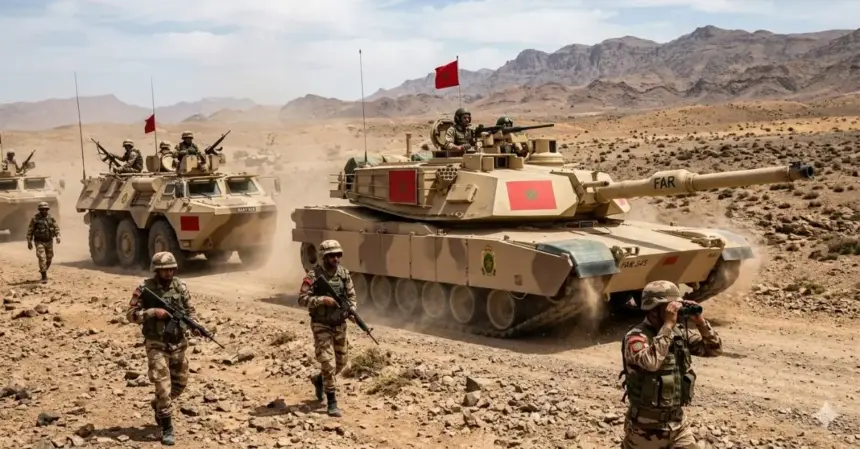
The geopolitical landscape of North Africa is undergoing a profound shift. According to the latest report from the Stockholm International Peace Research Institute (SIPRI), military power dynamics have moved dramatically. Morocco has emerged as the central pivot of ballistic and technological power in the region, becoming the largest arms importer on the African continent. This rise, marked by a 12% increase in major arms purchases over the 2021-2025 period, stands in stark contrast to its neighbor’s trajectory. Algeria, once the undisputed leader in military budgets, has recorded a staggering 78% drop in its arms imports.
This Algerian decoupling is more than a simple budgetary fluctuation; it reflects a deep transformation in alliances and renewal capabilities. While Rabat diversifies its sources and acquires cutting-edge technologies, Algiers appears to be losing steam, penalized by its near-exclusive dependence on a Russian industry under pressure. The SIPRI report highlights a cold reality: Morocco is no longer just following the race; it is leading it. This technological edge radically alters the balance of power and dictates a new political reading of tensions in the Maghreb.
Morocco’s Strategy for Technological Superiority
Morocco is not just buying weapons; it is purchasing a modern defense doctrine. The 12% increase in imports conceals a surgical selection of equipment. The Kingdom has invested heavily in fighter aviation, anti-aircraft defense systems, and, most importantly, in combat and surveillance drones. These tools, proven in modern theaters of operation, offer a flexibility that conventional armies struggle to counter. The agreement with the United States for the acquisition of F-16 Viper jets and HIMARS systems places the Royal Armed Forces (FAR) in a league of their own.
This dynamic is part of a long-term vision: industrial sovereignty. Morocco no longer wants to be just a client. Technology transfer agreements have been signed to allow for maintenance and, eventually, the local production of certain components. The goal is to reduce vulnerability to international stock shortages. By turning to diverse partners like the U.S., France, Israel, and China, Morocco avoids the trap of single-source dependence. This diplomatic agility is the bedrock of its current domination, allowing for the integration of the world’s best systems into a coherent and formidable defense ecosystem.
The Spectacular Decline of Algerian Imports
The figure is undeniable: -78%. For Algeria, this setback is a seismic event. Several factors explain this collapse. The first is diplomatic. Algeria’s main supplier, Russia, is completely preoccupied with the conflict in Ukraine, which limits its capacity to export new hardware and spare parts. Algiers finds itself facing a technological wall: its aging equipment no longer finds quick modernization channels. Furthermore, international pressure on countries purchasing from the Russian defense industry complicates financial and logistical transactions.
Beyond the Russian constraint, Algeria seems trapped in a heavy military bureaucracy. Unlike Morocco, which has opted for mobility and high technology, the ANP (People’s National Army) remains structured around a mass model—costly and difficult to project. This strategic gap creates a capacity vacuum that the SIPRI report highlights with precision. While Algiers continues to display record defense budgets in local currency, the absence of new major international contracts testifies to a real difficulty in maintaining its rank as a regional power.
Key Pillars of the SIPRI Report on North Africa
The SIPRI report does not just look at financial volumes; it analyzes the nature of the flows. To understand why Morocco now dominates the African rankings, one must observe the structure of acquisitions. Here are the essential points emerging from the analysis:
-
Morocco now captures a majority share of U.S. exports to Africa.
-
Moroccan diversification includes latest-generation surface-to-air defense systems (Patriot, Barak-MX).
-
Algeria’s decline leaves a leadership gap that Morocco fills with a steady increase.
-
Electronic warfare systems and cybersecurity are becoming priorities for the FAR.
-
Stagnation in Sub-Saharan African countries reinforces Maghreb bipolarity, to the Kingdom’s advantage.
This situation creates an asymmetry. Morocco possesses a more compact army, better equipped technologically and perfectly integrated with NATO standards. Algeria, despite having a large arsenal, suffers from a lack of qualitative renewal. Modern warfare has proven that technology often trumps numbers. By dominating the import market, Morocco secures a strategic lead that could last decades, redefining the contours of security in the Western Mediterranean.
Political Reading of a Forced Rebalancing
Morocco’s rise is not just military; it is eminently political. It accompanies the Kingdom’s diplomatic successes regarding the Sahara issue. A strong army is a negotiation lever and a guarantor of stability. For international partners, Morocco appears as a reliable and capable ally, able to secure its borders and participate in peacekeeping operations with world-standard equipment. This military leadership consolidates Rabat’s position as a privileged interlocutor for major powers.
For Algeria, this drop is a wake-up call. The relative isolation of its main supplier forces a painful reassessment. It attempts to turn to China or Germany, but these transitions take time and are expensive. The risk for Algiers is seeing its regional influence erode alongside its deterrent capabilities. The arms race in the Maghreb has changed face: it is no longer a competition of volume, but a battle for the mastery of the sky and intelligence, a domain where Morocco has taken a considerable lead.
FAQ on Armament in North Africa
Why has Morocco become the #1 importer in Africa? It is the result of a decennial modernization plan aimed at replacing old equipment with cutting-edge technologies, mainly from the U.S. and Israel, to ensure air and land superiority.
How do you explain Algeria’s 78% drop? Algeria is suffering the consequences of the war in Ukraine, which paralyzes its main supplier, Russia. Additionally, it struggles to diversify its suppliers to obtain technology equivalent to Morocco’s.
What is the impact on regional balance? The balance of power is shifting in favor of Morocco. The Moroccan army is becoming more modern and interoperable with Western powers, reinforcing its role as a regional leader.