

Since February 28, 2026, Iran has been in open war with the United States and Israel, following joint US-Israeli strikes that notably killed Supreme Leader Ali Khamenei. In retaliation, Tehran effectively closed the Strait of Hormuz, prompting an American response in the form of a naval blockade of Iran starting April 13. A ceasefire agreement signed in Versailles in mid-June held for only a few weeks: fighting resumed in early July, at a lower intensity but still real.
It is against this already explosive backdrop that a second front opened, more than 2,000 kilometers away. On September 11, 2026, after an offensive launched on September 3 that captured six districts across the Taiz and Hodeidah provinces — some 5,400 km² — Houthi rebels seized the island of Mayun (Perim), at the heart of the Bab-el-Mandeb strait, along with the entire western coast of Yemen. This chokepoint, through which a substantial share of global maritime trade normally passes, has thus fallen under the control of a Tehran ally.
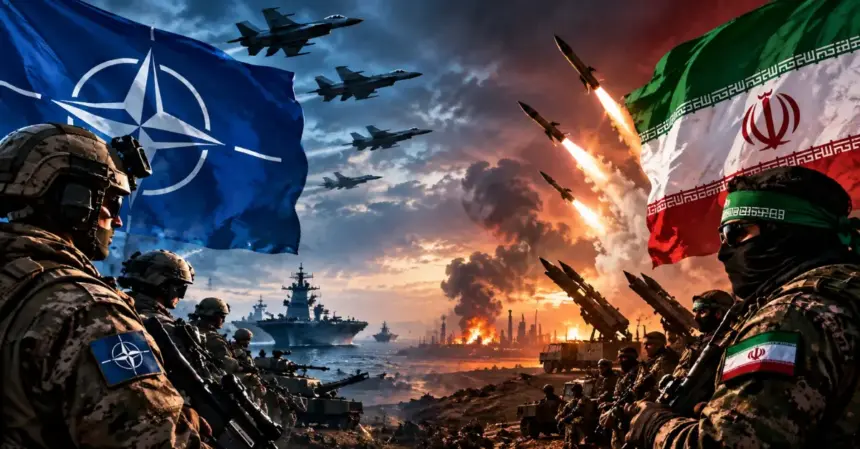
The two straits flanking the Arabian Peninsula — Hormuz and Bab-el-Mandeb — are now, each in its own way, under Iranian influence. It is this convergence that is currently fueling speculation about a direct NATO intervention.
Why the case for Western intervention is gaining traction
Several factual elements feed this scenario:
- The scale of the economic chokehold. The Strait of Hormuz alone carries roughly one-fifth of global oil and liquefied natural gas production, as well as raw materials essential to about 30% of the world’s fertilizer output. A prolonged closure of Bab-el-Mandeb, which on its own accounts for close to 15% of global maritime traffic, would add a second bottleneck to an economy already under strain.
- Prior signals of resolve. As early as May, NATO had suggested that intervention was not off the table “if the conditions were met,” in a context where the blockage of the Strait of Hormuz had immobilized around 150 vessels and given rise to an informal toll system that could reach two million dollars per tanker.
- Existing, though limited, Western engagement. European maritime security missions (Aspides, Atalanta) have been active in the region for several years, and some member states, including France, have previously carried out strikes against the Houthis. Expanding the mandate of these missions in response to the loss of control over Bab-el-Mandeb would amount to a gradual escalation rather than a declaration of war.
- Domestic economic pressure. In the United States, rising prices at the pump are weighing politically on the Trump administration ahead of the midterm elections — a factor that has previously pushed Washington toward de-escalation rather than an expansion of the conflict.
Why nothing indicates that war is certain
Conversely, several factors argue for caution in any prediction:
- Washington has so far avoided direct engagement against the Houthis, even in the face of Saudi requests. After the strike on the East-West pipeline, the US administration did not respond militarily in support of Riyadh.
- The Houthis themselves are calibrating their moves. Their spokesman stated that navigation remained safe for all shipping companies except Saudi vessels — a sign they are seeking leverage for negotiation rather than a total, immediate blockade that would unify the entire international shipping community against them.
- NATO has no automatic mandate. Intervention would require either a direct attack on a member state or a consensus political decision among the Alliance’s 32 countries — a consensus that is far from guaranteed, with European public opinion still divided on involvement in this conflict.
- The precedent of the Islamabad Memorandum (June 2026) shows that a ceasefire, however fragile, remains possible once economic pressure becomes unsustainable for all parties — including Iran, whose economy is already severely weakened by the crossing blockades.
What to watch
Rather than a certain path to war, three indicators will help gauge the crisis’s real trajectory:
- A possible total closure of Bab-el-Mandeb (rather than the current targeted blockade of Saudi vessels only);
- A direct strike on a vessel or piece of infrastructure belonging to a NATO member state;
- The trajectory of Brent crude prices, which have already passed $106, and their political impact in both the United States and Europe.
The escalation is real, well documented, and its economic consequences are already being felt. But turning this observation into certainty of a NATO-Iran war would mean ignoring the many diplomatic, economic, and political safeguards that have, so far, kept each phase of this crisis from turning into a full-scale conflict.
Analysis based on information available as of September 13, 2026. As the situation is evolving, some elements may change rapidly.