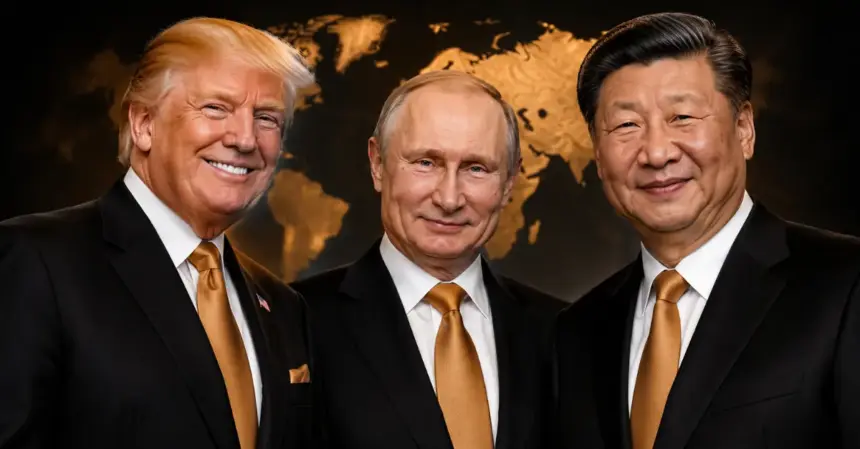
The event, held on the sidelines of the Asia-Pacific Economic Cooperation (APEC) summit, was billed as historic. The images certainly are. The results, much less so.
The context of an unprecedented meeting
The idea of bringing China into the discussions between Washington and Moscow had been floated by Vladimir Putin. For Russia, the appeal is obvious: break out of the diplomatic isolation that followed the war in Ukraine and present itself as an equal counterpart to the United States and China. For Beijing, hosting this trilateral format projects the image of a power able to bring the world’s main players together.
The context is tense. The war in Ukraine drags on. The United States is engaged in a conflict with Iran. The New START treaty, which capped deployed American and Russian strategic arsenals, expired in February 2026 with no successor. According to the SIPRI Yearbook 2026, China has about 620 warheads, compared with several thousand for the United States and Russia. The International Energy Agency also reports a global oil supply surplus, even as energy flows remain disrupted by tensions in the Middle East and by sanctions.
Donald Trump, for his part, said he wanted to make progress on the Ukrainian and Iranian files and open a nuclear dialogue that includes China. All three leaders therefore had reasons to meet. None of them, however, required a public, staged trilateral format.
A carefully staged show in Shenzhen
The meeting took place at the Kylin Villa. Xi Jinping chaired it. The three men sat around a large round table, with the Chinese flag at the center, facing a monumental painting of Chinese mountains. It lasted about an hour and a half. Bilateral talks had come before it.
Trump opened by declaring that the three countries are “writing history” and are “particularly well placed” to discuss reducing nuclear risks. Putin spoke of “common interests” in settling regional conflicts, including the one in Ukraine. Xi reminded the others that “when the great powers live in harmony, the world is at peace.”
The symbolism is clear: China at the center, the three powers in a closed circle, outside the broader multilateral forums. It is the image of a world in which major decisions are made among peers, without Europe or other actors.
The four commitments of the peace declaration
At the end of the meeting, the three parties released a “Declaration toward Peace.” The text, circulated notably by Xinhua and the White House, contains four points:
- As permanent members of the Security Council, the United States, Russia and China commit to reforming the UN so that it responds more effectively to global challenges and lives up to its fundamental mission of peace and security.
- The three countries plan to increase the production and supply of refined petroleum products for the benefit of all nations and reaffirm the importance of stable energy flows.
- The principle of state consent and respect for the immunities of state officials are of paramount importance; the International Criminal Court and similar bodies must not abuse their jurisdiction.
- A nuclear war cannot be won and must never be fought. The three countries will hold a dialogue on reducing nuclear risks and preventing proliferation.
No timetable, no figures and no verification mechanism accompany these wordings.
What the text does not say
The declaration mentions neither the war in Ukraine nor the conflict in Iran. It sets no interim framework on nuclear testing and no commitment not to expand arsenals. After the meeting, Trump acknowledged, in remarks reported by Reuters, that an agreement limiting nuclear weapons remains “very difficult,” because “once you have nuclear weapons, it is very hard to give them up.” China, whose arsenal remains far smaller, insisted for its part on the principle of a complete ban on nuclear weapons, without committing to any cap.
On oil, the commitment to increase supply comes amid a global surplus already noted by the IEA. It mainly benefits Russia, whose exports remain constrained by sanctions and by Ukrainian strikes on its refining infrastructure. No concrete measure to lift sanctions or guarantee transit was announced.
The point on the immunities of state officials and the International Criminal Court answers a Russian request (Putin is the subject of an ICC arrest warrant) and matches the current American line. The United States, which is not a party to the Rome Statute, has applied diplomatic and financial pressure against the Court.
Symbolic gains and concrete absences
For China, the gain is mainly one of image: it hosted and chaired a format that places Washington and Moscow face to face under its roof. For Russia, simply being seated at this table, after years of Western isolation, amounts to a recognition of status. For the United States, the main result is a Chinese commitment, admittedly vague, to take part in a nuclear dialogue. It is a start, but nothing more.
Analyses published by the Atlantic Council and other observers point to the gap between the staging and the substance. No public progress was recorded on the ongoing conflicts. Europe was absent from the format, which matches a long-standing goal of Moscow and Beijing: handling European security questions among the great powers, without the Europeans.
Outlook for a claimed multipolar world
This summit confirms that the three capitals can talk directly and produce a joint text. It also confirms that moving from dialogue to measurable commitments remains difficult. The disparity in nuclear arsenals, the diverging interests over Ukraine and Iran, and the disagreements over the role of international institutions were not resolved in an hour and a half.
What comes next will depend on what the diplomatic services do with the commitment to a nuclear dialogue, on how the UN reform pledge is interpreted, and on how oil flows actually evolve. For now, the main measurable result is symbolic: three leaders appeared together, signed a minimal text, and each can go home claiming a form of success. The conflicts that justified the meeting, meanwhile, continue.
Frequently asked questions
Why was this summit held in Shenzhen?
Because China was hosting the APEC summit there. The idea of a trilateral format was put forward by Putin and accepted by the other two parties.
Does the peace declaration commit the parties to nuclear arms reductions?
No. It reaffirms the principle that a nuclear war must not be fought and provides for a dialogue on risks and proliferation, with no figures or timetable.
Were Ukraine and Iran discussed?
Yes, in the opening remarks and the bilateral talks, according to the participants’ statements. They do not appear in the joint text.
Who comes out of this meeting as the winner?
China and Russia gain in status and image. The United States gets a Chinese commitment to discuss nuclear issues, with no guarantee of results.