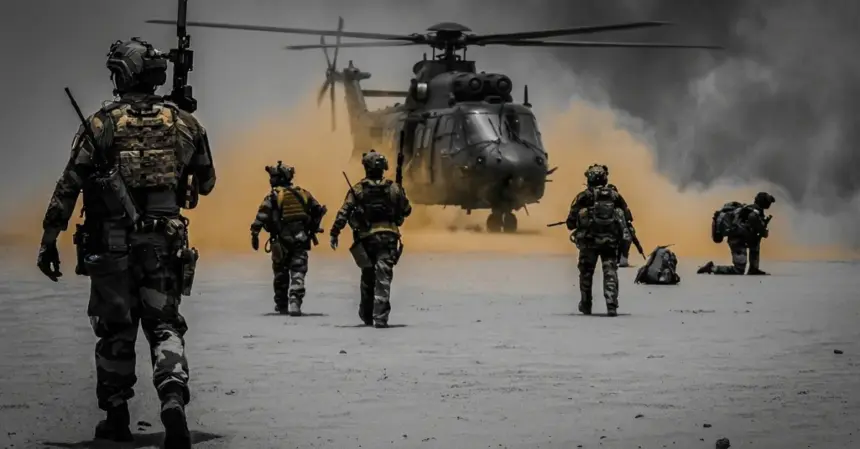
Night flights over unlit expanses, landings in the dust, sandstorms and a tent camp swept away by the wind: this is not a movie set, but the factual account of Exercise Chergui 2025, conducted with the Royal Armed Forces (FAR) in the Errachidia region. Held from September 20 to October 11, 2025 in the Tafilalet operational sector, this combined air-land training allowed the French to return to a desert environment they had seldom practiced in recent years.
A partnership reinventing itself after tensions
Franco-Moroccan military cooperation is nothing new. It follows a long tradition of joint exercises, particularly around the Tafilalet region. Yet according to information reported by Air & Cosmos on November 19, this edition marked a resumption after a decade without significant French participation. The French Army’s light aviation assets were committed to the Sahel as part of Operation Barkhane; then the Pegasus affair, revealed in 2021, chilled political relations and delayed the return of bilateral maneuvers.
The context has changed. Emmanuel Macron’s 2024 state visit to Morocco, accompanied by Paris’s firm support for Moroccan sovereignty over the Sahara, revived the momentum. Exercises are now multiplying. The scenario of Chergui 2025, built around a simulated aggression against Morocco’s territorial integrity, is not neutral: it aligns with Rabat’s security priorities while offering Paris a realistic training ground in an environment that metropolitan bases cannot easily reproduce. The French Army clearly stated in its official communication that the objective was to strengthen interoperability and consolidate the strategic partnership in the face of regional challenges in an unstable international context.
The desert as a school of war
The deployment itself was already a logistical exercise. From Pau, the 5th Combat Helicopter Regiment transported nine aircraft (two Tigers, three Gazelles and four NH90 Caïmans) over nearly 3,000 kilometers, along with their support teams. On site, the French contingent numbered about 185 personnel, alongside some 800 FAR personnel. According to information published by Air & Cosmos, French crews logged 380 flight hours, 200 of them over the training area.
What the pilots worked on is precisely what is hard to maintain in metropolitan France: very low-altitude flights following dry wadis, landings in the dust (the “dust landing”), and night navigation over expanses with no artificial lighting. Tiger crews validated their desert flight qualifications, both day and night. A report by the French Army, published in Terre Mag, describes live-fire sequences in the Missendal area, with Caïmans hovering about fifteen meters above the ground, air-to-ground firing and coordination with artillery.
The conditions imposed their own law. A French lieutenant colonel recounted that a tent camp was swept away by the wind, a mishap that some compared to episodes experienced in the Sahel. Dust infiltrates engine filters, accelerates wear on the blades (which spin at more than 700 km/h) and demands rigorous maintenance. Mechanics kept the aircraft operational in conditions described as “more rustic than in France”, while maintaining the same safety standards. These constraints are not trivial: they test the ability of an air detachment to operate far from its bases, with a limited logistics chain.
Joint maneuvers and interoperability
In the field, the French operated alongside Moroccan units: Gazelle, Puma and Chinook helicopters on the FAR side, M1A2 Abrams tanks, elements of the 5th Mechanized Brigade, M109 self-propelled guns, airborne special forces and armored reconnaissance. French infantrymen of the 1st Tirailleurs Regiment boarded Moroccan helicopters for heliborne operations. The command teams of both armies worked together within the operations center of the Moroccan mechanized brigade, during the command post exercise (CPX) and live exercise (LIVEX) phases.
Commander Mathieu, head of the French detachment, summed up the objective: strengthening the ability to operate in a joint, combined-arms framework with Moroccan partners. The vast open spaces, the absence of vegetation and the dust make positions easily visible, which forces tactics to be adapted: avoiding ridgelines and favoring wadis. These concrete adaptations, reported by the reconnaissance units of the 1st Chasseurs Regiment, show that the exercise was not limited to a political demonstration.
Key figures of the exercise
- Nine French helicopters deployed from Pau (two Tigers, three Gazelles, four NH90 Caïmans) and participation of Moroccan helicopters (Gazelle, Puma, Chinook).
- About 185 French military personnel alongside about 800 Royal Armed Forces personnel.
- 380 flight hours logged by French crews, 200 of them over the training area (according to Air & Cosmos on November 19).
- Period: September 20 to October 11, 2025, Errachidia region / Tafilalet sector.
- Main scenario: simulation of an aggression against Morocco’s territorial integrity, with combined ground-air maneuvers, air-to-ground firing and artillery, and joint command phases.
Strategic stakes for the Mediterranean basin and the Sahel
Why does this exercise matter beyond technical training? After the gradual withdrawal of French forces from the Sahel, Paris is seeking to maintain a capacity for influence and action in the Sahelo-Saharan region without a large permanent presence. Morocco appears as a stable partner, with modernized forces (Abrams, combat aviation, intelligence) and a key geographic position. For Rabat, these maneuvers strengthen its preparedness to defend its territory, including in areas close to the Algerian border, and consolidate diversified alliances.

Regional sensitivities exist. The announcement of the exercise had prompted Algerian reactions; once the maneuvers began, silence prevailed. The exercise is not a direct threat, but it takes place against a backdrop of persistent tensions between Rabat and Algiers over Western Sahara and the role of the Polisario Front. From the French perspective, the interest is twofold: maintaining operational cooperation useful for the fight against transborder terrorist and criminal networks, and sending a signal of continuity in the partnership despite past political setbacks. From the Moroccan perspective, it is also about demonstrating the FAR’s ability to operate in an allied framework under demanding conditions.
Some observers see it as a form of implicit deterrence and a way for France to remain present in the Maghreb after the withdrawals from Mali and Niger. Others point out that the exercise remained modest in scale (nine French helicopters) and was above all a classic bilateral training exercise, far from a large-scale power projection operation. Both readings coexist: the technical interoperability is real, and so is the political message.
FAQ
What is Exercise Chergui 2025?
A bilateral Franco-Moroccan exercise held in September-October 2025 in the Errachidia region, aimed at strengthening air-land interoperability in a desert environment, built around a scenario of defending Morocco’s territorial integrity.
Why is the Moroccan desert useful for the French army?
It allows crews to practice techniques (very low flying, dust landings, night navigation without lighting, maintenance under sand constraints) that are hard to reproduce in metropolitan France, while also testing long-distance logistical deployment.
What was the size of the forces involved?
About 185 French personnel (mainly from the 5th RHC, with elements of the 1st RC, 1st RT and 4th BAC) and about 800 FAR personnel, with nine French helicopters and Moroccan assets including Abrams tanks, Gazelles, Pumas and Chinooks.
What does this exercise mean for Franco-Moroccan relations?
It marks a concrete resumption of military cooperation after a period of tension (the Pegasus affair, Sahel commitments), in the wake of the 2024 presidential visit and ahead of a possible strengthened treaty in 2027.