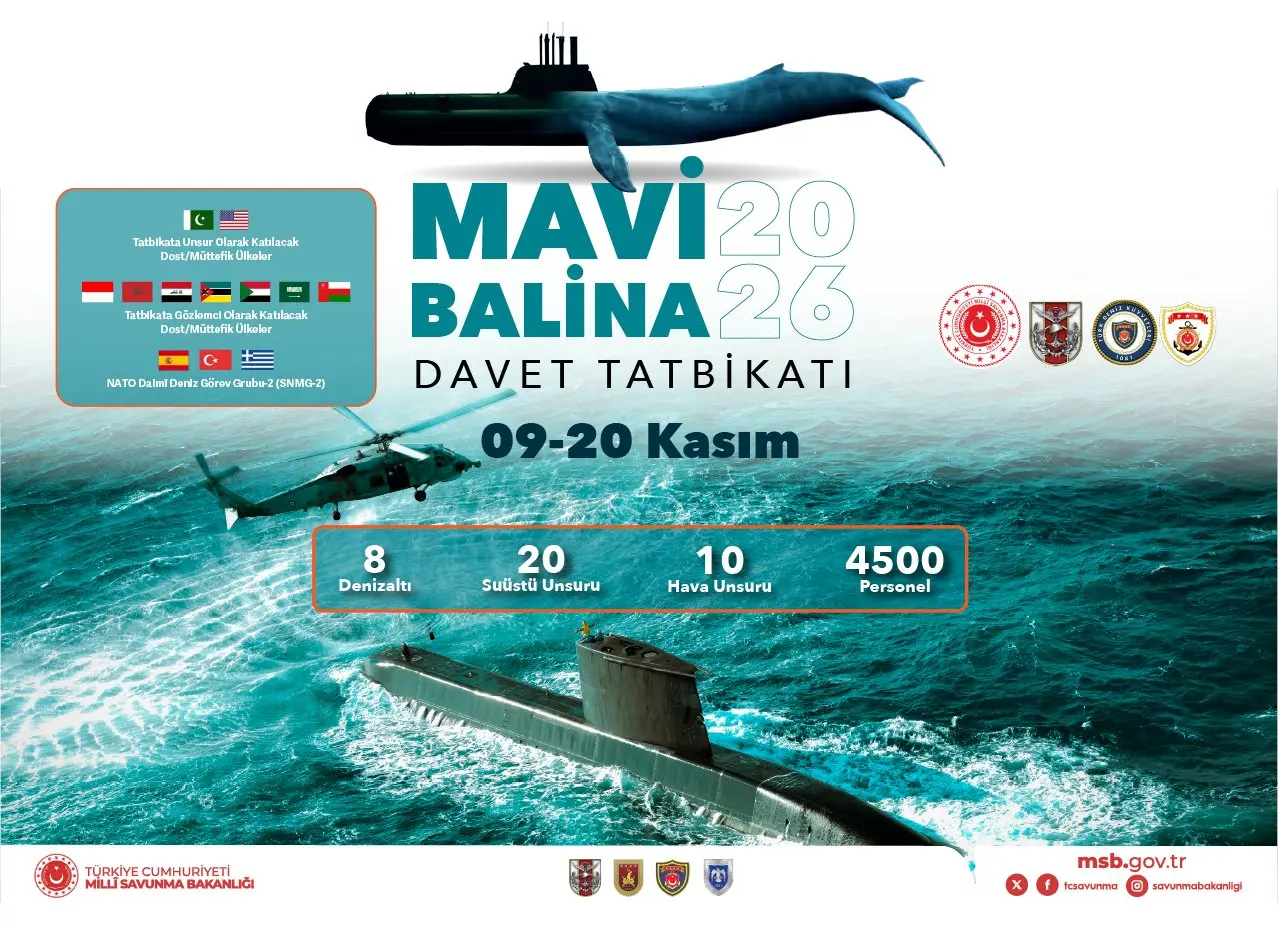
Morocco is not taking an active part, but the mere fact that Rabat appears on this list alongside Indonesia, Iraq, Mozambique, Mauritania, Sudan, Saudi Arabia and Oman deserves attention. The exercise, held under Turkish leadership from November 9 to 20 in the eastern Mediterranean, remains the region’s largest recurring anti-submarine warfare event. For a kingdom that is diversifying its military partnerships while remaining a major non-NATO ally of the United States, the invitation says something about its place in today’s maritime balance of power.
Background of a biennial exercise in the eastern Mediterranean
Mavi Balina (Blue Whale) is organized every two years by the Turkish Navy from Aksaz base, near Marmaris. The 2024 edition, held from November 4 to 15, had already brought together Turkish navy, air force and coast guard units, NATO’s Standing NATO Maritime Group 2 (SNMG-2) with Turkish, Canadian, Spanish and Greek vessels, American and Pakistani assets, and observers from eleven countries. The 2026 edition follows the same invitation logic: the forces actually taking part in the maneuvers are Turkish national units, SNMG-2, and American and Pakistani assets. Observers remain outside the combat scenarios.
The ministry’s spokesperson, Rear Admiral Zeki Aktürk, set out the purpose of the maneuvers as early as November 5: “close coordination and cooperation between air assets, surface ships and submarines against submarines in transit and on patrol missions.”
The deployment and Morocco’s place
The announced deployment includes eight submarines, twenty surface units, ten aircraft, one unmanned underwater vehicle and roughly 4,500 personnel. These figures, confirmed in the ministry’s official statement on its official account, give a sense of the scale of the ambition.
From November 7 to 13, Aksaz is also hosting port calls by three SNMG-2 ships (the Spanish replenishment ship Patiño, the Spanish frigate Blas de Lezo and the Greek frigate Aegean), as well as the American command ship USS Mount Whitney and the destroyer USS Bulkeley. These port calls provide a setting for talks between the commander of the Turkish fleet and the commander of the U.S. Sixth Fleet, who also leads NATO’s Naval Striking and Support Forces (Strikfornato).
For Morocco, attending as an observer fits into a broader sequence. Rabat took part in the Nusret mine warfare exercise organized by Turkey in October 2025. Industrial ties have grown denser: the purchase of Bayraktar TB2 drones from 2021, AKINCI deliveries in 2025, an order for Otokar Cobra II armored vehicles, and talks about an assembly and maintenance site near Casablanca.
A delegation from the Turkish company Emtekno met Royal Navy officials in late 2025 to explore technical cooperation and know-how transfers. None of these steps requires Morocco to give up its traditional partnerships; rather, they illustrate a strategy of multiplying interlocutors in an environment where underwater threats, offshore energy infrastructure and trade routes call for specialized skills.
The stakes of anti-submarine warfare
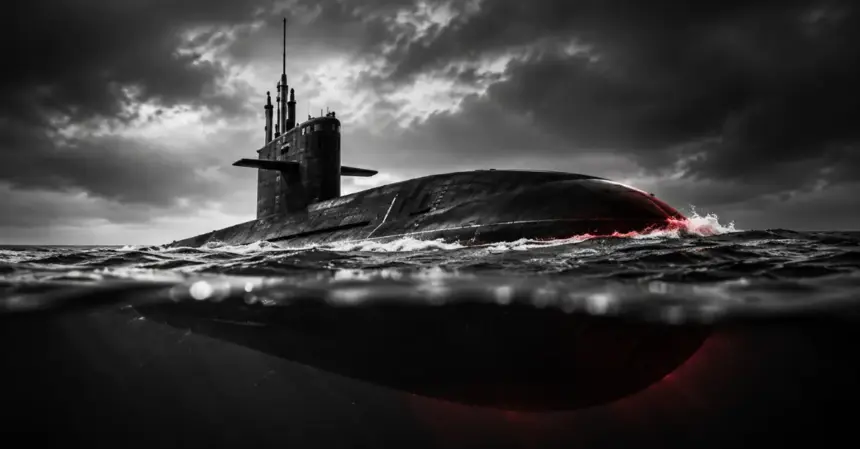
Anti-submarine warfare remains a demanding field. It combines active and passive sonar, helicopters fitted with sonobuoys, maritime patrol aircraft, frigates and the submarines themselves. In the eastern Mediterranean, the spread of modern conventional submarines, gas exploitation projects and competing claims over exclusive economic zones make these skills strategic.
Turkey has invested in its own submarine capabilities (the Reis class with air-independent propulsion) and in domestic detection systems. By inviting such a varied set of observers, it demonstrates both its ability to organize large-scale events and its willingness to maintain relations with countries that are not all aligned on the same regional issues.
Key figures for Mavi Balina-2026
- 8 submarines
- 20 surface units
- 10 aircraft
- 1 unmanned underwater vehicle
- Roughly 4,500 personnel
- Dates: November 9-20, 2026
- Area: eastern Mediterranean, coordinated from Aksaz
- Observers: Indonesia, Morocco, Iraq, Mozambique, Mauritania, Sudan, Saudi Arabia, Oman
- Active participants: Turkish units, SNMG-2, American and Pakistani assets
These figures, published by the Turkish ministry, make it possible to compare with the previous edition and gauge the relative scale of the event. They do not say, however, what specific lessons the Moroccan observers will draw from the briefings, system demonstrations or informal exchanges.
From Rabat’s point of view, the interest is twofold. First, technical: even as an observer, one witnesses multinational coordination procedures, sees sensors and platforms in action, and talks with staffs who regularly practice these scenarios. Second, diplomatic: being invited by Ankara to a framework that includes NATO and the United States signals an ability to engage with several maritime security circles without committing to binding coalitions.
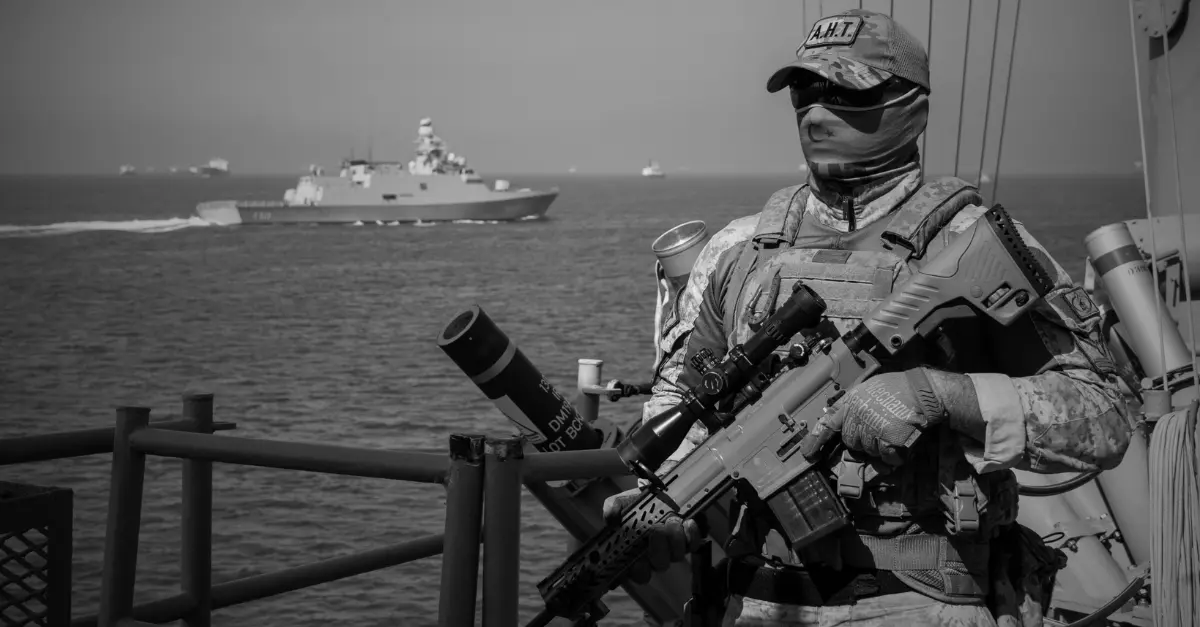
Some analysts see it as an illustration of the “cooperation without dependence” policy that Rabat has pursued for several years. Others stress that observer status limits political risk: Morocco does not appear as an operational player in a theater where tensions between Ankara, Athens and other capitals remain sensitive.
There are also limits. Observer status does not grant access to the most sensitive planning phases or to classified data. The concrete benefits will depend on the quality of the briefings, the contacts made, and the Royal Navy’s ability to turn these observations into training or equipment programs.
Nothing indicates, at this stage, that Morocco is considering acquiring heavy anti-submarine capabilities in the short term; its naval effort is focused more on monitoring the Atlantic approaches, the Strait of Gibraltar, and the gradual development of its surface and air assets.
Prospects for Rabat
The exercise takes place in a basin where submarines are not just tools of classic deterrence. They can threaten undersea cables, gas pipelines, platforms or convoys. Navies that master the detection and tracking of these discreet platforms retain an operational advantage.
For a country like Morocco, which manages extensive coastlines and significant commercial interests, observing how an allied navy organizes such a maneuver with NATO partners and other nations provides useful benchmarks, with no obligation to deliver immediate results.
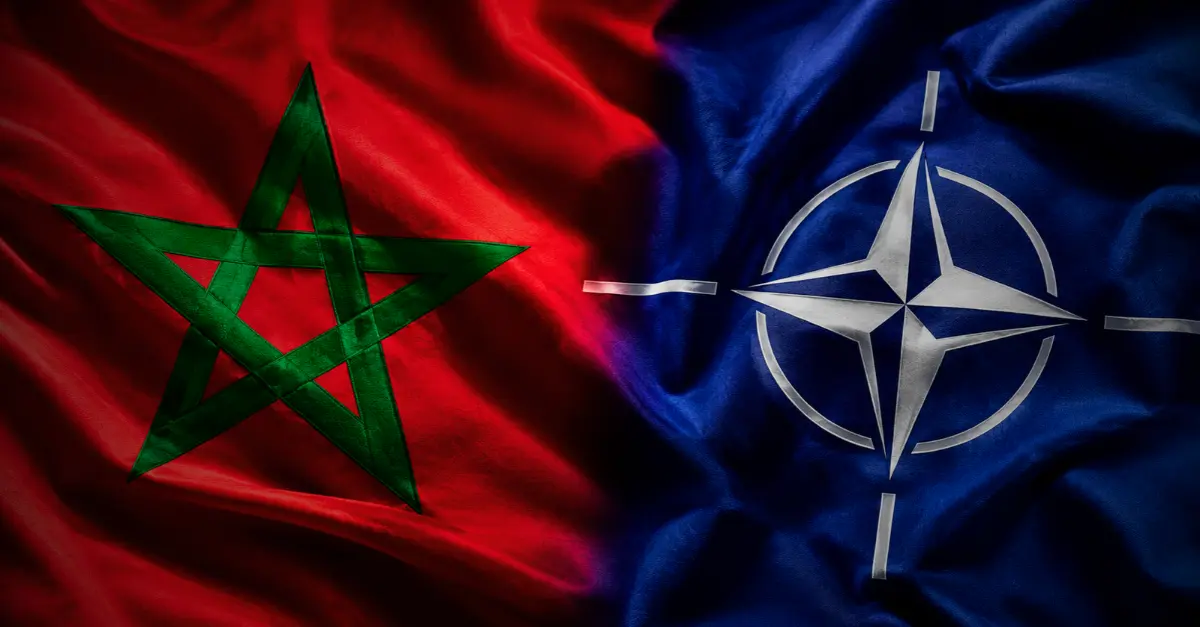
At the end of these twelve days, the observers will return home with notes, contacts and a better understanding of contemporary procedures. What Rabat does with them will depend on its budget priorities, the evolution of its industrial programs, and how it chooses to balance its relations with Ankara, Washington and its European partners. Mavi Balina-2026 does not, on its own, redraw the map of Mediterranean alliances.
It simply reminds us that mastery of the underwater domain remains a rare skill, that Turkey continues to invest in organizing it on a large scale, and that Morocco finds it worthwhile to attend.
FAQ
What exactly is Mavi Balina-2026?
A multinational, invitation-only exercise organized every two years by the Turkish Navy, focused on anti-submarine warfare in the eastern Mediterranean. It runs from November 9 to 20, 2026, and is coordinated from Aksaz base.
Is Morocco taking part in the maneuvers or only observing?
Only observing. The forces maneuvering are Turkish units, NATO’s SNMG-2 and American and Pakistani assets. Eight countries, including Morocco, follow the exercise without committing units.
Why does this exercise matter in the eastern Mediterranean?
It is one of the region’s most important recurring anti-submarine warfare events. It tests coordination between submarines, surface ships and air assets in a basin where energy stakes, trade routes and national submarine capabilities are growing.
How does it relate to Moroccan-Turkish military relations?
It fits into cooperation that is already under way: participation in the Nusret 2025 exercise, purchases of Turkish drones and armored vehicles, and ongoing industrial talks. Observer status remains a limited form of engagement.