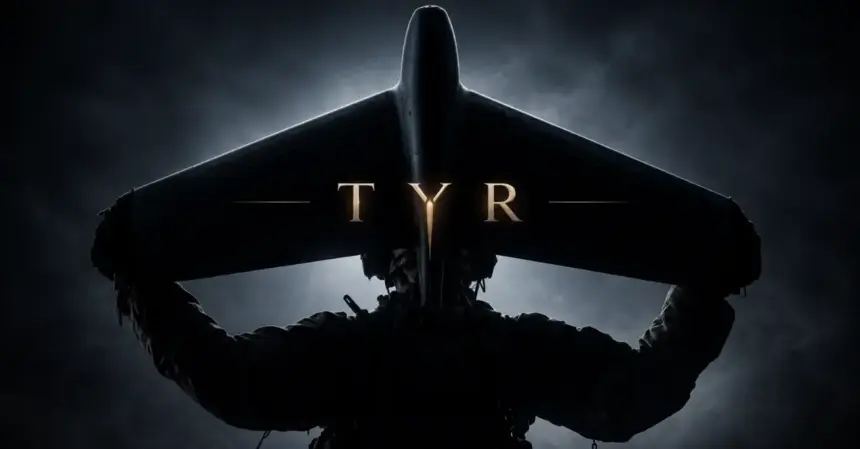
Washington, D.C. — October 12, 2026. In the aisles of the AUSA Annual Meeting & Exposition, the U.S. Army’s yearly flagship gathering, presentations follow one another at a steady pace. Amid the crowd of defense contractors, startups, and giants like Lockheed Martin or Northrop Grumman, a company barely two years old is drawing attention. It is called Heaviside Industries. Its product, the TYR, weighs less than 2.5 kilograms and claims it can kill a main battle tank.
This is no fireworks display. Heaviside has already carried out live-fire tests. According to the company, the TYR is currently under contract with customers of the U.S. Department of War. The message is clear: the miniaturization of precision-guided munitions is reaching a new level, with implications that extend well beyond the American market.
A binational startup with a singular profile
Heaviside is a U.S.-Norwegian startup just two years old. Its headquarters are in Los Angeles, but most of its engineering, development, and testing takes place in Norway, in partnership with the weapons manufacturer Nammo, which supplies the warheads and provides a test range for live-fire trials.
Nils Haagenrud, Heaviside’s chairman, sums up the company’s vision: “As adversaries massively adopt autonomous systems on the battlefield, American and allied forces must adopt technologies that extend their robotic advantage.” The company has about 70 employees and is actively hiring.
Its only publicly known contract to date is an IDIQ (indefinite-delivery, indefinite-quantity) agreement with a ceiling of $99 million, awarded under the U.S. Army’s REWSI (Rapid Electronic Warfare and Signals Intelligence) program. It is a notable signal of institutional confidence for such a young company.
🇺🇸 La guerre des drones change d’échelle ⚔️
👉 https://t.co/7kmyqsgybi2,5 kg pour frapper à 40 km ! Heaviside présente le TYR, affiché à moins de 100 000 $, capable d’engager plusieurs types de cibles, dont des chars
#Défense #Drones #USA #Heaviside #TYR #war #Guerre #Militaire https://t.co/MG0U44qyWK— Silicon Valley (@SiliconValleyMa) October 14, 2026
What the TYR can do
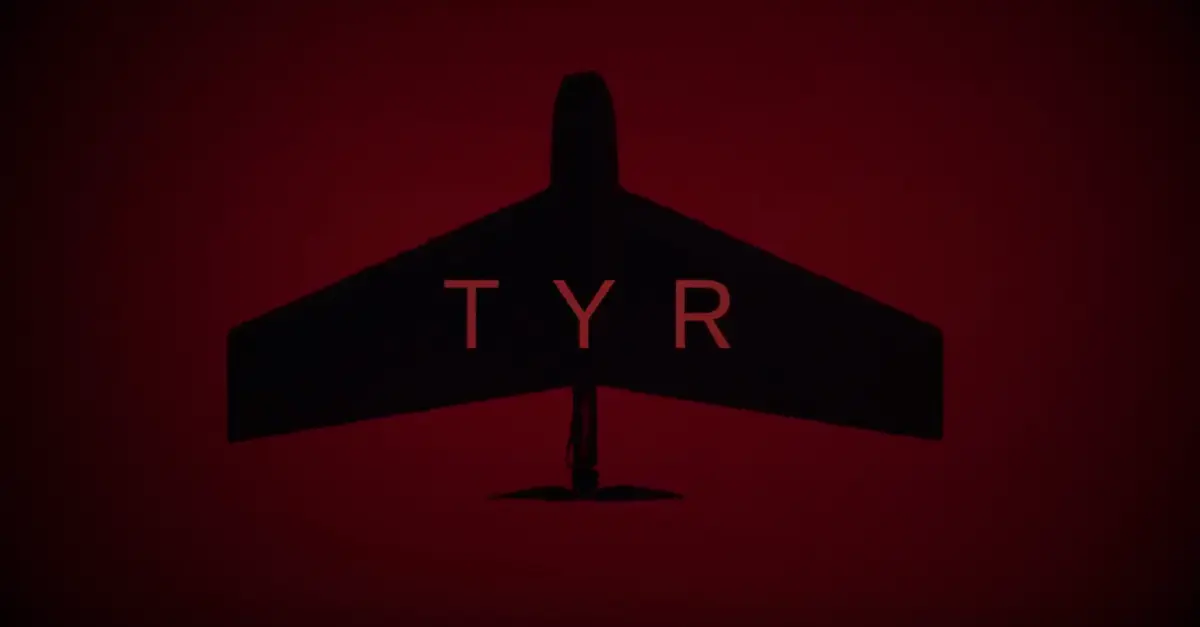
The TYR is a miniaturized fixed-wing loitering munition. Its range is about 40 kilometers, matching the maximum reach of its dual-band data link. The complete system — munition, radio link, ground control station, and launcher — weighs 15 pounds, or about 6.8 kilograms. The airframe alone weighs about 2.27 kilograms, and the warhead makes up roughly a third of that.
Technical specifications published by Heaviside Industries (October 2026)
- Air vehicle weight: approximately 2.27 kg (5 lbs)
- Complete system weight: under 6.8 kg (15 lbs)
- Range: over 40 km
- Maximum speed: over 240 km/h (150 mph)
- Endurance: 60 minutes
- Wingspan: 100 cm — length: 79 cm
- Available warheads: shaped-charge anti-tank, anti-structure, explosively formed penetrator (EFP), anti-personnel fragmentation
- Environment: designed to operate in GPS-jamming and communications-denied conditions
- Testing: live-fire tests completed, under DoD contract
The TYR’s warheads are all derived from Nammo’s M72 LAW series, with enough power to neutralize a main battle tank such as the T-72 or T-80. The TYR flies autonomously to the target area, begins to loiter, searches for a target, and when it identifies one, it alerts the operator, who has the final say. This is what specialists call the “human-in-the-loop” principle: artificial intelligence assists, but the final decision to fire rests with a human.
Ukraine as a laboratory, Norway as a testing ground
Heaviside designed and developed the TYR in part from lessons learned by Ukrainian forces and the U.S. Department of Defense during the early phases of the war in Ukraine, where loitering munitions proved unreliable because of GPS jamming and spoofing.
Haagenrud explains that he observed in that conflict the need for “something man-portable, compact enough to equip every soldier, and offering both the range and the penetrating power needed to neutralize a main battle tank.” This analysis, drawn directly from the field, shaped every design choice: the wings detach for easier transport, the batteries are integrated, and the launcher is reusable.
Trials have shown that the TYR can fly and detonate on targets at temperatures of minus 20 degrees Celsius, winter conditions typical of Norway. Climate resilience is no minor detail for a system meant to operate in Northern European, Central Asian, or high-altitude theaters.
The industrial partners involved include two British companies: Talos Technologies, which supplies the electric motor, and Raeon, which supplies the batteries. The TYR’s supply chain is therefore resolutely transatlantic — an asset at a time when the resilience of defense supply chains has become a political priority.
A market under tension, with well-established competitors
The market for loitering munitions and one-way effectors (OWE) has grown spectacularly over the past five years, with further growth forecast in the medium term. Heaviside is not entering this sector alone: AeroVironment, maker of the Switchblade, is the leading established American player.
AeroVironment recently won a $186 million order from the U.S. Army for its next-generation Switchblade systems, including, for the first time, variants fitted with blast-effect warheads. A $990 million IDIQ contract was also awarded to the manufacturer to meet infantry battalions’ needs for portable lethal munitions.
The TYR is positioned in a distinct segment: where the Switchblade 300 weighs less than a kilogram but has limited range, and the Switchblade 600 offers more power but at a higher weight and cost, Heaviside is trying to occupy a middle ground — long range, reduced weight, and warhead versatility.
Teledyne FLIR, Anduril, and European players such as Germany’s WB Group should also be mentioned, all present in this niche to varying degrees. Geopolitically, the Russian equivalents deployed in Ukraine — the Lancet and KUB-BLA — and Iran’s Shahed drones have shown that the proliferation of these technologies goes well beyond Western arsenals.
Pricing: still a blurry subject
The headline of the unveiling mentions a price target below $100,000. At this stage, a caveat is in order: Heaviside has said the TYR is “priced for mass deployment” but has not released an official price. The company clearly stands behind the goal of affordability, and its CEO Phillip Walker says he wants to “put precision strike in the hands of every warfighter.”
Phillip Walker stresses that the priority is “to be able to hit a target within one meter of accuracy, at an affordable price.” This pricing ambition directly echoes the lessons of the war in Ukraine, where the cost-effectiveness of loitering munitions has changed the very logic of attrition on the battlefield. A main battle tank costs several million dollars; a munition costing a few tens of thousands of dollars that can neutralize it represents a potentially structural economic imbalance.
The TYR is series-produced and intended to be manufactured in large numbers, a prerequisite for keeping its unit price within a range accessible to conventional armed forces.
Toward the democratization of precision strike
What stands out in the TYR’s presentation is less its raw performance — other systems achieve longer ranges — than its ambition of operational democratization. The guiding idea is to equip every soldier with a long-range strike capability, without depending on a heavy command architecture or costly weapons platforms.
The TYR can be used for ground and base defense, as a counter-drone system, or integrated onto larger unmanned systems. Drop tests from helicopters and light aircraft have already been carried out, trials from mid-sized UAVs are being considered, and integration onto naval platforms is also envisaged. Heaviside is also developing an unmanned underwater vehicle called Nyx, signaling a multi-domain ambition consistent with U.S. doctrinal directions.
The question of lethal autonomy, for its part, remains open. While Heaviside insists on human supervision in the firing decision loop, the TYR’s ability to automatically identify targets and notify the operator raises ethical and legal questions that are stirring international humanitarian law forums. The line between decision support and delegation of the decision is thin, and it will be tested more and more as these technologies spread.
In this context, the TYR is not merely a product. It is a symptom of a deep transformation of land warfare, where precision, partial autonomy, and low cost of access are redrawing the balance of power — including among states that cannot afford to maintain multibillion-dollar tank armies.
FAQ
What is a loitering munition?
A loitering munition, also called a kamikaze drone, is an autonomous or semi-autonomous flying vehicle that can patrol a given area before crashing into a designated target. Unlike a missile, it can loiter — that is, linger over the area — for several tens of minutes before engaging.
Can the TYR really destroy a modern tank?
According to Heaviside and its partner Nammo, the shaped-charge warheads derived from the M72 LAW are designed to penetrate the armor of tanks such as the Russian T-72 or T-80. Live-fire tests have been carried out, but Heaviside has not released detailed results against specific armored targets.
Why does Norway play a key role in this project?
Nammo, a Norwegian company partly owned by the Norwegian state, supplies the warheads and provides a test range for live-fire trials. Norway has suitable test areas and recognized expertise in precision munitions, which makes this partnership a concrete competitive advantage.
When will the TYR be available at scale?
Heaviside says the TYR is already under contract with customers of the U.S. Department of War and has completed its live-fire tests. Series production is the stated goal, but no publicly announced delivery schedule has been released at this stage.