



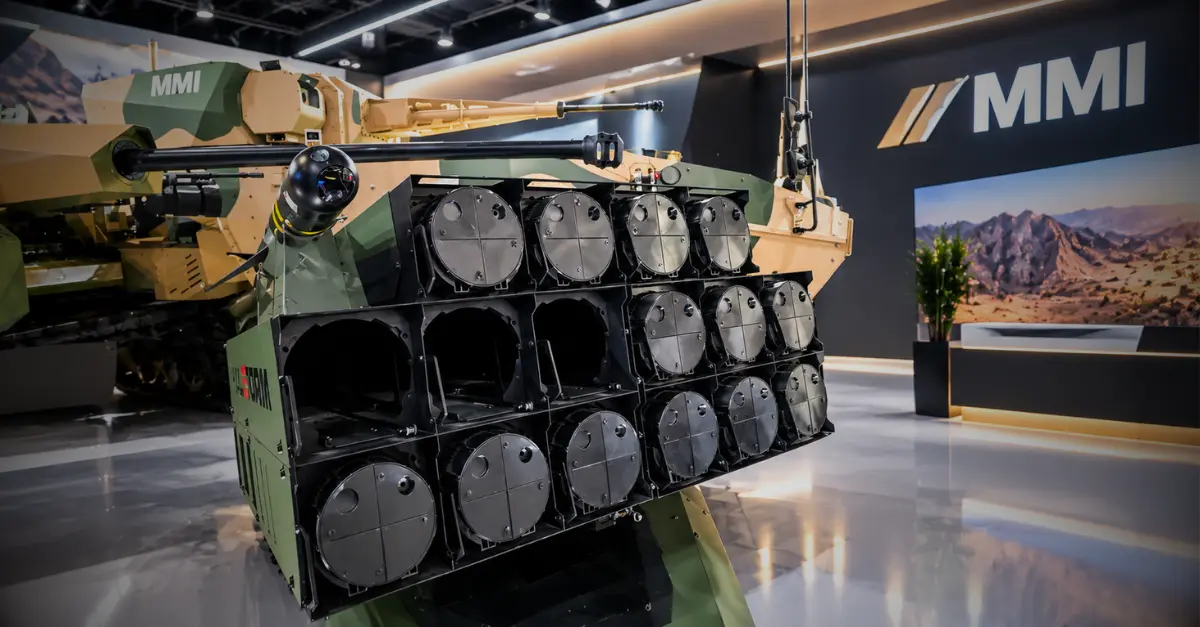
There are trade shows where you spot a trend, and others where a single piece of equipment sums up a change of scale. At the opening of the Marrakech Air Show this Wednesday, October 7, it was a multi-tube launcher on display at the MMI stand that caught my attention. Its name, HAILSTORM, is written on the side of the machine. Its official designation, visible on the plate placed in front of it, describes it as a multipurpose guided missile launcher system. According to information gathered at the show, it can also deploy loitering munitions.
Key takeaways
- MMI unveiled HAILSTORM at the Marrakech Air Show 2026.
- It is a multi-tube launcher, described as a multipurpose guided missile system.
- According to information gathered at the show, it can also use loitering munitions.
- Range, carrier vehicle and development status have not been made public.
A launcher unveiled at the heart of the show
The Marrakech Air Show runs from October 7 to 10 at the Royal Moroccan Air Force base, under the High Patronage of King Mohammed VI. This eighth edition highlights industrial sovereignty and “Made in Morocco”, two themes that give MMI’s presence particular resonance. The company, based in Casablanca, is no longer just an ammunition manufacturer: it is now showcasing a complete launch system.
Let me be clear from the outset about the limits of what I am reporting. I rely on photos taken on site, on the signage visible around the equipment and on information gathered on the occasion. I have not had access to an official technical data sheet. I therefore refrain from giving range, weight or performance figures, which appear neither in the images nor, to my knowledge, in any public document.
What the photos show
Here are the observable elements, which form the basis for everything else.
- A launch block arranged in stacked rows, with about sixteen visible tubes by my count, closed by circular covers; three slots are open and empty.
- Clear identification: the name HAILSTORM on the side, with a red “S”, and the plate reading “Multipurpose Guided Missile Launcher System”.
- A base that appears to pivot, suggesting a motorized aiming system, although I do not know its characteristics.
- Two munitions displayed nearby on transparent stands, one of them fitted with a spherical electro-optical seeker head.
- In the background, a turret bearing the MMI logo and a “30 mm medium cal” sign, pointing to the company’s medium-caliber ammunition range.
None of this says whether the system is in production, under testing or still at the demonstrator stage. A trade show mock-up is not delivered equipment.
MMI, from ammunition maker to systems integrator
To gauge the significance of this presentation, it is worth recalling who MMI is. The group comprises two sister companies, MMI Ammunition and MMI Weapon Systems, located in the MidParc industrial zone in Casablanca. The first makes 155 mm artillery ammunition and 30×173 mm cartridges, with a production unit in the Sidi Yahya free zone. It claims compliance with NATO STANAG standards and ISO 9001 certification. The second develops turrets, remote weapon stations, electro-optics and command systems.
A guided missile launcher extends this trajectory. It marks the move from ammunition to a complete system, with all the engineering that implies: structure, firing electronics, interface with the munitions, and integration on a carrier vehicle.
One caveat is in order, however. According to an article in the Moroccan outlet La Relève, which draws on findings from a specialized account, six ammunition references produced by MMI Ammunition also appear in the catalogs of the Israeli group Elbit Systems, with very similar designations and characteristics. I see this as a sign of industrialization built on partnerships or licenses, though the terms are not public. A Moroccan think tank, the IGH, also observes that no single partner covers the entire value chain.
Why combine guided missiles and loitering munitions
A guided missile targets an objective that has already been identified, with a very fast reaction time. A loitering munition, often called a kamikaze drone, patrols over an area, gives the operator time to identify a target, and then strikes it. The former favors speed, the latter persistence and flexibility of use.
Bringing these two families together on a single launcher follows a logic of efficiency. One platform, one support chain and one training pipeline make it possible to choose the effector according to the mission. Recent conflicts, in which loitering munitions have played a growing role, explain armies’ interest in this kind of versatility.
It does come at a technical cost. It requires rigorous software integration between the launcher, the munitions and the command post, as well as munitions qualified for the system. The question of their origin, domestic or imported, then becomes central.
A context of foreign purchases and industrial sovereignty
HAILSTORM arrives in a landscape undergoing a major shift. In April 2023, Washington approved the sale of 18 HIMARS launchers to Morocco, at an estimated cost of $524.2 million, along with 40 ATACMS missiles and GMLRS guided rockets. According to specialized media reports relayed in September 2026, ten launchers are now under contract. The Royal Armed Forces also operate Elbit’s PULS rocket launcher, reported in service since 2023, and Elbit announced in February 2026 a Moroccan order for 30 mm turrets worth $277 million.
In the loitering munitions segment, several signals point the same way. The defense press reports that a young Moroccan company, Aerodrive Engineering Services, has reportedly won a contract for 500 munitions of this type, and BlueBird Aero Systems has announced local production of its Spy-X model with industrial transfer. Against this backdrop, a Moroccan launcher able to use several types of munitions fits into a broader strategy: buying high-end systems abroad while building a national industrial base.
Possible readings
One reading sees HAILSTORM as a logical step in the country’s industrial build-up. Mastering the munition, then the system that fires it, reduces dependence on foreign suppliers and secures supply, which matters at a time of regional tensions and high global demand for ammunition.
The other calls for restraint. A trade show demonstrator says nothing about the system’s maturity, its testing or any eventual order. Fully integrating a launcher, with guidance, data links and munition qualification, is far more demanding than manufacturing a projectile. How much of the design is genuinely national remains hard to establish at this stage.
On the strategic front, finally, opinions differ. Some see a coherent deterrence tool in light of the drone threat in the region, others an additional driver of an arms race. This debate goes well beyond the case of HAILSTORM, and the available evidence does not allow it to be settled.
What remains to be confirmed
Several questions remain open: the intended carrier vehicle, the precise types of missiles and loitering munitions that are compatible, the range, the origin of the munitions, the stage of development and the existence of a customer. The remaining days of the show, and any documentation MMI may publish, should provide answers. I will return to the subject as soon as verifiable information becomes available.
FAQ
What is HAILSTORM?
It is a multi-tube launch system presented by MMI at the Marrakech Air Show 2026. Its display describes it as a multipurpose guided missile launcher.
Can HAILSTORM launch loitering munitions?
According to information gathered at the show, yes. The plate visible on site mentions only guided missiles, and the compatible munitions have not been detailed publicly.
Is MMI a Moroccan company?
Yes, MMI is based in Casablanca and comprises MMI Ammunition (ammunition) and MMI Weapon Systems (turrets, weapon stations, integration). Some of its munitions do, however, have equivalents in Elbit Systems’ catalog.
Is HAILSTORM already in service with the Moroccan army?
None of the information consulted confirms it. At this stage, it is equipment presented at a trade show.