


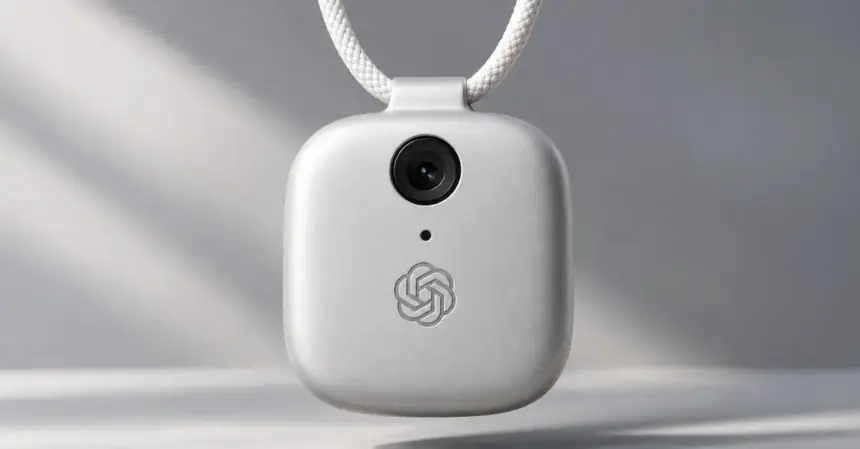
Some plot twists are so improbable that even a Silicon Valley screenwriter wouldn’t dare write them. Jony Ive, the designer who gave the iPhone its face, is now working with Sam Altman, the head of OpenAI, on an object meant to pull us away from screens. I’ll admit I read the news twice before believing it. Jony Ive’s smartphone has shaped our habits for nearly twenty years, and its creator is now taking on his own legacy.
Key takeaways
- Jony Ive and OpenAI are preparing a screenless AI device, presented as a “companion”.
- According to Bloomberg, it would cost between $300 and $400. OpenAI has confirmed nothing.
- Delivery is not expected before the end of February 2027, according to a court filing.
- Meta is betting on the Muse Charm, an AI keychain with a small screen, due in December.
- The challenge remains the same: to win people over without watching them around the clock.
The question is whether we are witnessing an industrial redemption or simply a displacement of the problem.
What we really know about the Jony Ive and OpenAI device
Let’s start with the facts, because the subject has already produced its share of rumors. In May 2025, OpenAI announced the acquisition of io, the start-up founded by Jony Ive, for roughly $6.5 billion. Ive’s design studio, LoveFrom, is leading the design. The project is run with former Apple executives, including Tang Tan, a veteran of the iPhone and the Apple Watch.
Since then, information has trickled out. According to Bloomberg, the first device would take the form of a compact ring, about the size of a hockey puck, powered by a battery. It would be fitted with microphones, a camera and sensors designed to read its surroundings, but no screen. Some of its parts would reportedly move on their own to signal that it is listening or responding. The same sources point to a price between $300 and $400.
OpenAI has confirmed none of these features. They should therefore be read as credible leaks, not as a spec sheet.
As for the timeline, a court filing in the trademark dispute between OpenAI and the audio start-up iyO indicates that the device will not ship before the end of February 2027. The original target was the end of 2026.
A “companion” rather than a replacement
This is the first point where the title of this article deserves some nuance. Does Jony Ive really want to kill the smartphone? Nothing we know says so. The reporting, notably by WIRED, describes a screenless device designed to work alongside the phone and the computer, not in their place. Ive and Altman have themselves spoken of a “third device” and a “family of devices”.
The nuance matters. For now, the smartphone remains the gateway to our digital lives: payments, navigation, messaging, photos. No screenless object has yet managed to dethrone it, as the failures of the Humane AI Pin and the Rabbit R1 showed. Both gadgets, sold as successors to the phone, disappointed because they did no better than it did.
So I’ll say it plainly: “killing the smartphone” is a columnist’s phrase, not an announced strategy. What Jony Ive and Sam Altman are aiming for is to install a new habit next to the old one, and then, perhaps, to watch it nibble away at it.
The promise of calm, and its irony
The official argument is appealing. Jony Ive and Sam Altman describe a more “peaceful” object that would free us from the attention screens capture. Ive himself has acknowledged on several occasions a share of responsibility for the compulsive use of the smartphone. A designer publicly owning up to the side effects of his own work is rare enough to be worth noting.
But the irony is hard to miss. The man who designed the most ubiquitous object of recent history proposes to detox us from it by selling us another device. For more than $300, no less.
More troubling still, the promise of calm rests on a mechanism that raises its own questions. To anticipate our needs without ever asking for our gaze, the object has to observe us continuously: to see, to hear, to remember. The silence of the screen is paid for with the constant presence of sensors.
A tech journalist has to ask the question frankly. Is a device that listens and watches in the background really less intrusive than a screen you can switch off? In Europe, regulators will scrutinize this point. France’s data protection authority, the CNIL, has already forced the suspension of sales of the AI pendant from the start-up Friend in France, a reminder that European law cannot be sidestepped.
Meta and OpenAI, two opposing bets on the post-smartphone era
The parallel with Meta is instructive. At the end of September 2026, at its Connect conference, Mark Zuckerberg unveiled the Muse Charm, a small device that clips onto a keychain or a bag. According to the specialist press, it runs Meta’s Muse AI agent, has a touchscreen of about two inches and 5G, and unlocks with a fingerprint sensor. It is due out in December. The product has been compared to a next-generation Tamagotchi, with an animated avatar you can customize.
Here is how I read the difference between the two approaches:
- OpenAI and Jony Ive are betting on the absence of a screen, ambient AI and an object placed in the home, with a launch expected in 2027.
- Meta is betting on a pocket companion with a small screen, an avatar and immediate availability, with a launch announced for December 2026.
- Common ground: both want a dedicated AI object that no longer depends on the smartphone’s screen to be useful.
The two visions differ in form, but they start from the same observation. The smartphone has become a mature market, dominated by Apple and Google, and AI labs want an access point of their own. Whoever controls the hardware controls the relationship with the user, the data that flows from it and, ultimately, the bill. For OpenAI, which today depends on phones made by others, the strategic stakes are considerable.
The obstacles we would be wrong to underestimate
I remain cautious about the chances of success, for at least three reasons.
First, the sector’s track record is harsh. The standalone AI gadgets launched in recent years have all struggled to convince. They were either redundant with the phone or too limited to justify an extra purchase. The announced price of OpenAI’s device puts it above most mainstream smart speakers.
Second, the legal question. Apple has taken legal action against OpenAI, accusing it of using trade secrets. OpenAI disputes the allegations. The outcome of this case could weigh on the timeline, even if nothing indicates at this stage that it would block the launch. The trademark dispute with iyO, for its part, has already led OpenAI to drop the name “io”.
Finally, usage. An object meant to “anticipate your needs” without a screen requires a reliable AI, capable of understanding context without getting it wrong. But an assistant that makes mistakes with no screen to correct them is more frustrating than one that makes mistakes on a screen you can check. The absence of a visual interface forgives no error.
A detox that remains to be proven
At bottom, the question is not technical but behavioral. Reducing screen addiction requires changing our habits, not just our objects. Yet the companies offering us these new devices live off our attention, our data or our subscriptions. Their interest is not to make us let go, but to move the point of contact.
That said, I don’t think the project should be waved away. Jony Ive has proven in the past that he knows how to create objects that change habits. And the idea of a less invasive technology answers a real demand, measurable in the success of “do not disturb” modes and simplified phones.
But the test will not be the elegance of the object. It will be its ability to give us back time without asking us to hand over, in exchange, constant surveillance of our daily lives. In 2027, we will know whether recess is truly over, or whether we have simply been moved to a different playground.
FAQ
When will the Jony Ive and OpenAI device be released?
According to a court filing, not before the end of February 2027. OpenAI had originally targeted the end of 2026.
How much will it cost?
OpenAI has not announced a price. According to Bloomberg, it would be between $300 and $400. An earlier leak pointed to $200 to $300.
Will the device replace the smartphone?
Nothing indicates so for now. The available information describes it as a screenless companion, meant to work alongside the phone and the computer.
How is Meta’s Muse Charm different?
It is a pocket device with a small touchscreen, an animated avatar and 5G. Meta announced it for December, while OpenAI’s device is expected in 2027.