


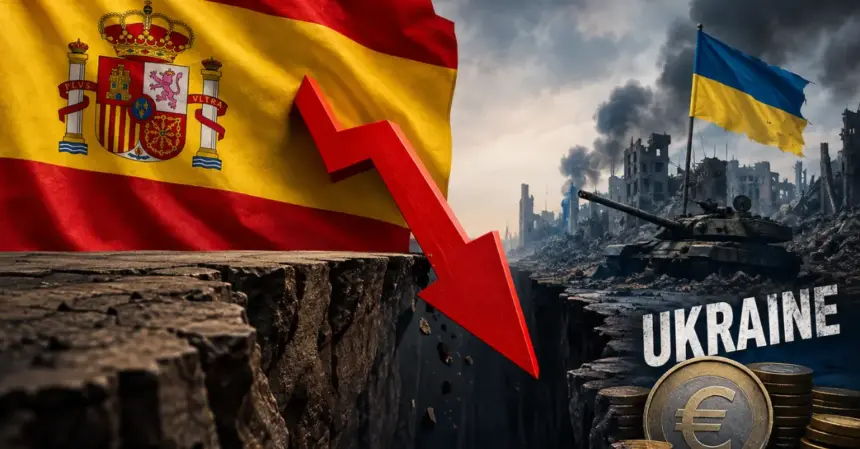
Over three years, Spain’s direct commitment to Ukraine now stands at around three billion euros.
That figure alone would remain manageable for the eurozone’s seventh-largest economy. The real issue lies elsewhere: this aid is layered on top of an accelerated, costly overhaul of Spain’s own defense budget, financed under increasingly tight fiscal conditions.
the express catch-up straining the books
Spain started from a very low base: 1.28% of GDP spent on defense in 2024, the lowest level in the entire NATO alliance. In one year, the country raised that spending by 43%, going from 22.7 to 33.1 billion euros, reaching 2% of GDP in 2025. It is this pace of catch-up, more than the amount itself, that raises concern.
Because much of this acceleration has happened without a parliamentary vote. With no budget passed since 2023 — the 2023 budget having been rolled over year after year — the Spanish government has relied on extraordinary credits to inject additional billions into defense, bypassing the parliamentary deadlock.
Madrid’s own admission to Brussels
The clearest signal comes from Spain itself. In April 2026, Madrid asked the European Commission to activate the national escape clause on defense spending for the 2025-2028 period — a mechanism that allows part of military spending to be excluded from the deficit calculation under EU fiscal rules. In its own request, Spain acknowledges that the rise in its defense spending between 2024 and 2025 has worsened its public balance, and that continuing this effort on the current trajectory will increase public debt and widen the deficit.
This comes on top of a fiscal situation that remains, overall, better positioned than that of its neighbors, but is losing headroom: Spain’s public deficit is expected to sit around 2.4% of GDP in 2025 and could rise to 2.6% in 2026, before stabilizing below the 3% threshold — with an increasingly narrow margin as interest payments, defense, and an aging population all push spending up at once.
a capability risk, not just a budgetary one
This financial pressure has an operational counterpart. A note from the French Institute of International Relations (Ifri), published in December 2022, points out that support for Ukraine has drawn heavily on the operational capacity of European armed forces already stripped down after three decades of budget cuts, with some systems withdrawn from service for lack of sufficient depth in equipment stocks. Spain is no exception: every transfer of equipment to Kyiv reduces, at least temporarily, what its own forces would have on hand in the event of a simultaneous engagement.
the worst-case scenario: direct involvement
This reasoning can be extended by deduction. Should the conflict spread beyond Ukraine and directly involve Spain as a NATO member — through Article 5, for instance — the indirect aid provided so far would give way to full military engagement. Such a scenario would mechanically involve human losses within the Spanish armed forces, along with a financial cost far beyond current aid packages: larger-scale troop mobilization, urgent replacement of equipment destroyed in combat rather than simply transferred, and sustained wartime spending over time. A defense budget already under strain, and partly financed without a parliamentary vote, would then face pressure of an entirely different magnitude than what is seen today.
the arguments that temper the risk
This reading is not unanimous. Several economic analyses point out that:
- Spain’s nominal growth remains higher than its average cost of debt, giving it borrowing capacity without an immediate deterioration of its debt-to-GDP ratio;
- part of the 2026 financing runs through the EU’s SAFE instrument, which pools the cost at the community level;
- the exemption Spain secured from NATO’s 5% target limits, for now, the scale of the trajectory it must finance compared with other member states.
outlook
The equation remains fragile: it depends on growth staying strong, tax revenue keeping pace, and the government’s ability to eventually return to a voted budget. Until those conditions are met, aid to Ukraine acts as an accelerant for a budgetary trend Madrid has already documented to Brussels — without even factoring in the heavier hypothesis of direct involvement of its own forces.
Trump’s threat to Spain
FAQ
Has Spain acknowledged that its defense spending is hurting its public finances?
Yes. In its April 2026 request to the EU to activate the national escape clause, Madrid states that the rise in its defense spending between 2024 and 2025 worsened its public balance and will increase its debt.
How is Spain financing its rise in military spending without a voted budget?
With the 2023 budget having been rolled over since, the government has used extraordinary credits to increase defense spending, bypassing the parliamentary deadlock.
Is there a consensus among economists on this budgetary risk?
No: some analyses consider the trajectory sustainable, thanks to nominal growth outpacing the cost of debt, for as long as that holds.