


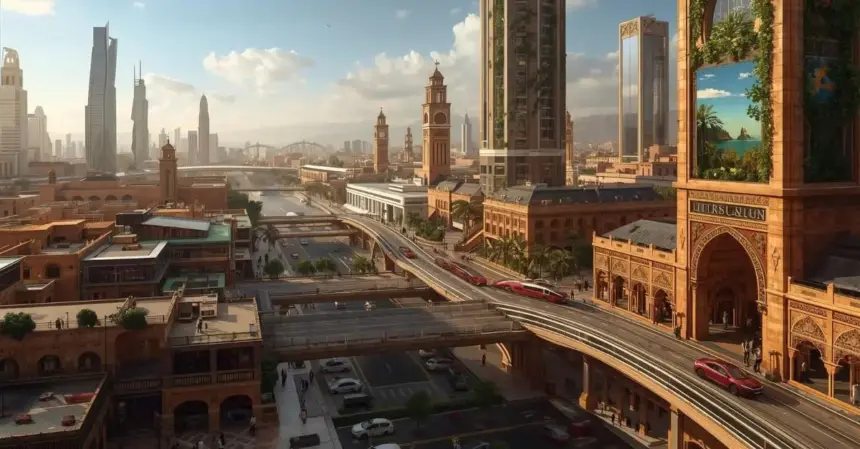
Urban planning in Morocco is currently undergoing an unprecedented mutation, driven by an ambitious royal vision and pressing ecological imperatives. By observing current construction sites, from Casablanca to Tangier, we can already discern the outlines of tomorrow’s metropolis. What will Moroccan cities look like in 2040? This is no longer a question of science fiction, but a reality taking shape through digitalization, sustainable mobility, and an architecture that attempts to reconcile modernity with ancestral heritage. The Kingdom is preparing to host global events, such as the 2030 World Cup, which serve as catalysts for these deep structural changes.
By 2040, Moroccan urban planning will no longer be limited to simple concrete expansion. We are witnessing a transition toward the smart city, where the management of water, energy, and transport flows is optimized by artificial intelligence. Saturated city centers are giving way to eco-districts where priority is given to pedestrians. The challenge is immense: housing a growing urban population while preserving natural resources. This 2040 vision relies on planning that integrates renewable energy directly into the heart of the building, transforming every apartment block into a power generation unit.
Evolution of the Moroccan Smart City
The concept of the smart city in Morocco will no longer be a marketing label in 2040, but an invisible and indispensable infrastructure. Today, projects like Zenata or the Green City of Benguérir are laying the groundwork for what the daily life of citizens will be. Imagine streets where public lighting adjusts in real-time based on human presence, and where waste collection is regulated by fill-level sensors. This technological optimization allows for a drastic reduction in municipal management costs while improving the quality of life for residents, who are often exhausted by noise and pollution.
The management of scarcity, particularly water, will become the central pivot of urban planning. In 2040, distribution networks will be equipped with ultra-sensitive leak detection systems, and wastewater recycling will be the norm for watering urban green spaces. Morocco, the African leader in energy transition, will massively integrate photovoltaics into the facades of official and residential buildings. 6G or 7G connectivity will allow for fluid road traffic management, almost entirely eliminating the legendary traffic jams of the major arteries of Casablanca or Rabat through dynamic regulation.
Integration of Technology in Buildings
Construction materials will change radically to meet thermal performance challenges. In 2040, more bio-sourced materials and low-carbon concretes will be used, capable of storing night-time coolness to release it during peak heat. Moroccan architecture of the future will make intensive use of BIM (Building Information Modeling), allowing the climate impact of a neighborhood to be simulated before it even breaks ground. This will ensure better air circulation, essential for fighting the increasingly frequent urban heat islands.
Social housing itself will undergo a qualitative revolution. No more monolithic, soul-less blocks; 2040 urban planning favors functional mixing. The same building will house apartments, offices, and service spaces. Rooftop terraces, once simple areas for drying laundry, will become hanging gardens or productive urban farms. This reclamation of vertical space is a direct response to urban sprawl that threatens peripheral agricultural lands, a crucial issue for the country’s food security.
Sustainable Mobility and Decarbonized Transport
The face of Moroccan cities in 2040 will be marked by the end of the hegemony of the individual thermal car. The massive deployment of the tramway and High-Level Service Bus (BRT) in all metropolises will have transformed habits. Mobility will be soft and shared. Secure bike lanes, shaded by climate-resilient trees, will connect peripheral neighborhoods to nerve centers. The high-speed train (Al Boraq) will be the true backbone of the country, connecting Agadir to Tangier in a few hours, facilitating intercity exchanges.
The “last mile” will be ensured by micro-mobility electric solutions. In 2040, historical centers like the Medinas of Fez or Marrakech will be totally pedestrianized, with delivery services provided by drones or small autonomous electric vehicles. This decarbonization of urban transport is not only ecological, it is also economic, reducing Morocco’s dependence on imported hydrocarbons. Electric vehicle charging infrastructure will be omnipresent, integrated into urban furniture and mandatory underground parking under every new construction.
High-Performance Multimodal Transport Network
To succeed in this transition, Morocco is betting on perfect intermodality. A single pass will allow users to switch from the train to the tram, and then to a bike-share. Here are the pillars of this new mobility:
-
Extension of aerial metro lines or monorails in high-density areas.
-
Generalization of “meeting zones” where speed is limited to 20 km/h to favor pedestrians.
-
Development of smart park-and-ride lots on the outskirts to encourage leaving the car behind.
-
Use of electric buses powered by regional solar plants.
-
Creation of green corridors dedicated exclusively to non-motorized transport modes.
Climate Resilience and Green Spaces
Facing climate change, 2040 urban planning must imperatively be “spongy.” Moroccan cities will learn to capture every drop of torrential rain to recharge urban aquifers. Urban parks will no longer be just places for leisure, but true thermal and water regulators. We will see “urban forests” appearing in the heart of Casablanca, capable of lowering the temperature by 3 to 5 degrees during heatwaves. This nature in the city has become a strong social demand for the mental and physical health of city dwellers.
The protection of coastlines will also be a major priority. With rising sea levels, cities like Casablanca, Tangier, or Agadir will have to rethink their waterfronts. 2040 developments will prioritize natural protections, such as restoring dunes or creating landscaped dikes, rather than simple concrete walls. Coastal urbanism will be more flexible, capable of adapting to marine hazards while offering quality public spaces, favoring tourism and the well-being of local residents.
Massive Vegetation Strategy
The plant palette of cities will change. Water-hungry lawns will be abandoned in favor of dry gardens and local species like the argan tree, carob, or olive, which are better adapted to water stress. In 2040, every citizen should be less than a 10-minute walk from a quality green space. These biodiversity zones will serve as refuges for local fauna and lungs for increasingly dense cities. The urban canopy will be scrupulously mapped and protected by strict urban planning laws, prohibiting any tree cutting without immediate and multiplied compensation.
Architecture Between Tradition and Modernity
The visual identity of the Moroccan city in 2040 will be a clever blend of futuristic lines and patrimonial reminders. Architects are rediscovering the virtues of the patio and the mashrabiya, no longer just for aesthetics, but for their formidable efficiency in natural ventilation. Raw concrete will sit alongside compressed earth and local stone—materials with a low carbon footprint. Facades will be “active,” capable of filtering light and producing energy thanks to transparent photovoltaic glass, a technology that has become affordable and standard.
The rehabilitation of the Medinas will remain a major challenge. In 2040, these historical hearts will be hubs of artisanal and technological innovation, connected to the rest of the city while keeping their soul. We will witness a phenomenon of managed gentrification, where young entrepreneurs choose to settle in old houses for their natural thermal comfort and unique living environment. Moroccan urban planning will have won its bet: not becoming a copy of Western metropolises, but asserting a singular Mediterranean and African model, turned toward the future.
Renaissance of Local Materials
The use of local materials will become a regulatory requirement. The use of compressed earth blocks (CEB) or hemp for insulation will become widespread in peri-urban constructions. These traditional techniques, updated by modern engineering, offer thermal inertia that cement cannot match. In 2040, Morocco will be cited as an example for its ability to modernize its ancestral know-how to meet global sustainable development challenges, creating a recognized international architectural signature.
Governance and Citizen Participation
The urban planning of 2040 will also be co-constructed. Thanks to digital platforms and augmented reality, citizens will be able to visualize and vote for the development projects in their neighborhood. Local governance will be more agile, capable of reacting quickly to the needs of residents. Municipalities will have “digital twins” of their cities—complex 3D models allowing the impact of a new road or a large building on sunlight and wind to be tested before the first stone is laid.
This transparency will strengthen the bond of trust between the administration and the citizens. Participatory budgets will allow for the funding of local projects: a community garden here, a playground there. Social inclusion will be at the heart of urban policies, aiming to reduce the fractures between wealthy neighborhoods and precarious zones. In 2040, the concept of the inclusive city will be a tangible reality, with infrastructure accessible to everyone, regardless of income or physical ability, making Morocco a model of urban social cohesion.
Participatory Urban Management Tools
The use of Big Data will allow for the anticipation of needs in school or health infrastructure. If a neighborhood sees its population getting younger, planning algorithms will automatically suggest the creation of a nursery or a cultural center. This predictive planning will avoid the multi-year lags we know today between the arrival of residents and that of basic services. The city of 2040 will be organic, capable of evolving in real-time according to internal migration flows and the demographic changes of the Kingdom.
FAQ on the Urban Future
Which cities will be the most modern in Morocco in 2040? Casablanca will remain the economic engine with its financial hub, but Tangier and Rabat will position themselves as leaders in sustainability and quality of life. Zenata and the Benguérir hub will be the country’s technological laboratories.
Will housing be more affordable in 2040? The industrialization of construction and the use of local materials should help stabilize costs. However, it is primarily the reduction in energy bills (insulation, solar) that will increase the real estate purchasing power of Moroccan households.
How will water management impact urban planning? It will be the limiting or facilitating factor for any project. No building permit will be issued without a strict plan for rainwater harvesting and consumption limitation, making cities much more economical and resilient.
Will cars disappear from Moroccan cities? They will not disappear, but their place will be drastically reduced in city centers. Cars will be electric, often shared, and their use will be supplemented by an ultra-efficient public transport network that will make owning a personal vehicle less essential.