

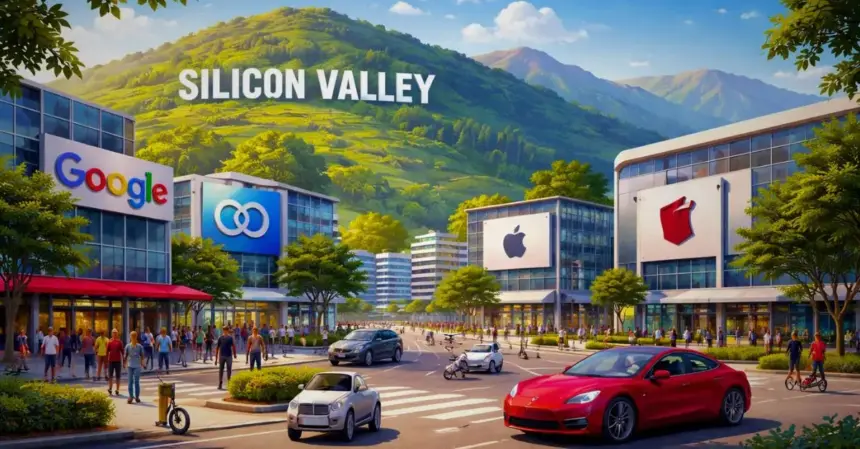
The True History of Silicon Valley Explained doesn’t begin in a glass office in Palo Alto, but in the mud of apricot orchards in Santa Clara County. Before becoming the global epicenter of innovation and technological wealth, this region was merely a peaceful agricultural expanse south of San Francisco. To understand how a few acres of land became the engine of the global economy, one must return to the roots of a boundless ambition.
- The technological awakening under Stanford’s impulse
- The arrival of semiconductors and the founding betrayal
- The personal computing revolution and the rebel spirit
- The Internet era and the triumph of algorithms
- The Venture Capital ecosystem and innovation finance
- Artificial Intelligence and new ethical challenges
- FAQ on the Silicon Epic
This narrative is one of visionaries, rebels, and military interests that converged to create a unique ecosystem. It is not just a series of inventions; it is a profound mutation of human society through the medium of silicon. Let us dive into the details of this fascinating epic where risk and genius met to shape our digital present.
The technological awakening under Stanford’s impulse
It all truly began thanks to the vision of Frederick Terman, Dean of the School of Engineering at Stanford University in the 1940s. Realizing that young graduates were systematically leaving for the East Coast to find work, he decided to transform the university’s land into an industrial park. His goal was simple: to create an organic link between academic research and the business world. This is where the concept of technology transfer was born, a fundamental pillar of Silicon Valley.
Terman encouraged his students, including William Hewlett and David Packard, to found their own company on-site rather than going into exile. With a starting capital of only 538 dollars and a small garage in Palo Alto, they laid the first stone of what would become an empire. This garage is now a historical landmark and symbolizes the founding myth of the “start-up.” The influence of Stanford has never wavered, still providing the constant flow of brains necessary for innovation today.
Financial support from the U.S. military during World War II and the Cold War also played a catalyst role. The government was desperately seeking advanced radar and communication technologies. Silicon Valley was not yet a software hub, but a cutting-edge military research center. This financial windfall allowed for the funding of heavy research infrastructures that the private sector could never have assumed alone.
The arrival of semiconductors and the founding betrayal
The decisive turning point occurred in 1956 when William Shockley, co-inventor of the transistor, returned to settle near his mother in Mountain View. He founded Shockley Semiconductor Laboratory, attracting the best talent in the country. However, his tyrannical and paranoid management style pushed eight of his brilliant engineers to resign. This group, famously known as the “Traitorous Eight”, would change the face of the world by founding Fairchild Semiconductor.
Fairchild became the “stem cell” of the region. From this company, dozens of other firms were born, including Intel, founded by Robert Noyce and Gordon Moore. During this period, journalist Don Hoefler used the term “Silicon Valley” for the first time in a 1971 article series. Silicon, the basic material for microprocessors, permanently replaced vacuum tubes, allowing for an unprecedented miniaturization of integrated circuits.
This culture of professional mobility became a trademark of the region. Unlike the East Coast, where loyalty to a company was the norm, the Valley established a culture of fierce competition and informal knowledge sharing. Success was no longer measured by seniority, but by the ability to disrupt the market with a new idea, often at the expense of one’s former employer.
The personal computing revolution and the rebel spirit
In the late 1970s, a wind of freedom blew over California. The Homebrew Computer Club brought together hobbyists dreaming of putting the computing power of mainframes, then reserved for governments and big banks, into the hands of individuals. It was in this soil of counter-culture that Steve Jobs and Steve Wozniak tinkered with the Apple I. They didn’t just sell a machine; they sold a promise of individual empowerment.
The graphical user interface, the mouse, and icons, though invented at Xerox PARC in Palo Alto, were popularized by Apple and then Microsoft. This period marks the transition from a hardware industry to one dominated by user experience. The Valley then became synonymous with design and genius marketing, capable of transforming complex technical objects into desirable consumer products.
Here are some key elements explaining the dominance of this region at that time:
-
The presence of venture capitalists ready to bet on crazy ideas.
-
California legislation favorable to employee mobility.
-
A conducive climate for informal exchanges in bars and cafes.
-
An exceptional tolerance for failure, viewed as a necessary step toward success.
The explosion of home computing led to massive infrastructure growth. Data centers began to bloom, and the first networks linking universities laid the foundations for what we know today as the Internet. Every decade brought a new layer of innovation, turning the region into a permanent laboratory in the open air.
The Internet era and the triumph of algorithms
In the 1990s, Silicon Valley began its most radical transformation with the advent of the World Wide Web. Netscape launched its browser and ignited a digital gold rush like never before. Money flowed, stock valuations soared, and the “dot-com” concept became the center of all attention. This was the era when companies like Yahoo, eBay, and soon Google redefined how we access information.
Google, founded by Larry Page and Sergey Brin in another iconic garage, introduced the concept of algorithmic relevance. By indexing the world, they created a new economic model based on targeted advertising and data. Silicon Valley was no longer just making objects; it was processing information flows. This software dominance allowed for scales of growth never before seen in human history.
The 2000 dot-com bubble, while devastating for many, did not kill the region. On the contrary, it acted as a purifier, leaving only the most solid models. From these ashes, Web 2.0 was born, driven by interactivity, social networks like Facebook, and the sharing economy. The Valley then became the center of gravity for global culture, dictating our modes of communication and consumption.
The Venture Capital ecosystem and innovation finance
One cannot understand Silicon Valley without talking about Sand Hill Road. This street in Menlo Park is home to the world’s largest Venture Capital firms. These financiers are not traditional bankers; they are often former entrepreneurs who understand technology and accept losing their stake in nine projects to find the one that will be the next “unicorn.”
This funding model created a virtuous cycle: profits from past successes are immediately reinvested into new start-ups. This creates a constant acceleration of the innovation cycle. Money is not just fuel; it is also a network. A renowned investor brings strategic contacts, hiring advice, and immediate credibility to the market.
The impact of this system is seen in the numbers. Today, Silicon Valley accounts for several trillion dollars in market capitalization. If it were a country, it would rank among the world’s largest economies. But this wealth also hides glaring social disparities, with the cost of living becoming prohibitive. This is the other side of unbridled growth.
Artificial Intelligence and new ethical challenges
Today, we are entering a new phase of the true history of Silicon Valley explained: that of generative artificial intelligence. Companies like OpenAI, backed by giants like Microsoft, are leading a technological arms race. Silicon is still there, but it is now used to train neural networks capable of simulating human thought.
The challenges have changed. We no longer ask if the technology is possible, but if it is desirable or safe. Issues of privacy, misinformation, and labor automation are at the heart of debates. The giants of the Valley, once perceived as liberators, are now scrutinized by regulators worldwide. The power they have accumulated exceeds that of many sovereign states.
Yet, despite the criticism, the attraction to this territory remains intact. Engineers from around the world continue to flock there, drawn by a unique concentration of talent. The mix of technological determinism and Californian optimism continues to produce solutions to the most complex problems, from energy transition to space exploration.
FAQ on the Silicon Epic
Why is Silicon Valley located in California?
The choice of California is explained by a combination of factors: the pleasant climate attracting engineers, the presence of Stanford University, and massive military grants after 1945. California law, which does not recognize non-compete clauses, also allowed employees to leave their companies to create their own structures, fostering rapid innovation.
Who invented the name Silicon Valley?
Journalist Don Hoefler popularized the name in 1971. He was looking for a catchy title for a series of articles about electronic chip manufacturers. “Silicon” refers to the material used in semiconductors, and “Valley” to the Santa Clara Valley.
Is Silicon Valley in decline today?
While remote work and rising costs have pushed some companies to leave, the region remains the undisputed leader in patents and fundraising. Its ability to reinvent itself, particularly with AI, proves its ecosystem is extremely resilient.
What was the first company in Silicon Valley?
Hewlett-Packard (HP) is often considered the founding company. Created in 1939 in a garage, it was the first to embody the spirit of collaboration between the university and private industry.