

The announcement that the 1930 centennial edition will be hosted across three continents has placed the Morocco 2030: Political Stakes of Organizing the World Cup at the very heart of international geopolitical discussions. By co-hosting the FIFA World Cup with Spain and Portugal, the North African Kingdom is doing much more than preparing a football tournament. It is the definitive validation of a long-term soft power strategy initiated over two decades ago. This colossal project is a bridge between Africa and Europe, signaling Morocco’s emergence as a stable, modern, and indispensable mediator on the global stage.
For Rabat, the stakes of the 2030 World Cup are deeply transformative. Since its first unsuccessful bids in the 1990s, the country has patiently built its credibility through massive infrastructure projects and diplomatic outreach. Today, organizing this event acts as a catalyst for structural reforms and a powerful lever for political legitimacy. The objective is to demonstrate Morocco’s capacity to manage massive global flows while projecting an image of a nation that is no longer just a spectator of globalization, but a primary driver of it.
The impact of this event is being felt long before the first whistle. Massive investments in infrastructure, such as the extension of the TGV (High-Speed Train) to Marrakech and Agadir, and the construction of the Hassan II Grand Stadium in Casablanca, showcase a political will for profound national renovation. Beyond the concrete and steel, a battle for influence is being fought to consolidate Morocco’s position as the natural gateway between the Atlantic, the Mediterranean, and the African continent.
Sports diplomacy as a tool for national sovereignty
In Morocco, football has always been more than a national sport; it is a tool for social cohesion and a vehicle for international recognition. By securing the World Cup organization, the Kingdom strengthens its diplomatic posture, particularly regarding sensitive regional issues. The massive support from African and Arab federations for this joint bid proves that Morocco has successfully positioned itself as the standard-bearer for the ambitions of the Global South. The Morocco 2030 project is thus a heavyweight political argument confirming the country’s internal stability in a complex region.
This FIFA recognition provides an unprecedented global platform. Every stadium and host city will become a showcase for Moroccan culture and organizational expertise. The country uses sports to “normalize” its presence in the elite club of nations capable of hosting planetary events. This sports diplomacy also facilitates smoother relations with European partners, Spain and Portugal, turning historical neighborly rivalries into an exemplary strategic cooperation that transcends continental borders.
Strengthening the Rabat Madrid Lisbon axis
The collaboration between the three host countries is undoubtedly one of the most fascinating political aspects of this edition. By aligning with two European Union members, Morocco is breaking traditional geographic and political barriers. This unprecedented triumvirat symbolizes a Mediterranean that unites rather than divides. Discussions regarding match distribution and the final are not merely technical; they reflect high-level negotiations about the balance of power within this transcontinental partnership.
This alliance allows Morocco to integrate further into European economic circuits. There are already discussions about undersea tunnel projects and reinforced maritime links that will serve as a legacy long after 2030. The political stake for Rabat is to deal as an equal with its northern neighbors, proving that the Kingdom’s development meets the highest international standards. It is a strong message to foreign investors: Morocco is a land of security, reliability, and sustainable growth.
The emergence of a continental and African leader
Hosting the World Cup in Morocco is a victory for the entire African continent. Since South Africa’s success in 2010, the continent has been waiting for its turn. Morocco, having rejoined the African Union in 2017 and multiplied cooperation agreements with sub-Saharan countries, has emerged as the natural leader to carry this ambition. The political stake is clear: Morocco wants to be the voice of Africa in the world of football and, by extension, in global decision-making bodies.
State-of-the-art sports infrastructures, such as the Mohammed VI Football Complex, already serve as a base for many African national teams. By hosting the World Cup, Morocco validates its “South-South” development model. It shows that an African nation can, through its own means and intelligent partnerships, reach the summit of organizational excellence. This is a lever of national and continental pride that redefines power dynamics with global football authorities often perceived as Eurocentric.
Socio-economic benefits for the Moroccan youth
The internal political dimension is equally crucial. With a predominantly young population, Morocco must meet high expectations regarding employment and future prospects. The 2030 World Cup project is a promise of economic dynamism. The tourism, transport, digital, and construction sectors will experience rapid acceleration, creating thousands of jobs and fostering technological skill transfers for the next generation.
-
Urban Modernization: Transformation of host cities including Tangier, Casablanca, Rabat, Marrakech, Agadir, and Fez.
-
Tourism Development: A goal to double annual tourist arrivals to reach 26 million by 2030.
-
Health Infrastructure: Upgrading medical facilities to meet strict FIFA standards, benefiting the general population.
-
Connectivity: Massive deployment of 5G and digitalization of public and legal services.
These points are not just technical goals; they are the foundation of a new social contract. The Moroccan government is using the 2030 deadline to set a clear horizon for public policies, enforcing administrative efficiency. The World Cup is therefore a development accelerator intended to leave a tangible legacy for the population, far beyond the duration of the competition itself.
Challenges of governance and transparency
Organizing such a massive event is not without risks. The world will be watching the management of budgets and the transparency of public tenders. The political stake here is to demonstrate impeccable governance. Morocco has already made significant progress in fighting corruption and improving the business climate. The success of the World Cup will depend on ethical and efficient resource management to avoid the pitfalls seen in other host countries in the past.
Environmental sustainability is also at the heart of political concerns. Morocco, a world leader in renewable energy with projects like the Noor solar plant, is committed to delivering a “Green World Cup.” The stake is to prove that rapid growth is compatible with the preservation of natural resources, particularly water, in a context of hydric stress. This is a major international credibility challenge for the Kingdom, which aims to be exemplary on climate issues.
Security and stability as key selling points
In a global context marked by instability, security is the central pillar of the Moroccan bid. The country is globally recognized for the efficiency of its intelligence services and its ability to secure large-scale events. The political stake is to confirm this status as a “haven of peace” in a complex geographic area. Security cooperation with Spain and Portugal to protect millions of fans will be a real-world test of the integration of transborder security services.
The security success of the tournament will reinforce Morocco’s image as a safe destination for tourism and long-term investment. This is a major political argument for attracting multinational headquarters and developing technological hubs. The institutional stability provided by the Monarchy offers a level of continuity that few countries can guarantee over a decade, reassuring both FIFA and economic partners alike.
The Grand Stadium of Casablanca: A monument to ambition
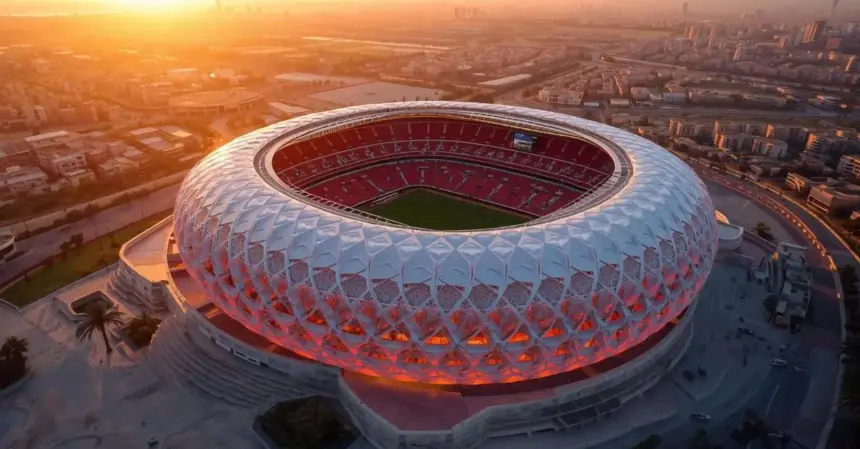
Among the most emblematic projects, the construction of the Grand Stadium of Casablanca in Mansouria stands as the future crown jewel. With a planned capacity of 115,000 seats, it aims to host the final of the 2030 World Cup. This stadium is not just a sports venue; it is designed as an architectural symbol of the country’s emergence, blending traditional Moroccan “Moussem” tent designs with futuristic engineering.
The cost and scale of this project spark debates, but politically, it represents the affirmation of Moroccan power. Aiming for the final is an assertion of leadership within the organizing trio. It is a subtle diplomatic negotiation being played out with Spain and its legendary Santiago Bernabéu. For Morocco, hosting the final would be the ultimate culmination of half a century of efforts and a symbolic recognition of its new status on the world stage.
FAQ
Which Moroccan cities will host the matches?
The cities slated to host matches are Casablanca, Rabat, Tangier, Marrakech, Agadir, and Fez. Each of these cities is undergoing major renovations to meet FIFA criteria regarding stadiums, transport, and hotel capacity.
What is the expected impact on the Moroccan economy?
Experts predict a significant contribution to the national GDP, driven by the construction and tourism sectors. It is estimated that the event could generate billions of dollars in indirect revenue and create tens of thousands of sustainable jobs.
Why is Morocco co-hosting with Spain and Portugal?
This joint bid is strategic: it unites two continents and allows for the sharing of infrastructure costs while maximizing global audience reach. It is a testament to strong diplomatic and economic cooperation between the three nations.
Is Morocco ready in terms of transport infrastructure?
The Kingdom already possesses a modern highway network and Africa’s first high-speed train. By 2030, massive extensions of the TGV and the modernization of international airports will ensure fluid movement for fans between host cities.
Morocco 2030 is not just a date on a sports calendar. It is a rendezvous with history intended to validate the Kingdom’s transition into a new dimension. By meeting the political, economic, and social challenges of this organization, Morocco secures a prominent place among the great nations of the 21st century. Football is merely the engine for a much larger ambition: that of a country that has given itself the means to achieve its dreams.