


The history of the Casablanca lighthouse begins long before the first stones of the current edifice were laid on the rocky promontory of El Hank. In the late 19th century, the Port of Casablanca was merely a modest maritime stopover, but the steady increase in commercial traffic made night navigation extremely perilous along the Moroccan coast. Hidden reefs and the unpredictable currents of the Atlantic Ocean demanded a permanent solution to guide ships safely toward the shore. In this context of urban modernization and maritime safety, the project for a monumental lighthouse was born, forever changing the city’s skyline.
- The Origins of a Titanic Project on the El Hank Point
- Architecture and Technical Prowess of the Casablanca Lighthouse
- The Daily Life of Keepers and Living Around the Tower
- The Lighthouse’s Impact on Casablanca’s Urban Development
- Tourism and Conservation of Moroccan Maritime Heritage
- The Future of Lighthouses in the Digital and GPS Era
- FAQ about the Casablanca Lighthouse
Today, this majestic structure, better known as the El Hank lighthouse, is far more than a simple technical beacon for sailors. It has become one of Morocco’s most powerful architectural symbols, testifying to human ingenuity in the face of the raging elements. Standing at an impressive height, it dominates the Corniche and offers a unique vantage point over the economic capital. To truly understand the significance of this structure, one must delve into the archives of the early 20th century and imagine the fervor surrounding its design and construction.
The lighthouse has survived storms, wars, and rapid urbanization, remaining faithful to its original mission. Its flash, visible for dozens of nautical miles, continues to reassure cargo ship captains and traditional fishermen alike. In this article, we will explore the behind-the-scenes story of its construction, the secrets of its Moorish-inspired architecture, and the crucial role it still plays in the country’s maritime security. Welcome to the summit of Casablanca’s sentinel, where the sky and the sea meet.
The Origins of a Titanic Project on the El Hank Point
The construction of this monumental work was no small feat. Launched in 1916, the work took place in the midst of World War I, reflecting the strategic urgency that the development of the Port of Casablanca represented for the authorities of the time. Designed by French engineer Albert Delande, the lighthouse had to meet exceptional resistance standards to withstand the repeated assaults of the Atlantic swell. The choice of the El Hank site was not accidental; this rocky outcrop offered the optimal visibility required to cover a wide angular sector off the Moroccan coast.
The construction site mobilized hundreds of workers and required top-quality materials, often transported by sea under complex logistical conditions. The architectural style chosen for the El Hank lighthouse broke away from the austere, utilitarian style of many European lighthouses of that era. Here, aesthetics met functionality. By integrating local decorative elements, the designers succeeded in creating a monument that fits perfectly into the Maghreb’s cultural landscape while fulfilling its technical role in maritime signaling.
The completion of the works in 1919 marked the beginning of a new era for navigation in Morocco. As soon as it entered service, the lighthouse drastically reduced the number of shipwrecks in the area, reinforcing Casablanca’s reputation as a safe and modern port. At that time, the lighting system relied on complex mechanical technologies, requiring rigorous daily maintenance from the lighthouse keepers—those unsung heroes who lived to the rhythm of the lens’s rotation.
Architecture and Technical Prowess of the Casablanca Lighthouse
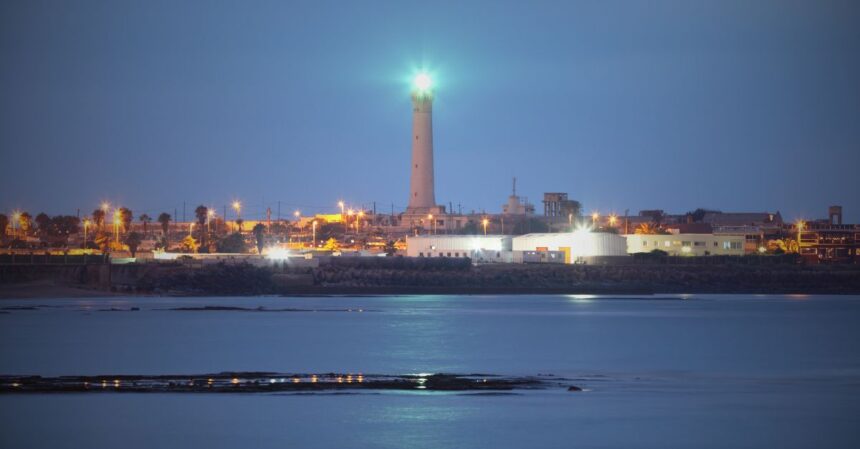
From an architectural standpoint, the lighthouse is a cylindrical tower made of dressed stone masonry, rising 51 meters above the ground (and about 65 meters above sea level). What immediately strikes the visitor is the fineness of the ornamental details decorating the top of the tower. Unlike the usual smooth structures, the El Hank lighthouse features cornices and patterns reminiscent of the minarets of Morocco’s great mosques, creating a visual bridge between the sacred and the profane, between the land and the ocean.
The interior of the lighthouse is just as impressive as its exterior. To reach the lantern, one must climb a spiral staircase with no fewer than 256 steps. This physical effort is richly rewarded by the discovery of the watchroom and the optical mechanism. The Fresnel lens, a true masterpiece of precision, allows the light from the lamp to be concentrated into a beam of prodigious intensity. Here are some technical features that make this building unique:
-
A luminous range reaching 30 nautical miles (approximately 55 kilometers) in clear weather.
-
A rotating optical system resting on a mercury bath to minimize friction.
-
A structure capable of withstanding winds blowing at over 180 km/h.
-
A unique signaling rhythm (groups of flashes) allowing sailors to identify Casablanca without confusion with neighboring lighthouses in Rabat or El Jadida.
Maintaining this machinery is a precision task that continues despite automation. The lenses must be cleaned regularly to prevent salt spray from clouding the glass. Each part of the mechanism, much of which is original, is carefully inspected to ensure absolute continuity of service. The lighthouse is not just a historical monument; it is an active navigation instrument, integrated into modern Vessel Traffic Services (VTS) and equipped with redundant backup systems to handle any power failure.
The Daily Life of Keepers and Living Around the Tower
Behind the splendor of the stone lies a human reality built on solitude and discipline. For decades, generations of keepers succeeded one another to watch over the flame, and later the electric bulb of the sentinel. Living in a lighthouse means accepting a lifestyle regulated by the biological clock of the ocean. Stories from former keepers often mention the incessant sound of the wind rushing through the tower and the dull vibration of the sea hitting the rocks of El Hank during high spring tides.
The lighthouse is surrounded by an enclosure that once housed the families of the keepers, creating a small community isolated from the rest of the city, despite being so close to it. Today, although automation has reduced the need for a constant human presence at the top, the site remains inhabited and monitored. This link between man and machine is essential to preserving the soul of the place. Anecdotes abound regarding memorable storms where keepers had to climb the steps several times a night to ensure the mechanism had not jammed due to cold or humidity.
Around the lighthouse, the El Hank neighborhood has also evolved significantly. Once a wild and deserted area, it is now integrated into the beating heart of Casablanca’s Corniche. The contrast is striking between the motionless verticality of the white tower and the bustle of restaurants, strollers, and surfers who frequent the surrounding beaches. For Casablancais, the lighthouse is a familiar landmark, a reassuring presence that structures the horizon and recalls the city’s glorious maritime past.
The Lighthouse’s Impact on Casablanca’s Urban Development
One cannot dissociate the history of the Casablanca lighthouse from the meteoric expansion of the “White City.” At the beginning of the last century, the lighthouse served as a limit to urban extension toward the west. Its presence encouraged the development of the Corniche, transforming a coastal area that was difficult to access into a popular place for leisure and strolls. Urban planner Henri Prost, who designed the plans for the modern city, already integrated the lighthouse’s silhouette as a structural element of the coastal perspective.
Over the years, the lighthouse became an object of national pride. It has been depicted on many vintage postcards, postage stamps, and even in films, symbolizing Morocco’s openness to the world and its mastery of cutting-edge technology. Its economic role is just as fundamental: by facilitating access to the port, it helped make Casablanca the leading commercial hub in North Africa, driving flows of goods and passengers essential to the kingdom’s growth.
The development of the Hassan II Mosque, located just a stone’s throw away, created a new architectural dialogue with the lighthouse. While the mosque impresses with its size and its minaret (the tallest in the world when inaugurated), the lighthouse retains its own historical nobility. The two buildings respond to each other at night: one projects a laser toward Mecca, while the other sweeps the Atlantic with its protective beam. This luminous duo defines Casablanca’s nocturnal identity, blending spirituality and maritime safety.
Tourism and Conservation of Moroccan Maritime Heritage
Today, the El Hank lighthouse has become a must-visit tourist destination for those wishing to discover Casablanca from a different angle. Although access to the top is sometimes regulated for safety reasons, visiting the site allows one to understand the importance of Moroccan maritime heritage. Conserving such buildings represents a major challenge for port authorities and the Ministry of Culture. It is about maintaining a delicate balance between the operational use of the lighthouse and its promotion as a historical monument.
Regular restoration efforts are undertaken to protect the stone against wind erosion and salt corrosion. The lighthouse’s characteristic white paint, which serves as a daytime visual signal, is frequently renewed. For photography enthusiasts, the lighthouse offers striking light contrasts, especially at sunset when the stone glows with orange hues before the first flash pierces the darkness.
Tourism around the lighthouse also contributes to the local economy. Guides often offer circuits including visits to the old Medina, the mosque, and the lighthouse, providing a complete vision of the city’s evolution. Promoting the history of the lighthouse is also a way to raise public awareness about the fragility of marine ecosystems and the importance of safety at sea. It is a place of learning where we realize that, despite GPS and satellites, a lighthouse’s light remains an ultimate and infallible guide.
The Future of Lighthouses in the Digital and GPS Era
In the age of satellite navigation and electronic charts, one might wonder if the Casablanca lighthouse still has a future. Yet, the response from maritime experts is unanimous: the lighthouse remains indispensable. In the event of a major electronic failure, a cyberattack, or satellite signal jamming, visual aids to navigation constitute the last line of defense against ecological and human disasters. The El Hank lighthouse is part of this strategic resilience network.
Furthermore, technological evolution does not bypass the lighthouse; it integrates with it. Light sources are now more energy-efficient thanks to high-power LEDs, and remote monitoring systems allow for the detection of any anomaly in real-time. The lighthouse is becoming a multi-use station, capable of hosting meteorological measurement equipment, communication antennas, or sensors for monitoring marine pollution.
The future challenge also lies in transmitting this memory. Projects for museums at the foot of the tower are frequently discussed to transform the old keepers’ quarters into interpretation centers for the sea. This would allow the history of the Casablanca lighthouse to be preserved for future generations, explaining how a simple stone tower allowed a city to become a global metropolis. The El Hank lighthouse has not finished lighting up our nights and our history.
FAQ about the Casablanca Lighthouse
Can you visit the inside of the El Hank lighthouse?
Yes, it is generally possible to visit the lighthouse for a small fee. Climbing the 256 steps requires good physical condition, but the panoramic view of Casablanca and the Atlantic Ocean at the top is truly spectacular. It is advisable to check opening hours with local authorities or guides on-site.
What is the actual range of the lighthouse’s light?
The nominal range of the lighthouse is 30 nautical miles, which is about 55 kilometers. However, this visibility can vary depending on atmospheric conditions (fog, heavy rain). Its flash is specifically designed to be identified among all other city lights.
Why does the lighthouse have this specific decoration?
Unlike many lighthouses worldwide that prioritize a purely functional shape, the Casablanca lighthouse was designed with a desire for cultural integration. Its Moorish style, inspired by minarets, was a way to pay tribute to traditional Moroccan architecture while building modern infrastructure during the Protectorate period.
Is the lighthouse still inhabited by a keeper?
Although the mechanism is automated, a human presence is maintained on-site for monitoring, routine maintenance, and welcoming visitors. The role of the lighthouse keeper has evolved into maintenance technician and maritime heritage manager functions.