

For several decades, the Maghreb has been the stage for an arms race that rarely speaks its name. However, in recent years, this rivalry has taken on a new dimension, moving from the sands of the Sahara to the azure Mediterranean skies. Morocco vs Algeria: The battle for the skies tilts in Rabat’s favor, is the striking conclusion emerging from the most recent international military analyses. While Algeria’s defense budget remains historically higher, the Moroccan strategy seems to have operated a major doctrinal shift. By prioritizing cutting-edge technology, integration with Western standards, and elite training, the Kingdom of Morocco is redefining the balance of aerial power in the region.
- A Strategic Analysis of Aerial Power in the Maghreb
- The F-16 Viper a Master Asset for Moroccan Forces
- The Limits of the Algerian Response and the Su-57 Gamble
- Pilot Training and International Interoperability
- Quantity Versus Quality the New Maghreb Military Paradigm
- A Strategic Advance Consolidated by Alliances
This strategic duel at the summit of the Maghreb is no longer a simple question of national prestige. It is a quest for absolute aerial superiority, capable of dictating the outcome of a potential conflict before ground troops even meet. To understand how Rabat has managed to compensate for its numerical inferiority with a qualitative edge, one must dive into the technical details and geopolitical alliances that structure this unprecedented technological confrontation.
A Strategic Analysis of Aerial Power in the Maghreb
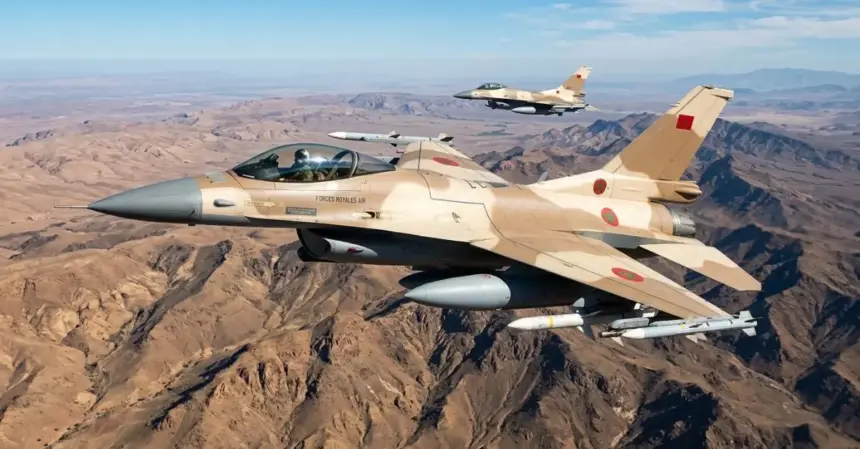
American expert Harrison Kass, in a study published by The National Interest, highlights that Morocco has successfully leveraged a perfect alignment with American military doctrine. Contrary to an older vision that counted the number of airframes on the tarmac, modern warfare is won in the electromagnetic spectrum. Morocco understood this early on by investing massively in the modernization of its F-16 Fighting Falcon fleet. These aircraft are no longer the simple light fighters of the 80s, but ultra-sophisticated multi-role combat platforms capable of rivaling higher-generation planes.
Algeria, for its part, traditionally relies on Russian hardware. While the Sukhoi Su-30MKA remains an impressive machine for its endurance and maneuverability, it currently suffers from a technological lag compared to new Western detection systems. Algiers’ strategy rests on saturation and mass, whereas Rabat bets on surgical precision. This divergence in military philosophy is at the heart of the current debate: can quantity still prevail over technological quality in a sky saturated with radars and electronic countermeasures?
Rabat’s strategic advantage is not limited to aircraft alone. It includes a totally integrated Command and Control (C2) architecture. Thanks to its ties with the United States and Israel, Morocco benefits from privileged access to real-time data-sharing systems, such as the Link 16. This system allows each plane to see what others see, creating a global vision of the battlefield. Conversely, Algeria must deal with systems that are often siloed, making coordination complex in the event of a large-scale engagement.
The F-16 Viper a Master Asset for Moroccan Forces
The spearhead of the Royal Moroccan Air Force is undoubtedly the F-16 in its “Viper” version. The modernization of the Moroccan fleet to the Block 70/72 standard is a total game-changer. The central element of this update is the AESA APG-83 radar. Unlike classic mechanical radars that sweep the sky with a mobile antenna, the Active Electronically Scanned Array radar can track dozens of targets simultaneously while being extremely difficult to jam. This gives the Moroccan pilot a situational awareness unmatched in the region.
In addition to the radar, Morocco has acquired armaments that transform its fighters into true snipers of the sky. The AIM-120C-7 AMRAAM air-to-air missile allows for engagement of targets Beyond Visual Range (BVR). In a real combat scenario, this means a Moroccan F-16 could theoretically lock onto and shoot down an opponent before the latter has even detected it on its screens. It is this “first look, first shot” capability that validates the idea that Morocco currently possesses a decisive qualitative advantage over its neighbors.
The Pillars of Morocco’s Technological Superiority
-
Latest Generation AESA Radars: Increased detection capability and resistance to electronic countermeasures.
-
Long-Range Missiles: Use of the AMRAAM to dominate BVR (Beyond Visual Range) combat.
-
Sniper Laser Designator Pods: For absolute precision during ground strikes, limiting collateral damage.
-
Joint Helmet Mounted Cueing System (JHMCS): Allowing the pilot to aim at a target simply by turning their head.
-
NATO Interoperability: Regular participation in large-scale exercises like African Lion, strengthening the operational experience of pilots.
This technological panoply is complemented by high-level maintenance. Agreements with Lockheed Martin provide for local maintenance centers, ensuring maximum operational availability of the fleet. In contrast, fleets of Russian origin sometimes suffer from significant maintenance delays linked to complex supply chains and the current geopolitical situation of Russia.
The Limits of the Algerian Response and the Su-57 Gamble
To attempt to restore the balance, Algeria has its sights set on the Sukhoi Su-57, the Russian fifth-generation fighter intended to rival the American F-35. On paper, the Su-57 possesses stealth characteristics and super-cruise capabilities that could theoretically outclass the Moroccan F-16. However, this project is surrounded by numerous uncertainties. Harrison Kass notes that Russia is struggling to mass-produce this aircraft for its own needs, making export deliveries uncertain and distant.
Furthermore, the history of exported Russian armaments often shows “monkey models”—downgraded versions that are less capable than those used by the Russian Air Force itself. Algeria is thus taking a major industrial and financial risk. Purchasing an aircraft that has not yet proven itself in high-intensity real combat is a risky bet compared to a Morocco that buys American systems that are proven, tested, and constantly improved across numerous global theaters of operation.
The potential acquisition of the Su-57 by Algiers also raises the question of American sanctions via the CAATSA law. By turning to Russian high-tech equipment, Algeria exposes itself to diplomatic and economic pressure from Washington, whereas Morocco strengthens its alliances. This geopolitical dimension is inseparable from pure military power: an army without diplomatic support and guaranteed spare parts quickly becomes a “paper force” in the event of a prolonged crisis.
Pilot Training and International Interoperability
A plane, no matter how modern, is only as good as the one flying it. This is where Morocco scores crucial points. Pilots of the Royal Air Force benefit from training aligned with US Air Force curricula. They participate annually in large-scale maneuvers, simulating complex aerial combat against adversaries using modern tactics. This “real world” experience and constant exchange with Western forces create a culture of operational excellence that is difficult to match.
Algeria, though possessing brave and trained pilots, remains more isolated in its training methods. Its exercises are often internal or with a limited number of partners. The absence of regular confrontation with NATO standards limits the ability to adapt to asymmetric electronic warfare tactics. In the battle for the skies, the ability to improvise and use encrypted, shared communication systems is often what separates victory from defeat.
The strategic partnership between Morocco and Israel, formalized by the Abraham Accords, adds an extra layer of superiority. Access to Israeli drone technology, such as the Heron or Hermes, allows Morocco to ensure constant surveillance and conduct precision strikes without exposing its pilots. This drone-fighter integration is the new paradigm of modern warfare, and Rabat seems to have taken several leaps forward in this strategic domain for regional control.
Quantity Versus Quality the New Maghreb Military Paradigm
If we look at the raw numbers, Algeria still possesses a larger fleet, with nearly a hundred Russian fighters of various types. But as recent military history reminds us, from the Gulf War to current conflicts in Eastern Europe, mass no longer guarantees dominance. Morocco made a deliberate choice for a more compact but technologically superior force. This approach allows for budgets to be concentrated on maintenance, precision weaponry, and continuous training.
Electronic superiority has become the ultimate judge. A plane capable of jamming an adversary’s radar while guiding its missiles via satellite possesses a force-multiplier advantage. In this configuration, a single modernized Moroccan F-16 could theoretically hold its own against several previous-generation aircraft. This mathematical and technological reality is why experts say the battle for the skies tilts in Rabat’s favor.
Finally, one must mention the coherence of the Moroccan doctrine. Every purchase, whether it be Patriot missile batteries for surface-to-air defense or new Apache attack helicopters, fits into a global vision of territorial protection. Morocco does not seek to match Algeria in the number of tanks or planes, but to make any aerial aggression too costly and ineffective. This is the very definition of a successful deterrence strategy based on technology.
A Strategic Advance Consolidated by Alliances
Morocco has successfully transformed its geography into a powerful diplomatic lever. As a major non-NATO ally of the United States, the country benefits from technology transfers that are denied to other nations. This privileged relationship ensures the Kingdom always has a version’s lead over its regional competitors. The mutual trust between Rabat and Washington allows for an integration of weapons systems that goes far beyond a simple commercial sale.
On the other side of the border, Algeria finds itself in a delicate position, torn between its historical dependence on Moscow and the need to modernize from alternative sources. But changing a major supplier would take decades and cost billions in training and infrastructure. This logistical rigidity is a major brake on rapid modernization, whereas Morocco, already anchored in the Western ecosystem, progresses through fluid and constant technological leaps.
In conclusion, the Maghreb sky is witnessing a profound mutation. Morocco, through its agility, its choice of quality, and its solid partnerships, has built an air force that commands respect. While the balance remains fragile and Algeria has considerable financial resources to attempt to close its gap, the current dynamic clearly leans in favor of Rabat. Technology has redrawn the map of power, proving once again that in the air, it is artificial intelligence, silicon, and training that dictate the law.
FAQ: Understanding the Aerial Rivalry Between Morocco and Algeria
Why is it said that Morocco has the advantage despite a smaller fleet? The advantage is no longer measured by the number of planes but by their technological quality. Morocco uses modernized F-16s with AESA radars and AMRAAM missiles that allow for the detection and shoot-down of targets at very long distances, often before being spotted.
Can Algeria catch up with the Russian Su-57? That is Algiers’ goal, but the Su-57 faces production issues and its real-world performance is still debated. Furthermore, integrating new Russian systems takes time, whereas Morocco already has an operational fleet perfectly trained to modern standards.
What role do drones play in this confrontation? Drones are essential. Morocco has acquired highly effective Israeli and Turkish (Bayraktar TB2) technologies for surveillance and targeted strikes. This complements its fighter fleet and allows for multi-layered aerial dominance that Algeria is attempting to mimic with Chinese and Iranian models.
Does this aerial superiority guarantee peace? In military doctrine, clear technological superiority acts as a powerful deterrent. By making any aerial attack risky and uncertain for the adversary, Morocco stabilizes its security environment and discourages the temptation of open conflict.