

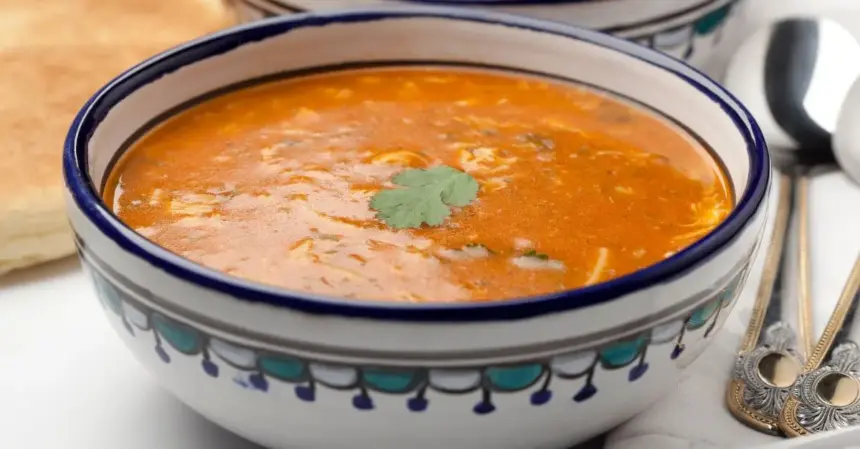
In the vast panorama of world gastronomy, few dishes manage to capture the essence of a nation as effectively as Moroccan Harira. This velvety, golden-red soup is far more than a simple starter; it is a liquid monument to a thousand-year-old civilization. As a cornerstone of the Kingdom’s intangible heritage, Harira represents the historical continuity of Morocco, bridging the gap between medieval imperial courts and modern family kitchens. Its complex aroma, dominated by fresh cilantro, celery, and a hint of ginger, serves as a sensory reminder of Morocco’s unique position as a cultural crossroads between Africa, Europe, and the Middle East.
Recognized for its thick, comforting texture, Harira is a nutritional masterpiece. It strikes a delicate balance between tender meat, hearty legumes (chickpeas and lentils), vibrant tomatoes, and a sophisticated blend of spices. While it is enjoyed year-round, its cultural significance peaks during the holy month of Ramadan. As the sun sets, the “Ftour” (breaking of the fast) begins with a steaming bowl of Harira, typically accompanied by sweet dates, honey-drenched Chebakia cookies, and hard-boiled eggs. This ritual is not just about nutrition; it is a restorative ceremony that has defined Moroccan family life for centuries.
The Medieval Roots of an Imperial Legacy
To trace the lineage of Harira, one must consult the chronicles of the great Moroccan dynasties. Distinguished historians, such as Mohamed Mezzine and Abdallah Laroui, have noted that the culinary organization of cities like Fez and Marrakech began to take shape as early as the Idrisid era. However, it was during the Almoravid and Almohad empires that Moroccan cuisine achieved its refined complexity. Medieval manuscripts from the Maghreb and Andalusia describe thick, cereal-based soups—direct ancestors of the modern Harira—that were served to nourish the elite and the scholarly community.
The expansion of trade routes following the Islamic conquest introduced a new palette of flavors to the region. Ingredients like ginger, turmeric, and saffron from Taliouine were integrated into local pots, elevating simple broths into sophisticated culinary exports. Chroniclers of the 12th and 13th centuries frequently mentioned rich vegetable and meat pottages served during religious festivities. This historical depth proves that Harira is not a recent invention but a sustainably preserved tradition that has survived the rise and fall of empires, remaining a constant in the Moroccan soul.
Agricultural Continuity and Local Terroir
While spices traveled from afar, the heart of Harira has always been rooted in Moroccan soil. The use of chickpeas and lentils reflects the agricultural heritage of the Kingdom’s fertile plains, such as the Saïss and the Haouz. This reliance on local produce is what gives Harira its “Moroccanness.” It is a dish that speaks of the land. The addition of “Smen”—a salted, fermented butter—adds a deep, pungent layer of flavor that is uniquely Moroccan, a taste that cannot be replicated by any other ingredient in the Mediterranean basin.
The preparation process itself is a testament to the local lifestyle. The slow-simmering technique allows the fibers of the legumes and the proteins of the meat to meld perfectly with the acidity of the tomatoes. In 2026, even with the advent of modern kitchen technology, the most respected Hariras are still those made with patience and precision, respecting the ancestral rhythm of Moroccan home cooking. This dedication to process ensures that the “soul” of the soup remains intact, regardless of the era.
Family Transmission as a Cultural Shield
The true secret of Harira lies in its oral transmission. It is a recipe learned by the hand and the eye, passed down from mother to daughter across generations. This matriarchal heritage has acted as a shield against the homogenization of global food trends. In every Moroccan household, the preparation of Harira is a rite of passage. While the core ingredients remain constant, regional variations add a beautiful diversity to the national landscape:
-
The Fassi Style: Known for its extreme delicacy and aromatic lightness.
-
The Marrakchi Version: Robust, spicy, and deeply earthy.
-
The Northern Style: Often featuring slight variations in the balance of fresh herbs.
-
The Rural Tradition: Occasionally utilizing “Sourdough” (Khmissa) for the thickening process to add a natural tang.
This regional diversity does not dilute the dish’s identity; instead, it strengthens it. Harira remains the common denominator of the Moroccan people, a dish that erases social boundaries. Whether served in a palace or a modest mountain home, it carries the same weight of tradition and the same promise of hospitality. It is the culinary expression of Moroccan sovereignty over its own history.
The Ritual of the “Tadouira” and Culinary Art
The most technical part of the Harira recipe is the Tadouira—the thickening process. A mixture of flour and water (and sometimes tomato paste) is added to the boiling pot in a slow, steady stream. The cook must stir constantly to achieve a smooth, velvety consistency without lumps. This step requires a level of intuition that only comes with years of practice. It is this “velvet touch” that distinguishes a master cook. The resulting texture should be thick enough to coat a spoon but light enough to drink comfortably.
Beyond the flour, the final addition of fresh cilantro and parsley is crucial. These herbs are added at the very end to preserve their vibrant color and sharp fragrance. This attention to detail is a hallmark of the Moroccan culinary arts. It is a kitchen of “a pinch of this and a handful of that,” where measurements are felt rather than weighed. This intuitive approach is why a bowl of Harira in Morocco tastes like no other soup in the world; it is seasoned with the experience of the ancestors.
Harira in the Global Arena of Cultural Diplomacy
Today, Harira serves as a powerful tool of cultural diplomacy. At international summits, cultural festivals, and Moroccan embassies worldwide, it is presented as the ultimate symbol of the Kingdom’s hospitality. To share a bowl of Harira is to share an invitation into the heart of Moroccan society. It is a dish that promotes peace, coexistence, and generosity. By championing Harira as a national treasure, Morocco reinforces its cultural presence on the global stage, ensuring that its culinary sovereignty is recognized and respected.
In 2026, as people increasingly seek authenticity in an artificial world, Harira stands out as a “living memory.” It is a dish that has not been commercialized into oblivion but remains a sacred home-cooked meal. It reminds us that tradition is a living thing, deeply rooted in the soil but capable of reaching across borders to touch the hearts of food lovers everywhere. The Harira is, and will always be, the taste of Morocco.
FAQ: Secrets of the Moroccan Harira
What makes Moroccan Harira different from other North African soups?
The defining characteristic is the Tadouira (flour thickening) and the specific trio of celery, parsley, and cilantro used in high volumes. While other regions have legume soups, the Moroccan Harira’s balance of cinnamon, ginger, and Smen, combined with its velvety texture, is unique to the Kingdom’s culinary tradition.
Why is Harira served with sweet Chebakia?
This is a classic Moroccan culinary contrast. The saltiness and acidity of the soup are perfectly balanced by the honeyed sweetness of the Chebakia. This combination provides a rapid glucose boost and a sense of satiety, which is essential after a day of fasting during Ramadan.
Can Harira be made without meat?
Yes, a vegetarian Harira is quite common and equally delicious. The protein density from the lentils and chickpeas, combined with the rich spice profile, ensures the soup remains nourishing. Many families prefer this lighter version during the hot summer months.
How do you achieve the perfect red color?
The secret lies in using high-quality, very ripe fresh tomatoes combined with a touch of concentrated tomato paste added during the Tadouira phase. The use of paprika and a pinch of saffron also contributes to the deep, inviting hue that characterizes a successful Harira.