


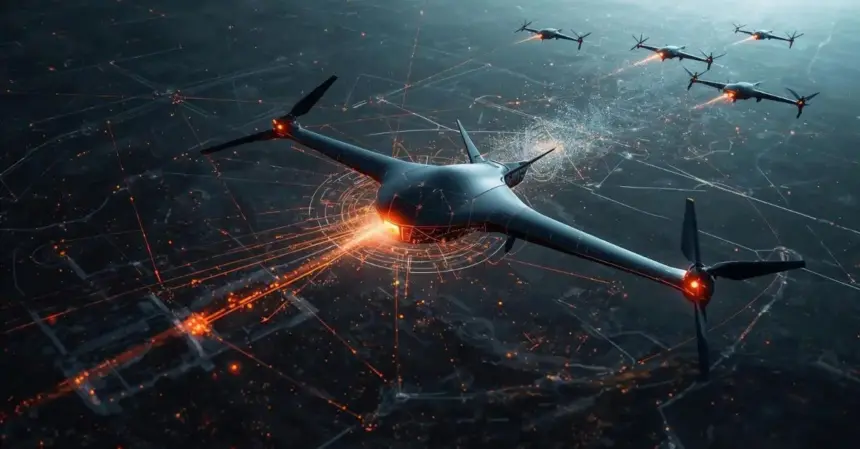
The year 2026 marks the definitive transition from conventional combat to what military strategists call “Hyperwar.” In the current tensions surrounding Iran, the frontline is no longer just a geographical boundary; it is a complex web of data streams and automated response systems. This evolution is characterized by the integration of high-level Artificial Intelligence into every tier of command. While the world watches the skies for traditional fighter jets, the real battles are being won or lost within milliseconds by algorithms designed to outthink and outpace human decision-makers.
At the heart of this technological revolution is the emergence of the “Software-Defined Battlefield.” For the first time, companies that once focused purely on silicon valley analytics are now embedded in the theater of war. The conflict in Iran has become a proving ground for autonomous systems and predictive modeling. As the Iranian Revolutionary Guard Corps (IRGC) deploys its latest asymmetric tactics, Western-backed forces are countering with an unprecedented level of computational dominance. This shift represents a fundamental change in how sovereignty is protected and how modern wars are waged.
The Role of Palantir as the Neural Network of Modern Defense
In 2026, Palantir Technologies has evolved from a data analytics firm into the indispensable central nervous system of modern military operations. Its AIP (Artificial Intelligence Platform) acts as a massive aggregator, pulling in petabytes of data from satellite constellations, tactical drones, and deep-web intelligence. By utilizing Machine Learning to identify patterns that are invisible to the human eye, Palantir provides commanders with a “common operating picture” that is updated in real-time.
This platform does more than just organize information; it predicts intent. By analyzing the logistical movements of Iranian drone launchers and naval assets, the AI can forecast a strike before the first engine is even started. This predictive capability has effectively collapsed the “OODA loop” (Observe, Orient, Decide, Act), allowing for preemptive neutralization of threats. In 2026, the side with the most data is strong, but the side with the best algorithmic processing is invincible.
Asymmetric Superiority and the Iranian Drone Swarm
Iran has recognized that it cannot compete with the sheer budget of Western military tech, so it has perfected the art of the low-cost swarm. The Shahed-136 and its 2026 successors represent a masterclass in cost-effective warfare. These “suicide drones” are designed to be expendable, forced through defense perimeters by sheer volume. Even the most advanced AI-driven interceptors face a mathematical crisis when 400 drones, costing $30,000 each, are launched against a carrier group or critical energy hub.
The Iranian strategy focuses on saturation. By overwhelming the processing limits of Aegis and Patriot systems, these drones force defenders into an economic trap. Spending a $2 million interceptor missile to stop a $20,000 drone is a losing game in a long-term conflict.
-
Mass Production: Iran’s 2026 manufacturing lines are fully automated, producing thousands of units monthly.
-
Decentralized Control: Advanced variants now use “Swarm Intelligence” to coordinate with each other without a central pilot.
-
Electronic Resilience: New optical-only guidance systems bypass traditional GPS jamming.
-
Dual-Use Tech: Utilizing off-the-shelf components to evade international sanctions.
The Automation of the Kill Chain and Moral Dilemmas
The “Kill Chain”—the sequence from finding a target to engaging it—has been almost entirely automated by 2026. Through systems like Project Maven, AI identifies a target, assigns the nearest available weapon system, and prepares the firing solution. This has reduced the window of engagement from minutes to seconds. However, this speed brings significant ethical risks. The 2026 conflict has seen heated debates over “Meaningful Human Control” as the pace of Hyperwar often leaves the human operator as a mere rubber stamp for the AI’s suggestions.
The risk of “algorithmic bias” or sensor error leading to civilian casualties is a constant threat. If an AI misinterprets a grain silo as a missile silo due to a specific thermal signature, the consequences are immediate and lethal. Furthermore, the militarization of the cloud has turned civilian data centers into legitimate military targets. If a server in Dubai is processing AI targeting data for the US Navy, Iran argues it becomes a valid point of attack, blurring the lines between the digital world and the physical battlefield.
FAQ on Technology in the 2026 Iran Conflict
Is Palantir actually controlling the weapons?
No, Palantir provides the software that analyzes data and suggests actions. A human commander still holds the “final authority” to fire. However, the AI handles the complex logistics and target identification that make the strike possible.
Why are cheap drones so dangerous to high-tech armies?
Because they rely on “Economic Attrition.” If an attacker sends enough cheap drones, the defender eventually runs out of expensive missiles or the radar system becomes overwhelmed by too many signals at once.
Can AI-driven defenses be hacked?
Cyber-warfare is a major part of the 2026 conflict. Iran employs specialized units to “poison” the data fed into Western AI systems, attempting to trick the algorithms into seeing threats where there are none or ignoring real attacks.
What is the LUCAS system?
LUCAS is the American response to Iran’s drone strategy. It is a low-cost, mass-produced autonomous drone designed to intercept other drones or strike targets in large numbers, fighting “fire with fire.”