
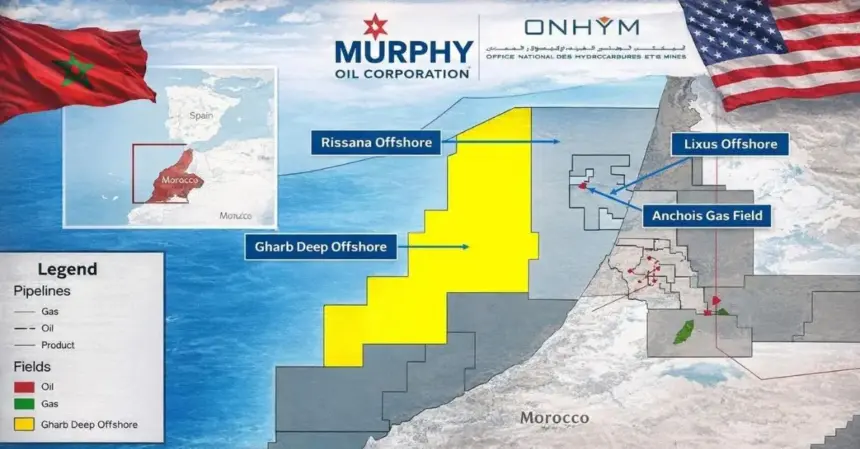
The Moroccan energy sector is currently navigating a pivotal era of transformation, underscored by a burgeoning appeal to global exploration titans. Recently, the announcement from the American firm Murphy Oil Corporation sent a wave of optimism through economic circles. The Houston-based company has formally disclosed its intent to intensify seismic data studies in the Gharb Offshore Shallow block, situated along the Atlantic coastline.
This move is far from a mere routine investment; it represents a profound vote of confidence in Morocco’s legal stability and geological promise. As the Kingdom strives to diversify its revenue streams and bolster its energy sovereignty, the entry of Murphy Oil marks a strategic milestone where cutting-edge technology meets vast, untapped deep-water resources.
Interest in the Gharb basin is not a new phenomenon, but the precision of Murphy Oil’s roadmap provides a fresh layer of industrial credibility. By focusing on existing seismic data and planning sophisticated new analyses, the corporation aims to map potential natural gas reservoirs with unparalleled accuracy. Morocco has masterfully implemented a fiscal framework that is often lauded as one of the most competitive globally for oil and gas ventures. This strategy is paying off, attracting players capable of weathering the massive costs associated with deep-water exploration. For market analysts, this collaboration between the National Office of Hydrocarbons and Mines (ONHYM) and the American giant signals a prosperous future for the Gharb region, evolving from its agricultural roots toward a high-tech industrial destiny.
Navigating the Seismic Exploration Phase
The journey initiated by Murphy Oil is anchored in rigorous scientific methodology. Offshore gas exploration invariably begins with an intensive phase of interpreting 2D and 3D seismic data. These datasets act as a subterranean ultrasound, allowing geologists to visualize rock structures thousands of meters beneath the seabed. The Gharb field possesses complex geological traits that demand world-class technical expertise—a domain where Murphy Oil is a recognized leader. The immediate objective is to identify “prospects,” specific locations where the likelihood of finding trapped natural gas is highest. This desktop-based modeling and computational analysis are vital prerequisites before any physical drilling occurs, as deep-water wells can cost upwards of tens of millions of dollars each.
The operational roadmap is transparent: the coming years will be dedicated to narrowing down these targets. Only after this meticulous phase will the final decision to spud a well be made. Current timelines suggest the first potential exploration well will be drilled after 2028. While this might seem distant to the general public, it represents a standard and secure pace within the energy industry. During this interval, Morocco continues to upgrade its port facilities and pipeline networks to be “gas-ready” for future production. The economic ripples will be felt long before the first cubic meter of gas is extracted, notably through the creation of specialized jobs and the demand for advanced logistics services in coastal hubs like Kenitra and Larache.
A Powerhouse Partnership: Rabat Meets Houston
Murphy Oil’s choice of Morocco as a primary focus is no coincidence. The nation has solidified its reputation as a beacon of stability in a sometimes turbulent region. The economic synergy with the United States, already robust through the Free Trade Agreement, finds a new pillar in transitional fossil energy. Natural gas is increasingly viewed as the bridge fuel of the green transition, essential for backing up intermittent renewable sources like solar and wind, where Morocco is already a regional champion. By developing its own gas assets, the Kingdom reduces its reliance on costly imports and stabilizes its trade balance. This push for autonomy is the cornerstone of the vision led by His Majesty King Mohammed VI to transform Morocco into an emerging industrial power.
The technical specifics of this partnership include several critical commitments:
-
In-depth analysis of thousands of square kilometers of 3D seismic surveys.
-
Knowledge and technology transfer to ONHYM engineers and technicians.
-
Comprehensive environmental impact assessments following global best practices.
-
Detailed logistical planning for future deep-sea drilling operations.
This collaboration is built on shared risks and rewards. If the discoveries meet expectations, Morocco could not only satisfy its domestic energy needs—particularly for its combined-cycle power plants—but also look toward exporting gas to Europe via the Maghreb-Europe Gas Pipeline (GME). Morocco’s geographic position makes it a natural gateway for African energy to reach the European market, reinforcing its role as a major geopolitical pivot.
Economic Projections for Moroccan Offshore Gas
The Murphy Oil announcement complements a series of recent successes in the Moroccan gas sector, including projects by Chariot Energy and Sound Energy. However, the involvement of a major player like Murphy Oil shifts the scale of operations significantly. We are discussing deep offshore exploration, where reservoirs are potentially much larger and more impactful. The capital expenditure required for such projects is measured in billions of dirhams, injecting direct growth into the national GDP. Once production commences, the fiscal revenues for the Moroccan state will provide vital funding for infrastructure and social programs, fostering a virtuous cycle of development across the country.
Beyond the financial metrics, an entire industrial ecosystem is beginning to take shape. Subsea engineering, specialized maritime transport, and platform maintenance are sectors poised for rapid growth. Moroccan universities are already aligning their curricula to train the next generation of petroleum engineers and high-tech technicians. This skill acquisition is crucial to ensure that the wealth found beneath the seabed truly benefits the local population. The Murphy Oil project in the Gharb basin acts as a catalyst for innovation and modernization within the Moroccan industrial fabric, all while adhering to the country’s climate goals by prioritizing gas as a “cleaner” alternative to coal-fired power.
FAQ: Understanding the Murphy Oil Project in Morocco
Why did Murphy Oil choose Morocco over other global markets? Morocco offers a rare blend of political stability, a very attractive legal and fiscal framework for foreign investors, and significantly under-explored geological potential. Its proximity to European energy markets and existing pipeline infrastructure makes it a top-tier destination for American energy majors.
When will we see the first results from actual drilling? As per the company’s strategic plan, the current focus is on seismic data interpretation. The first exploration well is tentatively scheduled for some time after 2028. This long-lead approach is necessary to ensure technical safety and financial efficiency in complex deep-water environments.
How will this project affect the average Moroccan energy bill? In the long term, domestic gas production can significantly lower the costs of electricity generation. By reducing the need for expensive imports and insulating the economy from the volatility of international energy prices, the project aims to provide more stable and affordable energy for both households and businesses.