

The mystery of Atlantis has captivated the human mind for over two millennia, ever since the Greek philosopher Plato penned the stories of Timaeus and Critias. While many have searched the depths of the Atlantic Ocean or the Aegean Sea, a growing body of researchers is turning its gaze toward Morocco. The North African kingdom, with its rich history and strategic position, offers a compelling backdrop for the lost empire. This theory isn’t just a flight of fancy; it is supported by striking geographic alignments and geological evidence that suggest the mythical city might be closer than we ever imagined.
Plato’s description of Atlantis placed the kingdom beyond the Pillars of Hercules, which we know today as the Strait of Gibraltar. Morocco sits exactly at this gateway. For those who believe in the Moroccan Atlantis, the vast coastal plains and the towering Atlas Mountains provide a physical blueprint that matches Plato’s writings. Could it be that the concentric circles of the legendary city are not underwater, but buried beneath the mud and silt of the Moroccan coastline following a massive prehistoric flood?
The debate isn’t just about location; it’s about a sophisticated ancient culture that may have predated our known history. Morocco is home to some of the oldest human remains ever discovered, pushing the timeline of civilization further back. If a powerful maritime empire existed 11,000 years ago, the Moroccan coast would have been the ideal hub for trade between the Mediterranean and the Atlantic. The idea that Atlantis was a real North African power is gaining traction as satellite imagery reveals strange structures in the Souss-Massa region.
Geographic Evidence and the Strait of Gibraltar
One of the most powerful arguments for the Moroccan location is the proximity to the Strait of Gibraltar. In ancient times, passing through these pillars was a journey into the unknown. Plato described a vast plain near the sea, surrounded by mountains that shielded the land from the north. The Souss Plain, located between the High Atlas and the Anti-Atlas mountains, fits this description with uncanny precision. It is a fertile expanse that has supported life for millennia, echoing the “two harvests a year” mentioned in the dialogues.
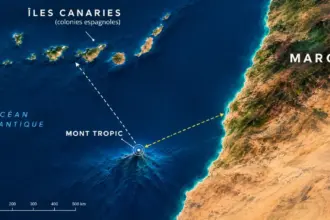
Beyond the landscape, the mineral wealth of Morocco mirrors the resources of Atlantis. Plato spoke of orichalcum, a rare reddish metal second only to gold. Morocco is historically famous for its rich deposits of copper, silver, and other minerals in the Atlas range. The high concentrations of these metals in the region suggest that a mining-based civilization could have flourished here. Furthermore, the bathymetry of the Atlantic floor off the Moroccan coast shows submerged islands and plateaus that would have been above sea level during the last Ice Age.
Recent studies into sea-level rise and seismic activity provide a scientific framework for the “sudden destruction” of Atlantis. The region is prone to earthquakes and tsunamis, much like the one that devastated Lisbon in 1755. A similar event 12,000 years ago, at the end of the Younger Dryas, could have easily overwhelmed a coastal capital. Marine sediment analysis along the Moroccan shelf has identified “tsunami-ites”—layers of sand carried deep inland by massive waves—dating back to the very era Plato described.
Cultural Ties and the Amazigh Connection
The indigenous people of Morocco, the Amazigh (Berber), possess a culture that is deeply rooted in the land and sky. Their mythology and symbols offer tantalizing clues. The very name “Atlas” is central to both Greek myth and Moroccan geography. In the legend, Atlas was the first king of Atlantis, and his name is forever immortalized in the mountain range that dominates the Moroccan landscape. This connection suggests that the story of Atlantis might be a distorted memory of a real pre-Berber civilization.
Traditional Amazigh architecture and social structures often reflect a high level of organization. The ancient irrigation systems, known as foggara or khettara, show a mastery of water management that Plato attributed to the Atlanteans. Here are several cultural intersections that link Morocco to the legend:
-
Ancient Script: Some researchers find similarities between old Tifinagh (Amazigh script) and symbols associated with lost civilizations.
-
Megalithic Sites: The M’zora stone circle in northern Morocco is an astronomical monument that hints at advanced prehistoric knowledge.
-
The Bull Cult: Rock carvings across the Atlas depict bull worship, a central religious practice in the Atlantean narrative.
-
Local Lore: Legends of “cities of brass” or sunken kingdoms have persisted in North African oral traditions for centuries.
These cultural echoes suggest that if Atlantis fell, its people didn’t vanish; they merged with the local populations of the Maghreb. The sophistication of early North African societies, often overlooked by Eurocentric history, provides a fertile ground for the idea that a “Mother Culture” once existed here. The Moroccan people today might be the distant descendants of that glorious maritime empire, carrying its legacy in their crafts, their language, and their resilience.
Why Science is Taking the Moroccan Thesis Seriously
Modern technology is changing the way we hunt for lost cities. With LIDAR and high-resolution satellite mapping, we can now see through vegetation and topsoil. In the Souss-Massa area, researchers have identified concentric geological formations that bear a striking resemblance to Plato’s description of the city of Atlantis. While some geologists argue these are natural formations, the spatial math involved is hard to ignore. The diameter and spacing of these “rings” align almost perfectly with the measurements given in the Greek texts.
The discovery of Homo Sapiens fossils at Jebel Irhoud, dating back 300,000 years, has already moved the “cradle of humanity” to Morocco. This makes the existence of an advanced society 10,000 or 12,000 years ago much more plausible. If Morocco was the starting point for modern humans, it could very well have been the site of the first great empire. Archaeologists are now more open to the idea that the Sahara, which was once green and lush, hosted complex societies before it turned to desert.
In conclusion, the Moroccan Atlantis theory bridges the gap between folklore and hard science. Whether it was a literal island or a coastal kingdom, the evidence in Morocco—from the geologic scars of ancient floods to the linguistic roots of the word Atlas—is too significant to dismiss. As we continue to dig deeper into the Moroccan soil and sea, we may find that Plato wasn’t writing a fairy tale, but a history of a world that was lost to the waves, only to be rediscovered in the heart of North Africa.
Frequently Asked Questions (FAQ)
Why is Morocco considered a top candidate for Atlantis? Morocco is located directly beyond the “Pillars of Hercules” (Gibraltar), featuring the Atlas Mountains and fertile plains that match Plato’s descriptions. Its history of seismic activity and ancient human presence further supports the theory.
Are there any specific ruins I can visit? While no “Atlantis” signpost exists, the M’zora megaliths and the ancient site of Lixus offer glimpses into Morocco’s deep prehistoric and classical past. Many believe the actual city remains buried under sediment in the Souss-Massa region.
What does the name ‘Atlas’ have to do with it? According to Plato, Atlas was the first king of Atlantis. The fact that the Atlas Mountains are located in Morocco provides a direct linguistic and mythological link between the country and the lost kingdom.