
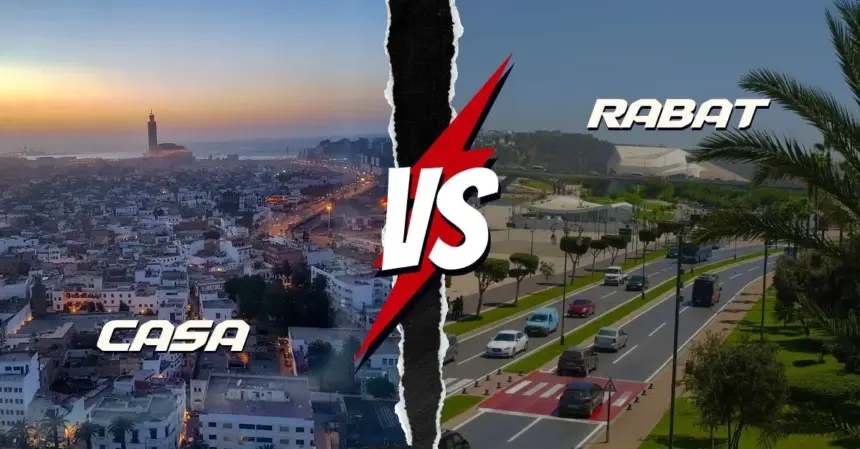
Morocco in 2026 is buzzing with economic and social energy. With major milestones like the 2030 World Cup approaching, the job market is undergoing profound changes. For any professional, whether a fresh graduate or an experienced executive, one central question remains: should you choose the overflowing energy of Casablanca, the economic capital, or the organized serenity of Rabat, the administrative capital? This dilemma is not just geographical; it touches on corporate culture, cost of living, and ultimately, the definition of success.
Casablanca remains the country’s financial lung, concentrating nearly half of the national GDP. It is the city of fast opportunities, the skyscrapers of Casablanca Finance City, and productive stress. Conversely, Rabat has transformed into a modern “City of Light,” offering a more balanced lifestyle while attracting cutting-edge technology sectors and international institutions. The choice between the two depends on your priorities: a meteoric rise or sustainable quality of life.
Casablanca: The Playground for the Ambitious
Working in Casablanca in 2026 means accepting a frantic pace. The metropolis is the headquarters for multinationals, major banks, and heavy industries. If you are targeting sectors like finance, marketing, international trade, or logistics, Casablanca is indispensable. Salaries are generally higher there than elsewhere in Morocco, reflecting the market’s competitiveness. However, this salary premium is often absorbed by a higher cost of living, particularly regarding housing and transportation.
The dynamism of Casablanca offers a unique learning curve. The professional network is dense, and networking opportunities occur daily. It is the city where careers can take off in record time. But beware, the “White City” requires great resilience. Commute times, despite the tramway expansion and new tunnels, remain a major challenge. Here is what characterizes employment in Casablanca:
-
Concentration of headquarters and financial hubs (CFC).
-
Massive opportunities in offshoring and digital sectors.
-
Competitive salaries but high pressure at work.
-
Extremely rich nightlife and cultural scene for decompressing.
-
A very dynamic professional real estate market.
Rabat: The Elegance of Balanced Performance
Rabat is no longer just a city for civil servants. In 2026, it stands out as a hub of excellence in renewable energy, cybersecurity, and biotechnology. The Technopolis science park and new industrial zones in Salé-Kenitra have attracted automotive and aerospace giants. Working in Rabat means benefiting from a greener, less polluted, and significantly less congested environment than its neighbor.
The capital increasingly attracts executives looking to reconcile a high-level career with family life. Working hours are often better respected, and the corporate culture is more composed. The transportation infrastructure in Rabat (efficient tramway, modern stations, wide avenues) greatly facilitates daily life. If your field involves the public sector, diplomacy, or research and development, Rabat is your natural destination.
Cost of Living and Well-being Comparison
The bottom line remains purchasing power. In 2026, real estate in Casablanca reached new heights, making it difficult for young executives to find housing in the city center. In Rabat, although prices in Hay Riad or Souissi are high, there are quality alternatives in the immediate vicinity. The cost of services and food is relatively similar, but time management makes the difference: time lost in traffic jams in Casablanca is a significant “invisible cost.”
In terms of well-being, Rabat often wins the duel. The city is dotted with parks and bike paths and offers quick access to better-maintained beaches. Casablanca, despite having the Ain Diab corniche, remains a concrete city where social pressure is palpable. However, for a “workaholic” who feeds on business adrenaline, Rabat’s calm might seem monotonous. It is a matter of temperament.
FAQ on Employment in Morocco
Is remote work common in both cities in 2026? Yes, the hybrid model has become generalized in the digital and consulting sectors in both Casablanca and Rabat, allowing people to live a bit further from business centers.
Is it easy to commute between the two cities? Thanks to the Al Boraq high-speed train, the journey takes less than an hour. Many professionals live in Rabat and work in Casablanca, although this remains physically demanding in the long run.
Where are the best opportunities for entrepreneurs? Casablanca remains the ultimate business city for launching commercial startups, while Rabat is ideal for projects related to social innovation or green technologies.