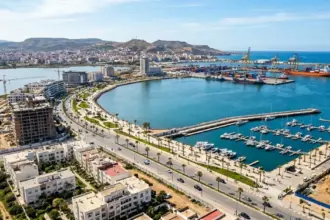

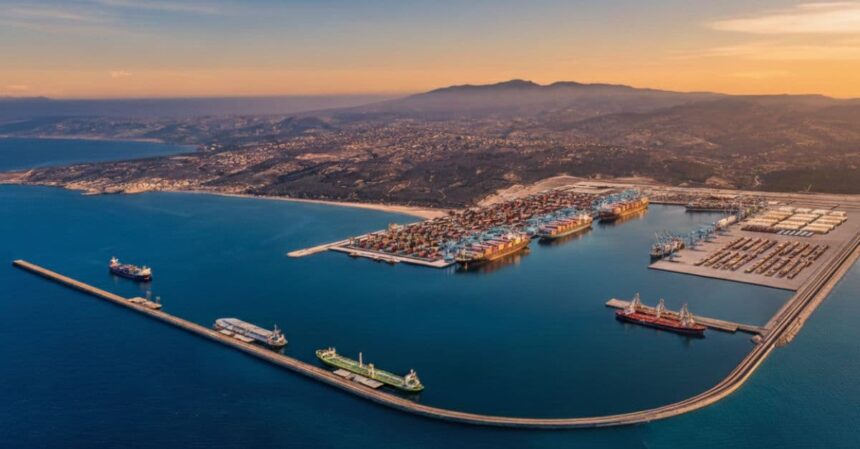
The maritime trade maps of the 21st century are being redrawn, and Morocco is at the heart of this transformation. With the near completion of the Nador West Med port complex, the Kingdom is solidifying its position as a global logistics powerhouse. Located on the strategic Betoya Bay, this massive infrastructure project follows the blueprint of the highly successful Tanger Med. However, Nador West Med brings a unique value proposition: it is designed to be the primary energy and industrial hub for the Western Mediterranean. This deep-water port is not just about moving boxes; it’s about creating an integrated economic ecosystem that links Africa, Europe, and the Middle East in a seamless flow of goods and energy.
What makes Nador West Med a “game changer” is its sheer scale and versatility. While many Mediterranean ports are constrained by urban density or shallow waters, this new complex offers vast expansion areas and the ability to host the world’s largest ultra-large vessels. By providing state-of-the-art terminals for containers, bulk cargo, and liquid hydrocarbons, Morocco is offering global shipping lines a high-efficiency alternative. The port’s location allows ships to shave off valuable hours from their journeys, reducing fuel consumption and operational costs. In an era of volatile supply chains, the reliability and strategic depth offered by Nador West Med are invaluable assets for international trade.
A vision for regional industrialization
The true genius of the Nador West Med project lies in its massive Industrial Zone. Spanning over 1,500 hectares in its initial phase, this zone is specifically designed to attract high-value manufacturing and logistics companies. By creating a duty-free environment adjacent to the port, Morocco is inviting global industries to set up shop just a stone’s throw away from European markets. Industries such as automotive parts, renewable energy components, and agri-business are expected to thrive here. This “port-plus-industry” model ensures that the value-added processes happen on Moroccan soil, creating thousands of skilled jobs and driving the socio-economic development of the Oriental region.
Integration is the keyword for this project. Nador West Med is being connected to the national railway network and a dedicated highway, ensuring that cargo can move swiftly to the interior of the country and beyond. This multimodal connectivity is a crucial factor for investors looking for stability and speed. Furthermore, the port is integrated with the Marchica lagoon development project, balancing heavy industrial growth with environmental protection and high-end tourism. This holistic approach proves that Morocco is not just building a port, but engineering a sustainable regional transformation that will benefit generations to come.
Key advantages of the complex
To understand the competitive edge of Nador West Med, one must look at the technical and economic pillars that support it. This is more than a docking site; it is a full-service maritime city. Key highlights include:
-
A world-class container terminal with a capacity of 3 million TEUs.
-
Specialized liquid bulk terminals for oil, gas, and chemical products.
-
Proximity to the Maghreb-Europe gas pipeline, enhancing energy security.
-
Advanced digital infrastructure for automated port operations and tracking.
-
Direct access to a young, trainable, and competitive workforce.
By leveraging these advantages, Morocco is positioning itself as a reliable partner for the European Union’s “near-shoring” strategy. As European companies look to bring their production closer to home to avoid Asian supply chain disruptions, Nador West Med offers the perfect combination of proximity, competitive labor costs, and world-class infrastructure. This synergy is expected to trigger a massive influx of Foreign Direct Investment (FDI), further diversifying the Moroccan economy and strengthening its resilience against global shocks.
Pioneering the Green Energy Transition
In addition to traditional logistics, Nador West Med is being built with the future in mind—specifically the Green Hydrogen economy. Morocco is already a leader in solar and wind energy, and Nador is perfectly situated to become a major export hub for green fuels. As the world moves away from carbon-heavy shipping, having a port that can provide green bunkering services will be a massive competitive advantage. The vision includes the production of green ammonia and hydrogen within the industrial zone, which can then be shipped directly to European industrial centers. This makes Nador West Med a vital node in the global energy transition.
Boosting the Oriental region’s economy
For decades, the Oriental region of Morocco was seen as a peripheral area. Nador West Med changes that narrative completely. The port is the catalyst for a massive urban and social upgrade. New vocational training centers are being established to teach logistics, maritime engineering, and industrial management to the local youth. This focus on human capital ensures that the economic gains are inclusive. The ripple effect of the port’s activity will revitalize local businesses, from hospitality to service providers, turning Nador into a vibrant, modern metropolis that can compete with other major Mediterranean cities.
Geopolitical stability and strategic partnership
Geopolitically, the port strengthens Morocco’s role as a bridge between continents. By managing two of the most important ports in the region (Tanger Med and Nador West Med), the Kingdom becomes a central actor in Mediterranean security and trade stability. This dual-port strategy provides redundancy and extra capacity, ensuring that trade flows remain uninterrupted even during peak times. International partners view this as a sign of political and economic maturity, making Morocco a preferred destination for long-term strategic projects and alliances in the Euro-Mediterranean space.
FAQ: Frequently asked questions
Is Nador West Med bigger than Tanger Med?
In terms of current container capacity, Tanger Med remains the largest (handling over 9 million containers). However, Nador West Med is launching with an initial capacity of 5 million containers (expandable to 12 million) and will feature Morocco’s first Liquefied Natural Gas (LNG) terminal, making it a larger hub for energy and heavy industrial integration.
How will this port affect the environment?
The project includes strict environmental impact assessments to protect the Mediterranean coast. It is designed with modern sustainable standards and will serve as a primary gateway for Morocco’s green hydrogen exports, helping to reduce the overall carbon footprint of regional maritime trade.
What kind of jobs will be available?
The port and its 700-hectare industrial zone will create demand for a wide range of professionals: crane operators, logistics managers, maritime engineers, and IT specialists. Additionally, specialized training programs have been launched to prepare the local workforce for roles in manufacturing, energy, and tertiary services.
When will Nador West Med be operational?
Following a meeting chaired by King Mohammed VI in January 2026, it was confirmed that the port is scheduled to begin operations in the fourth quarter of 2026, ahead of the original 2027 schedule.