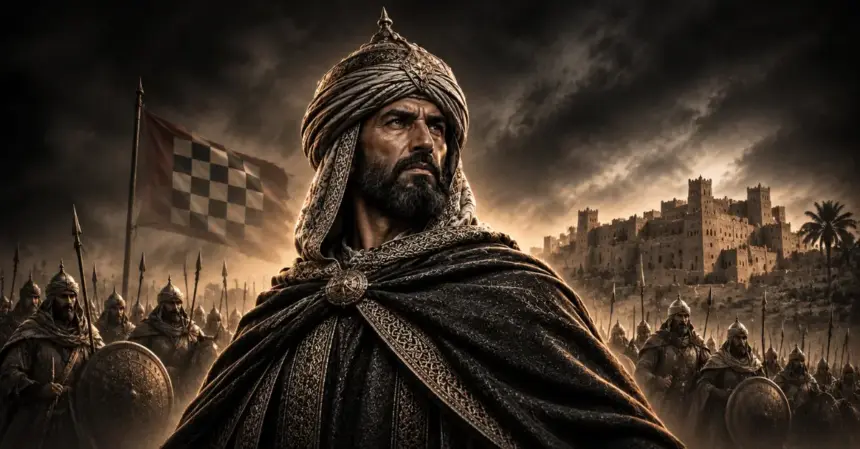
On 2 October of that same year, he entered Jerusalem, ending 88 years of Frankish rule. At the same time, Morocco was the centre of the Almohad Empire, one of the great powers of the Mediterranean. The relations between Saladin and Morocco, and the Moroccan presence in Jerusalem after 1187, are a real but often oversimplified chapter of this history.
The context of the Crusades and the rise of Saladin
The First Crusade ended in 1099 with the capture of Jerusalem. For almost fifty years, the Latin states held their ground against divided Muslim powers. Nur ad-Din, ruler of Aleppo and Damascus, began to turn the tide. When he died in 1174, Saladin, already master of Egypt, emerged as the main leader of the resistance.
Saladin (Salah ad-Din Yusuf ibn Ayyub) was born around 1137-1138 in Tikrit, into a Kurdish family in the service of the Zengids. Trained militarily by his uncle Shirkuh, he became vizier of Fatimid Egypt in 1169, abolished the Shiite caliphate in 1171 and gradually extended his authority over Syria. He founded the Ayyubid dynasty. His central goal became the recapture of Jerusalem.
Morocco under the Almohads and Ya‘qub al-Mansur
In the 12th century, Morocco was the heart of the Almohad Empire. Founded in the High Atlas by Ibn Tumart and consolidated by Abd al-Mu’min, this empire stretched under Caliph Ya‘qub al-Mansur (1184-1199) from Morocco across much of al-Andalus and Ifriqiya. Al-Mansur defeated the Banu Ghaniya in Ifriqiya in 1187-1188, then inflicted a major defeat on Alfonso VIII of Castile at Alarcos in 1195. Almohad Morocco thus had a solid land army and, above all, a fleet regarded as one of the most powerful in the Mediterranean.
The relations between Saladin and Morocco
After the victory at Hattin and the recapture of Jerusalem, the Third Crusade got under way. Saladin sent an embassy to Marrakesh in 1189-1190, led by Ibn Munqidh. The letters, preserved notably by Abu Shama, asked for Moroccan ships to be sent to block the Strait of Sicily and disrupt the supply lines of the Crusaders besieging Acre.
Ya‘qub al-Mansur received the ambassador with honour but did not send the requested fleet. Contemporary sources (Abu Shama, Ibn Khallikan) are clear on this point. The reasons were mainly Morocco’s military commitments in Ifriqiya and al-Andalus, as well as earlier tensions over the raids of Qaraqush and the Banu Ghaniya, which Saladin had more or less tolerated. Ibn Khaldun, in the 14th century, claims that a fleet of 180 ships was eventually sent.
Saladin’s army was mainly made up of Egyptian, Syrian and Jazira contingents, Mamluks, as well as Moroccans.
Hattin and the reconquest of Jerusalem
On 3-4 July 1187, Saladin drew the Frankish army away from its water sources. At the Horns of Hattin, the Crusaders were surrounded and annihilated. King Guy of Lusignan was captured and the True Cross was taken. This victory opened the road to Jerusalem, which surrendered on 2 October 1187. Saladin negotiated ransoms and avoided a general massacre. The city was re-Islamised.
The Moroccan Quarter in Jerusalem
In 1193, al-Afdal, Saladin’s son, established as a waqf the quarter at the foot of the western wall of the Haram al-Sharif, for the benefit of the people of the West. In Arabic sources, it is called Ḥārat al-Maghāriba. In Moroccan memory and in many accounts, this quarter is identified as the Moroccan Quarter. It welcomed pilgrims, students and families from Morocco. A Maliki madrasa, the Afdaliyya, was founded there.
Medieval sources do not say that Saladin personally granted these lands as a direct reward to Moroccan soldiers who fought in 1187. The foundation was primarily driven by the desire to repopulate Jerusalem and to host pilgrims from Morocco. Over time, the quarter became strongly associated with the Moroccan presence in Jerusalem. The Moroccans’ Gate (Bab al-Maghariba) preserves its memory.
A Moroccan memory in Jerusalem
On 10 June 1967, three days after the capture of East Jerusalem, the quarter was razed on the orders of the Israeli authorities to create the Western Wall plaza. About 135 houses were destroyed within hours and the inhabitants were expelled. A physical trace of the historic Moroccan presence in Jerusalem disappeared.
The ties between Morocco and Jerusalem cannot be reduced to a military alliance in 1187. They run through Almohad diplomacy, pilgrimage, the settlement of Moroccan families and the founding of a quarter that endured until 1967. Almohad Morocco was a power with which Saladin sought dialogue. There was no documented large-scale military aid. However, after the reconquest, Moroccans settled permanently in the Holy City.
This story deserves to be told accurately: a real diplomatic request, a refusal of naval aid, and a later Moroccan presence in Jerusalem embodied by a quarter destroyed in 1967. This is where the most concrete and lasting link between Morocco and Jerusalem in that period lies.