

They are no longer just surveillance or strike tools; they are becoming a segment of the value chain where mid-sized countries can find a place more easily than in traditional combat aviation. Morocco provides a recent example, and the figures published this week by the European Bank for Reconstruction and Development (EBRD) make it possible to place it with a fair degree of precision.
According to the EBRD’s Transition Report 2026-27, released on November 17, Moroccan exports of inputs used to manufacture drones increased 1.6-fold between the 2019-2021 period and 2024. That represents growth of 60%. The institution relies on CEPII trade data to measure these flows. The report specifies that these inputs belong to a sector with both civilian and military applications. The figure is notable because it predates the more recent announcements of factory projects on Moroccan soil.
This growth puts the Kingdom on a par with Slovenia and Slovakia, whose component exports also rose by 60% over the same period. Bulgaria doubled its exports, while Serbia multiplied them by 3.2. These developments fit into a broader context: the barriers to entry in the drone segment are considered lower than in conventional defense equipment, which allows mid-sized economies to build positions in components and, sometimes, in finished systems.
Key figures on the growth of drone input exports (2019-2021 to 2024, CEPII data via the EBRD)
- Morocco, Slovenia and Slovakia: multiplied by 1.6 (+60%)
- Bulgaria: multiplied by 2 (+100%)
- Serbia: multiplied by 3.2 (+220%)
- Türkiye: 41% of global exports of heavy drones (mainly military)
- United States: 21% of the same exports
- Israel and China: 11% each
- Small drones (mostly commercial): China 65%, Netherlands 7%, Malaysia 6.7%
These data do not give the absolute volumes Morocco exports in this specific niche. They measure relative momentum. They do, however, fit into an industrial fabric that is already visible: Moroccan aerospace exceeded 29 billion dirhams in exports in 2025, with a local integration rate above 40%, driven in particular by assembly and wiring systems. Some of these skills (composites, electronics, wiring, precision machining) are dual-use.

In 2024, the Kingdom was therefore already exporting components for this sector, while several local military drone production projects were still in preparation. Since then, the initiatives have materialized. The French group Harmattan AI, founded by Franco-Moroccan entrepreneur Mouad M’Ghari, signed a letter of intent in October 2026, on the sidelines of the Marrakech Air Show, with the National Defense Administration to develop and produce the IRIFI system in Morocco. It is an autonomous strike drone announced with a range of up to 2,000 km, GNSS-independent navigation and visual guidance in the terminal phase. The company plans an industrial setup near Casablanca (the Nouaceur area in particular) and a research center in Rabat, with the ambition of serving African and Middle Eastern markets. Production of critical components is presented as set to take place locally.
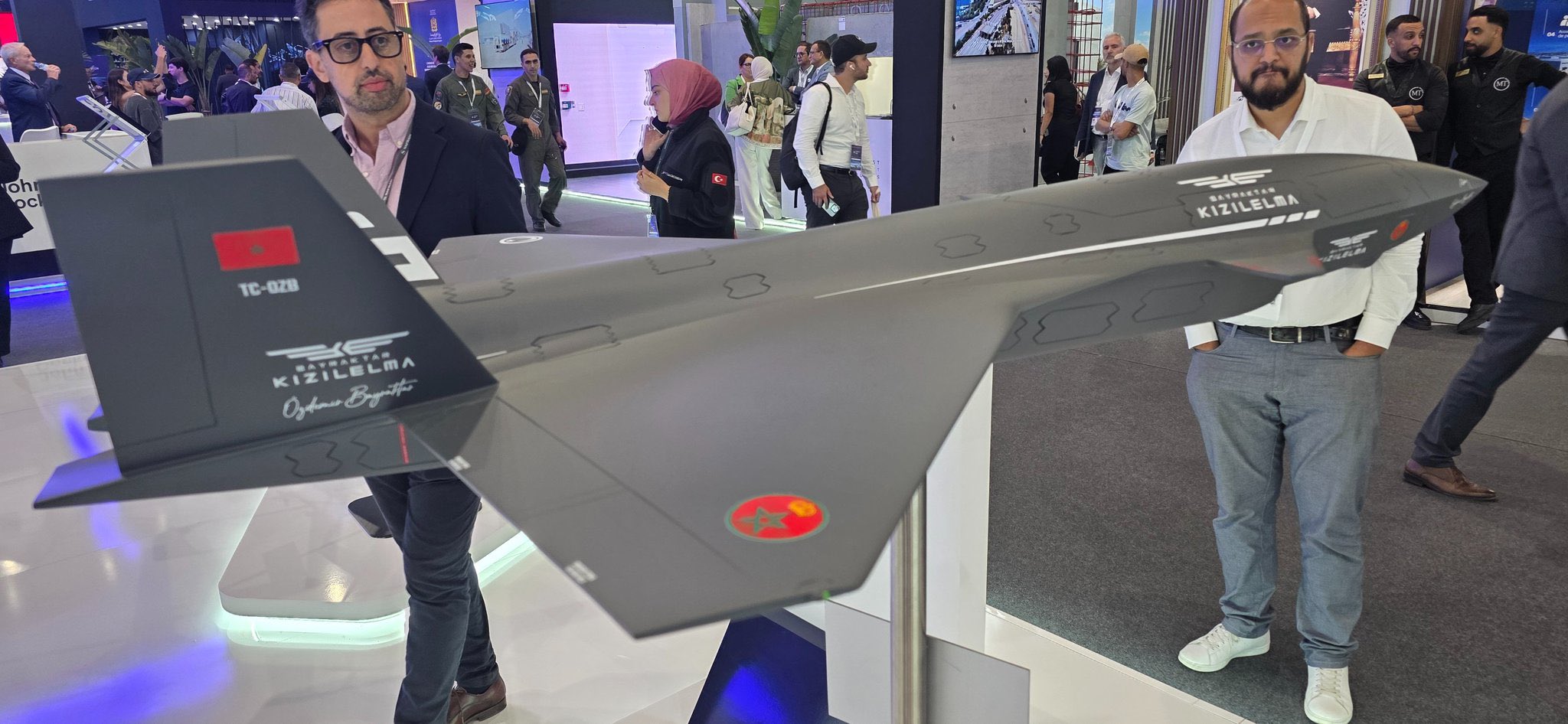
In Benslimane, two other projects are moving forward in parallel. One, led by BlueBird, the Israeli subsidiary of the IAI group, concerns SpyX-type loitering munitions. The other, via the company Atlas Defense linked to Türkiye’s Baykar, aims at the production and maintenance of Bayraktar-type platforms. These installations rely on transfer agreements and on Morocco’s stated desire, expressed for several years, to reduce its purely import-based dependence in the field of unmanned systems.
The EBRD report places these movements within the global landscape. Türkiye accounts for 41% of global exports of heavy drones, mainly military, ahead of the United States (21%), Israel and China (11% each). In the small drone market, which is mostly commercial, China dominates with 65% of exports, followed by the Netherlands (7%) and Malaysia (6.7%). Poland also stands out in the intermediate classes. These market shares are a reminder that the major players remain concentrated, but that windows of opportunity exist in sub-segments.
Why does this matter for the Mediterranean basin? First, because drones have become a central element of regional military balances, from maritime surveillance to precision strikes and electronic warfare. Morocco, which already has a substantial fleet acquired from several suppliers (notably Türkiye, Israel and the United States), is seeking to bring part of the chain in-house. This responds to a logic of partial sovereignty: having maintenance and adaptation capabilities and, eventually, regional export capacity. Africa and the Middle East are explicitly cited as target markets by Harmattan AI.
Economically, the stakes echo those of the automotive and aerospace sectors: attracting investment that generates skilled jobs, local subcontractors and higher-value exports. The EBRD notes that the economies in its regions can benefit from rising defense and AI spending, provided they have pre-existing industrial capacity. Morocco has built such capacity in aerospace and automotive; the drone segment is a possible extension.
Views differ on the real scope of these ambitions. For Moroccan backers and industrial partners, it is a move up the value chain consistent with the Kingdom’s industrial strategy and a diversification of partners (France, Türkiye, Israel). More cautious observers point out that the projects often remain at the letter-of-intent or start-up stage, that announced production volumes are not always specified, and that mastery of the most sensitive components (sensors, guidance software, advanced propulsion systems) remains limited. Risks of technological dependence on the initial partners, or of stricter export controls from some supplier countries, are also raised. Finally, the dual-use nature of the technologies raises questions of regulation and regional perception, particularly amid persistent tensions in North Africa and the Middle East.
The 60% increase in input exports before the new factories even come online shows that Morocco did not enter this segment solely through recent military projects. A base already existed. The open question is how far this base can support the production of complete systems for regional markets, and under what conditions (real transfers, volumes, local integration, export markets). The next production reports and the trade data for 2026-2027 will provide more concrete evidence than the current growth rates.
FAQ
What exactly does the EBRD mean by “drone inputs”?
Components and materials used in manufacturing unmanned aircraft, whether civilian or military. The data come from CEPII and reflect relative changes, not detailed absolute volumes for Morocco.
Are the factories announced in Benslimane and with Harmattan AI already in production?
The projects are moving forward (recruitment, letters of intent, training), but serial production timelines are only partially disclosed. BlueBird has mentioned a start of operations around April 2026 for the Benslimane site; Harmattan aims for local production of critical components.
Does Morocco already export complete drones?
The EBRD data cover components. The ongoing projects aim at producing systems (IRIFI, SpyX, Bayraktar platforms), oriented toward national needs and, eventually, regional markets. Export volumes of finished systems are not yet documented on a large scale.
Why does Türkiye appear so dominant in heavy drones?
Because it has developed a complete industrial sector, notably through Baykar, and accounts for 41% of global exports in the heavy drone category, according to the EBRD report.