
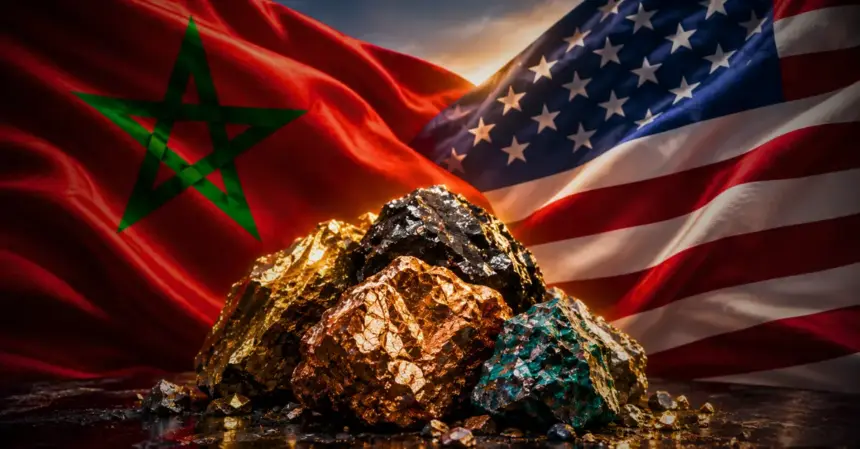
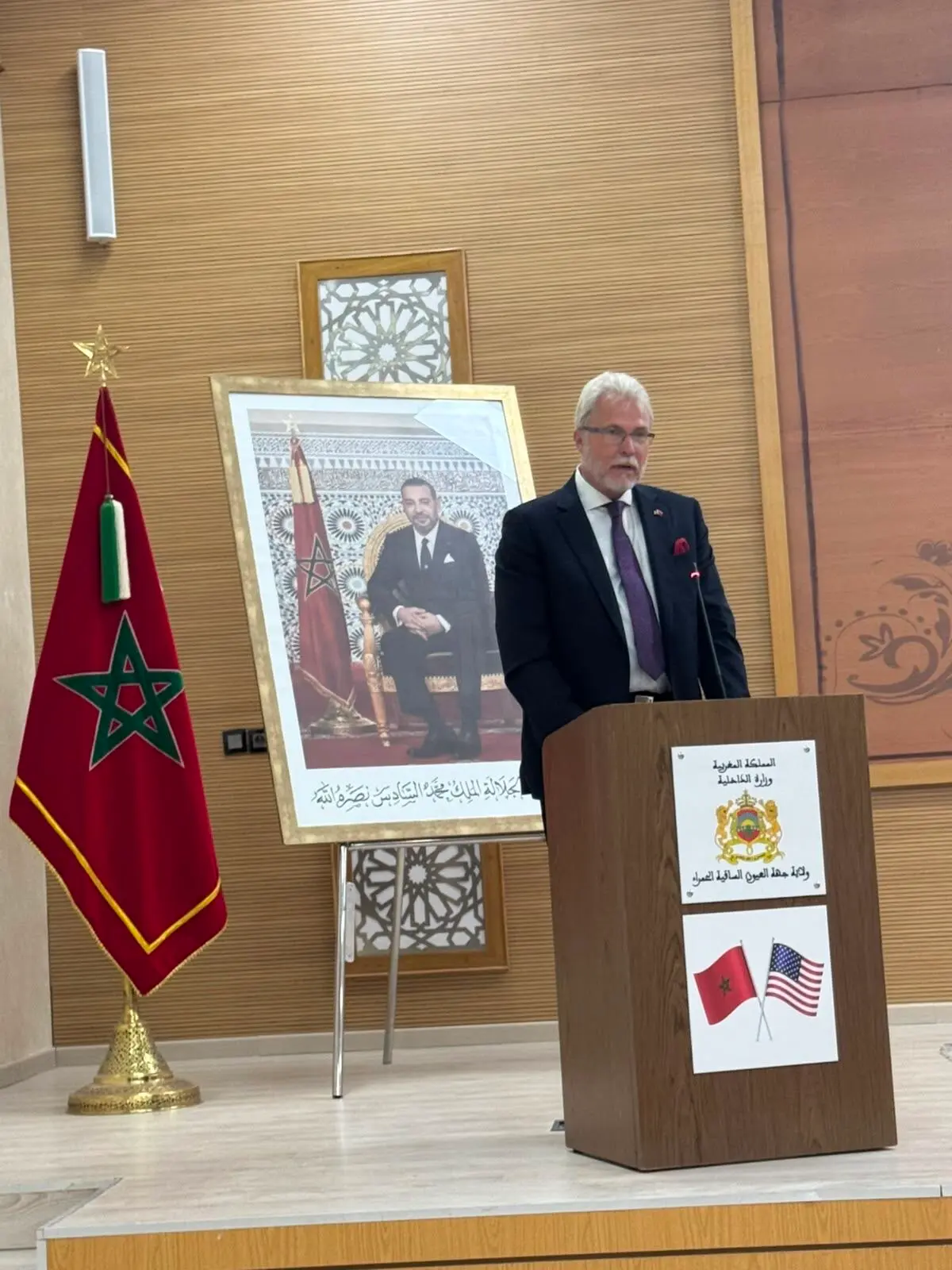
The information was highlighted by the Kingdom’s ambassador to the United States, Youssef Amrani. It reflects a shared determination to deepen an economic partnership that both capitals consider still lagging behind their political and strategic relationship. I propose to examine its significance, Morocco’s strengths and the areas of uncertainty.
Key takeaways
- The United States has designated Morocco a priority market for critical minerals, energy and LNG, according to Ambassador Youssef Amrani.
- A green ammonia project in Laayoune aims for 560,000 tonnes per year, with 900 megawatts of electrolysis capacity.
- The project is only at the preliminary engineering study stage, funded by the USTDA.
- Morocco is highlighting its automotive and aerospace industries, as well as its African initiatives.
- Economic relations are meant to rise to the level of the strategic partnership between the two countries.
A designation announced before the American financial community
It was at a conference of the Investment Company Institute, a global association representing the asset management sector and individual investors, that Youssef Amrani referred to this designation. The choice of platform is not insignificant. This was not a conventional diplomatic forum, but an audience of asset managers, that is, players capable of directing capital toward infrastructure and industrial projects.
The ambassador presented the convergence of priorities as the “main starting point” of the cooperation. In Washington, he noted, supply chain security, strategic minerals and trusted technology systems now sit at the top of the agenda. According to him, these priorities are “fully shared” by Morocco.
I note that these remarks belong to diplomatic discourse, which by nature is geared toward promoting the country the speaker represents. The “priority market” designation was put forward by the ambassador. The concrete details of this classification, such as funding mechanisms or associated programs, have not been specified at this stage. We will add them to this article as soon as they are documented by official American sources.
Why critical minerals matter so much
Critical minerals are resources essential to strategic sectors: batteries, electric vehicles, electronics, defense and renewable energy. Their extraction, and above all their refining, is highly concentrated geographically, which exposes industrialized economies to dependencies considered risky. This explains the proliferation, in recent years, of American and European initiatives aimed at diversifying their sources of supply.
In this context, a stable partner, close to Europe and already tied to the United States by a trade agreement, is of obvious interest. Morocco also holds a unique position in phosphates: according to estimates from the United States Geological Survey (USGS), it holds the largest known reserves in the world. Phosphates do not appear on every list of critical minerals, but they are at the heart of global food security through fertilizers, and their industrial sector is now extending toward battery materials.
The term “critical” also varies from one country and administration to another, and the lists evolve. This element of uncertainty calls for caution when assessing the significance of a priority market designation.
Energy, from LNG to green ammonia
The energy component of the statement is the most concrete. The ambassador cited a green ammonia project planned in Laayoune, led by ORNX Green Hydrogen. The U.S. Trade and Development Agency (USTDA) funded a preliminary engineering study for the project in July. The facility is expected to produce around 560,000 tonnes of green ammonia per year, with an electrolysis capacity of 900 megawatts.
A few words of explanation are in order. Green ammonia is made from hydrogen produced by electrolysis of water using renewable electricity. It is used to manufacture fertilizers and can also serve as a carrier to transport hydrogen or as a fuel in maritime transport. For Morocco, which enjoys strong sunshine and steady winds, it is a way to make the most of its renewable potential and reduce its dependence on imported fertilizers and fossil fuels.
A preliminary engineering study is, however, still an early stage. Between this point and a final investment decision, financing, commercial outlets and permits must still be secured. Many green hydrogen projects around the world have suffered delays or been abandoned for lack of immediate profitability. I therefore regard this project as a signal of interest, not as a done deal.
As for LNG, the mention of a priority market echoes Morocco’s search for a more diversified gas supply, and the positioning of American producers, who have become among the world’s leading exporters of liquefied natural gas. The precise terms of cooperation in this area were not detailed in the reported statements.
The industrial strengths put forward
Youssef Amrani emphasized the Kingdom’s industrial capabilities, describing it as Africa’s leading car producer and a rising aerospace hub. He added that major American companies are already established there.
This argument is central. A supply chain is not limited to a raw resource. It requires factories, ports, a skilled workforce and a predictable regulatory framework. By highlighting the automotive and aeronautics sectors, Moroccan diplomacy seeks to present the country as a processing and assembly platform, and not merely as a supplier of raw materials. It is also a way of responding to the goal, shared by several economies, of relocating production capacity or bringing it closer to their markets.
A historic partnership to build on
The ambassador placed this approach within a long history. He recalled that Morocco was the first country to recognize the independence of the United States, and that 2026 will mark the 250th anniversary of bilateral relations. The year also marks the 20th anniversary of the free trade agreement between the two countries, the only one Washington has concluded with an African state.
According to him, economic relations should reach the level of excellence of the strategic partnership, which reflects, he said, the shared ambition of King Mohammed VI and U.S. President Donald J. Trump. This phrasing points to a gap that observers regularly note: the political and security dialogue is dense, but trade and American investment in Morocco remain modest relative to the potential. The free trade agreement has certainly boosted flows, but the United States remains a less important trading partner for the Kingdom than the European Union.
The Kingdom’s African ambitions
The final part of the speech concerns Africa. Youssef Amrani highlighted King Mohammed VI’s Atlantic Initiative, which aims to facilitate access to the Atlantic Ocean for some twenty landlocked Sahel countries. He also mentioned the African Atlantic gas pipeline project linking Nigeria to Morocco, with a planned extension toward Europe.
These initiatives are presented as a way to connect African economies, develop concrete projects that support regional integration and create opportunities for international partners. For American investors, the argument is clear: Morocco offers itself as a gateway to a space far larger than its domestic market alone.
The Nigeria-Morocco pipeline is, however, a very large-scale undertaking that crosses many countries and whose full financing remains a challenge. Its completion will depend on technical, financial and political factors that go well beyond the bilateral framework.
Political stakes and reservations
A partnership of this kind cannot be read in economic terms alone. Laayoune, where the green ammonia project is to be located, lies in the Southern provinces, which Morocco administers and whose status is contested by the Polisario Front, backed by Algeria. The United States recognized Moroccan sovereignty over this territory in December 2020, under the first Trump administration. Any economic cooperation in this area is therefore part of a broader legal and diplomatic debate, which some actors, notably within the United Nations and the African Union, continue to follow closely.
Other reservations concern dependence. A country that becomes a “priority market” for a major power gains visibility and capital, but it is also exposed to shifts in American policy, which can change with political turnovers and trade priorities. Morocco also maintains close relations with the European Union, with China, which is investing notably in the battery sector, and with the Gulf countries. Its room for maneuver will depend on its ability not to be locked into a single axis.
Key figures
- 560,000 tonnes of green ammonia per year, the expected output of the ORNX project in Laayoune
- 900 megawatts of planned electrolysis capacity
- 2026, the 250th anniversary of bilateral relations according to the ambassador
- 20 years, the age of the free trade agreement between the two countries
- Some twenty Sahel countries concerned by the Atlantic Initiative
What to watch
Three elements will help gauge the real significance of this designation. The first is its translation into funding: commitments from American agencies, private investment, guarantees. The second is the progress of the projects cited, in particular the ORNX project, whose next step will be a more advanced feasibility study, followed by an investment decision. The third is Morocco’s ability to build an attractive industrial and regulatory offering over the long term, notably in the refining and processing of minerals.
Ultimately, the open question is one of depth. Declarations of intent are plentiful in international relations, and only projects carried through to completion turn a priority classification into tangible economic change. That is what we will be following in the coming months.
FAQ
What does “priority market” mean for the United States?
According to the Moroccan ambassador, Morocco is identified by Washington as a key partner for critical minerals, energy and LNG. The concrete mechanisms of this designation have not been publicly detailed at this stage.
Where does the green ammonia project in Laayoune stand?
It is at an early stage. The USTDA funded a preliminary engineering study in July. The project targets around 560,000 tonnes per year with 900 megawatts of electrolysis, but no final investment decision has been announced.
Why is the free trade agreement being highlighted?
It is twenty years old and remains the only agreement of its kind concluded by the United States with an African country. It provides an existing trade framework on which cooperation in strategic sectors can build.