

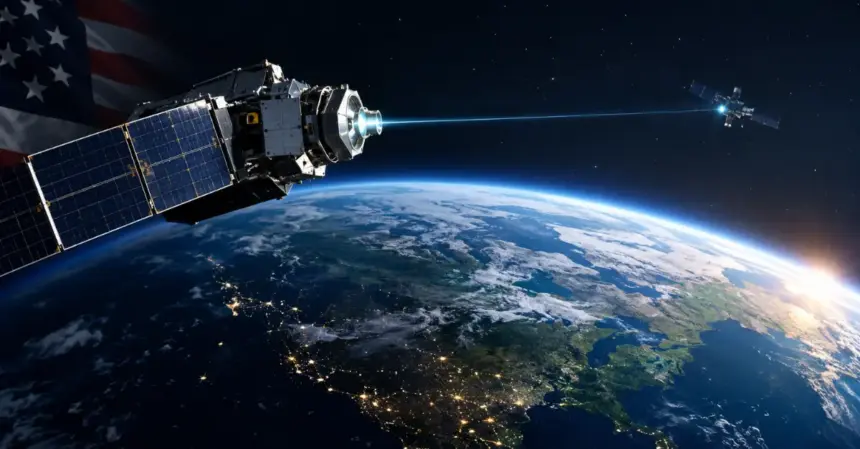
Some statements pass almost unnoticed, and their significance only becomes clear later. The one made by US Air Force Secretary Troy Meink may be among them. According to The Guardian, he said the United States now has “space control” weapons in orbit. There was no president or secretary of state to announce it, and no technical detail was offered. But the meaning is clear: what used to be unspoken has become an acknowledged fact.
What Washington actually said
I will stick to what is established. Troy Meink oversees the Air Force and, by extension, the Space Force, created in 2019 during Donald Trump’s first term. He said the United States remains ready to respond to evolving threats and that, to that end, it has space control weapons in orbit.
Asked about the nature of these systems, a Space Force spokesperson deliberately stayed vague. “Space control,” he explained in essence, can involve kinetic and non-kinetic means to affect an adversary’s capabilities. He added that these capabilities can be used for both defensive and offensive purposes.
Two terms need explaining. A kinetic weapon acts through physical impact: a projectile, a missile, a vehicle that strikes its target. A non-kinetic weapon acts without contact: jamming, cyberattacks, or blinding a sensor with a laser or an electromagnetic pulse.
Washington justifies its move by the lack of transparency from Moscow and Beijing, which it says also have weapons in orbit. These accusations come from the American side and have not, at this stage, been publicly documented. China has denounced what it calls preparation for war in space, and Russia reiterates its opposition to any weapon in orbit.
What international law prohibits, and what it leaves open
Many readers assume space law bans weapons in orbit. The reality is more nuanced. The 1967 Outer Space Treaty, signed by the United States and the USSR among others, prohibits placing nuclear weapons or any other weapons of mass destruction in orbit. It does not, as such, prohibit conventional weapons in orbit.
That prohibition has a history. In 1962, the United States detonated a nuclear bomb at an altitude of roughly 400 km over the Pacific in the Starfish Prime test. The electromagnetic effects were felt as far as Hawaii, disrupting electronic equipment and communications. Several satellites were damaged. The episode convinced both superpowers that such tests were too dangerous. A 1963 treaty banned nuclear tests in the atmosphere and in space, and the 1967 treaty completed the framework for the weapons themselves.
Current law therefore leaves a considerable gray area, and that is the space in which great-power competition now operates.
Why orbit appeals so much to military planners
The military appeal is obvious. A missile fired from Chinese territory toward the United States must cross the Pacific, where it can be intercepted by several layers of defense: bases in Guam, Hawaii, Alaska and California, plus ships deployed in the region. The longer the trajectory, the more time the defender has.
A weapon placed in orbit a few hundred kilometers above an adversary drastically shortens that time. The interception window shrinks to the point where defense becomes very difficult. This logic fuels the idea of a “fourth pillar” of nuclear deterrence, after land-based silos, submarines and aircraft. An orbital delivery system would complicate the calculations of any adversary contemplating a first strike.
The concern is not purely theoretical. In February 2024, US officials worried about a possible Russian project to put a nuclear anti-satellite weapon in orbit, which would have violated the 1967 treaty. Washington reportedly asked countries such as India and China to press Moscow. Russia denied the allegation.
What kinds of weapons are we talking about
Without official details, we can only reason from what is known.
Capabilities already documented
Spy satellites, which handle imagery and electronic eavesdropping, have existed for a long time. There are also so-called “inspector” or rendezvous satellites, able to approach another spacecraft to observe it, jam it or interfere with its sensors.
A newer class of vehicles fitted with robotic arms is particularly worrying. In 2022, China tested a satellite that docked with a defunct BeiDou navigation satellite and moved it to a “graveyard” orbit. According to the video this article draws on, a new Chinese vehicle with a manipulator arm was reported in April 2026. The reusable spacecraft observers call “Shenlong,” whose mission Beijing has not officially detailed, reportedly returned to Earth on 24 September after about three months in orbit, during which it allegedly captured and released the same satellite several times. These elements need to be confirmed with specialized sources.
On the American side, the X-37B military space plane, which has flown classified missions for more than a decade, shares similarities with this family of vehicles, although its orbits have mostly been away from heavily used zones.
Ground-based weapons
Ground-based anti-satellite systems are already in service. A laser or an electromagnetic pulse is aimed at a satellite whose highly predictable trajectory is known. According to the information relayed in the video, the Space Force integrated the mobile Meadowlands system in June 2026, a directed-energy weapon designed to temporarily neutralize adversary satellites.
What “space control” might cover
Several hypotheses coexist. The first is robotic vehicles able to inspect, grab or move adversary objects. The second is directed-energy weapons, lasers or electromagnetic, mounted on satellites, either to neutralize other satellites or, in theory, to target the Earth. The third is missile interceptors, in the lineage of the 1980s Strategic Defense Initiative, which today’s technology makes more credible. This ties into the “Golden Dome” project Donald Trump has announced publicly, whose space component is not expected to mature before 2028 according to the Pentagon’s timeline. Finally, there are kinetic weapons, with their consequences.
None of this is confirmed. It would be imprudent to claim, as some suggest, that these weapons explain Donald Trump’s remarks about a “discombobulator” after the US operation in Venezuela. That is conjecture, not an established fact.
The debris risk
The most serious argument against arming orbit is the debris risk. Any collision at orbital velocity, on the order of several kilometers per second, breaks objects into thousands of fragments that remain in orbit and can strike other satellites. In 1978, NASA scientist Donald Kessler described the risk of a chain reaction, now known as Kessler syndrome: beyond a certain threshold, collisions feed on themselves and some orbits become unusable.
States are aware of this risk and have taken it anyway. The United States conducted anti-satellite tests in the 1960s and again in 1985. China destroyed one of its weather satellites in 2007, scattering a large cloud of debris. Russia destroyed one of its satellites in November 2021, forcing the International Space Station crew to take shelter.
Placing weapons in orbit worsens the equation: in a conflict, those weapons become legitimate targets, and every attempt to neutralize them generates more debris. Modern societies depend on satellites for navigation, communications, finance, weather forecasting and agriculture. The US military is especially dependent on them, which is both its strength and its vulnerability.
Two readings of the announcement
There are two ways to understand this move. The first, Washington’s own, is one of transparency: since everyone is developing these capabilities, better to acknowledge it and set rules. The second is more critical: by normalizing weapons in orbit, the United States accelerates an arms race that China and Russia are also fueling.
Neither reading excludes the other. The Secure World Foundation, cited in the video, estimates that around a dozen countries, including France, India, Japan, the United Kingdom, Australia, Israel, Iran and the two Koreas, are developing military space capabilities. Whether some will follow the American example remains to be seen.
The scenarios worrying experts
Several situations raise legal and strategic problems with no clear answer:
- A state such as North Korea places a nuclear warhead in orbit. Could trying to move it trigger an explosion?
- Does a commercial or allied satellite that supplies intelligence to a belligerent become a legitimate target?
- A national spy satellite is captured by a foreign vehicle. What recourse exists, and with whom?
- A directed-energy weapon is deployed in orbit. Should it be treated as a weapon of mass destruction?
No sanction or verification mechanism exists today to settle these cases.
An open question
What I take from this announcement is less the technical revelation, still unknown, than the shift in posture. For decades, space powers maintained a comfortable ambiguity. That ambiguity has just cracked. It now falls to diplomacy to show whether this transparency opens the way to rules or merely confirms a race already under way.
FAQ
Are weapons in space prohibited?
Only nuclear weapons and weapons of mass destruction are banned in orbit, under the 1967 treaty. Other weapons are not expressly prohibited, which leaves a legal gray area.
What is a kinetic weapon?
It is a weapon that destroys its target through physical impact, such as a projectile or a vehicle that collides with it. It contrasts with non-kinetic weapons, such as jamming or lasers.
Why is space debris a problem?
Debris stays in orbit at very high speed and can damage other satellites. Excessive accumulation could make some orbits unusable, a scenario known as Kessler syndrome.
Has the United States specified the nature of these weapons?
No. Officials refer to kinetic or non-kinetic means for both defensive and offensive use, without further detail.