

Saturday, 19 Sep 2026
  • The interview
  • Moroccans
  • Hardware test
  • Start-ups
  • My favorites
  • Advertisement
  • Contact
Business Club
Silicon Valley Maroc – le mag tech marocain
  • Tech
  • AI
  • Cybersecurity
  • Business
  • Real estate
  • Expat
  • Military
    MilitaryAfficher plus
    Armes hypersoniques, pourquoi le Maroc doit s'y préparer avant 2035
    Hypersonic weapons, could this become Morocco’s next major military leap

    Hypersonic weapons have stopped being a theoretical curiosity reserved for superpowers, and…

    Par Foxtrot
    Le Maroc, seul pays africain classé dans le top 20 mondial de la sécurité publique en 2026
    Morocco Ranks among Top 20 Nations Worldwide for public security, the only African country on the list

    Morocco public security 2026 has carved out a distinctive spot in this…

    Par Hafid Driouche
    Moulay Hassan I : le Maroc muscle sa Marine royale avec son patrouilleur le plus moderne
    Moulay Hassan I: Morocco upgrades Its Royal Navy with Its most advanced Patrol vessel yet

    The Moulay Hassan I patrol vessel officially joined the Royal Moroccan Navy…

    Par Foxtrot
    Missile LORA au Maroc
    LORA missile Morocco, the 430 km jump that redraws the FAR’s deterrence

    The LORA missile and Morocco are not yet bound by a signed…

    Par Foxtrot
    Harmattan AI Rabat, 50 ingénieurs pour faire décoller l'intercepteur Gobi marocain
    Harmattan AI Rabat, 50 engineers to launch the Gobi Interceptor in Morocco

    The French defense technology company has established an engineering center in Rabat…

    Par Foxtrot
  • English
    • Français
    • العربية المغربية
    • English
    • Español
  • Tourisme
  • Numérique
  • Business
  • Finance
  • Marketing
  • Apple
  • Claude
  • Google
  • Grok
  • OpenAI
  • USA
  • Europe
  • Afrique
  • Asie
  • Golfe
  • 🇲🇦
  • Casa
  • Rabat
  • Marrakech
  • Tanger
  • Agadir
  • Fès
  • Meknès
  • Oujda
  • Nador
  • Essaouira
  • Dakhla
  • Kenitra
  • Laâyoune
Redimensionnement de policeAa
Silicon Valley Maroc – le mag tech marocainSilicon Valley Maroc – le mag tech marocain
Rechercher
  • Tech
  • AI
  • Cybersecurity
  • Business
  • Real estate
  • Expat
  • Military
  • English
    • Français
    • العربية المغربية
    • English
    • Español
Vous avez déjà un compte ? Se connecter
Suivez-nous
  • Dakhla
  • Casa
  • Marrakech
  • Tech
  • Rabat
  • Maroc
  • Plan du site
  • Contactez-nous
© 2026 - Colmar.tech
Silicon Valley Maroc – le mag tech marocain > Blog > Maritime > Morocco’s new shipping route bypasses Spain
MaritimeMorocco

Morocco’s new shipping route bypasses Spain

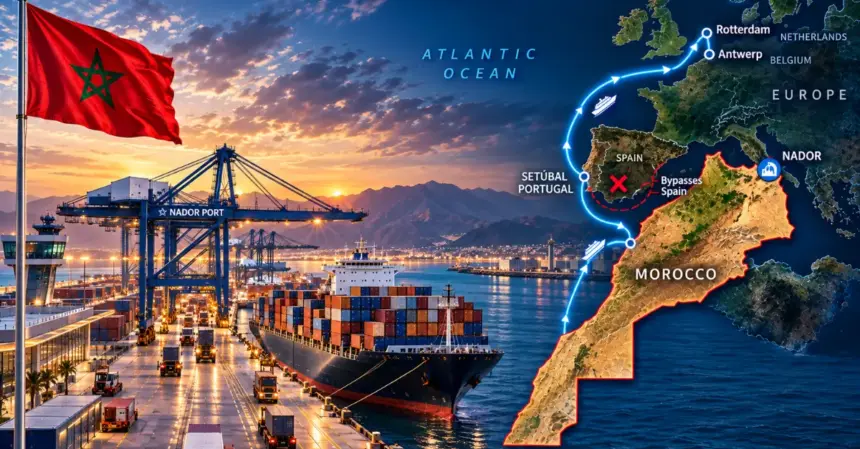
A new shipping route has just changed the game for Moroccan exporters: since September 10, 2026, Dutch carrier WEC Lines has been running a direct link between Nador and Setúbal, Portugal, without going through the Spanish overland corridor.

Julie - Sanchez
Dernière mise à jour : 17 September 2026 23h25
Julie - Sanchez
Partager
Maroc, la nouvelle route maritime qui contourne l'Espagne
Partager

In practical terms, goods from northeastern Morocco can now reach Northern Europe by sea, with a crossing of just three days between the two ports.

I’ve been following this story for several months, and this launch confirms a deeper trend: Morocco is methodically diversifying its maritime access points so it no longer depends on a single logistics corridor. This isn’t a technical detail reserved for freight professionals — it’s a strategic signal worth paying attention to.

A weekly service built for agri-food exports

The new service, named ISS-PT, runs on two vessels with a capacity of 868 TEU each, operating on a 14-day rotation with weekly departures. That technical choice is no coincidence: WEC Lines is primarily targeting agricultural and agri-food exporters, a sector where every day of transit counts.

The fleet will offer refrigerated containers in 40 and 45-foot sizes, suited to frozen and perishable goods, along with larger units designed to carry European-format pallets. It’s a detail that speaks directly to fruit and vegetable exporters in northern Morocco, a sector where freshness on arrival makes all the difference to margins.

Along the route, the ship also calls at several Spanish ports — Málaga, Gibraltar, Huelva — before continuing on to Portugal. The itinerary touches Spain without depending on it: that’s the real nuance of this new route.

Why bypassing Spain matters

Until now, most Moroccan freight bound for Northern Europe traveled overland, crossing Spain and then France. A long trip, costly in fuel, and above all vulnerable to disruption: trucker strikes, border congestion, or the occasional diplomatic tension between Rabat and Madrid.

With this direct maritime link, transit times become predictable. Once containers are transshipped in Setúbal onto other WEC Lines services, the announced delivery times give a good sense of the gain:

  • Montoir (France): about three days
  • Teesport (UK): about five days
  • Moerdijk (Netherlands): about six days
  • Rotterdam: about seven days
  • Antwerp: about eight days

In other words, an exporter in Nador can now reach the major port hubs of Northern Europe — Rotterdam, Antwerp, Hamburg, Liverpool, Dublin — without a single truck crossing the Iberian Peninsula. For a company exporting several times a week, this modal shift represents a genuine reduction in logistics risk, beyond the question of cost alone.

Another piece in Morocco’s port strategy

This service didn’t come out of nowhere. It fits into a port investment policy Morocco has pursued for over a decade, anchored by two flagship projects.

On one side, Tanger Med, which since opening in the 2000s has become one of the busiest container ports in Africa and the Mediterranean basin. On the other, the Nador West Med complex, sized for an initial capacity of 3 million TEU, whose phased rollout is meant precisely to strengthen the Nador region’s connections to Northern Europe.

In my view, it’s this staged rollout of Nador West Med that makes WEC Lines’ timing particularly well-chosen. The new terminal doesn’t need to be fully operational to capture traffic: carriers are already anticipating demand and positioning themselves before competitors settle into these new routes.

Cutting reliance on a single corridor

On the geopolitical level, the stakes go beyond pure logistics. Historically, Moroccan trade flows to Northern Europe depended almost entirely on the route through Spain. A single point of passage is a point of fragility: any disruption on the Spanish side — social, administrative, or diplomatic — immediately hits Moroccan exporters, with no credible alternative.

By opening a direct maritime route to Portugal, Morocco gives itself room to maneuver it didn’t have before. It’s no coincidence that several observers in the maritime sector see this as a deliberate diversification of the kingdom’s trade routes, rather than simply a commercial offering from a Dutch shipping line.

What this means in practice for businesses

For an exporter based in northeastern Morocco, the logistics equation shifts on several fronts at once: less reliance on long-haul road transport, a smaller carbon footprint thanks to the shift to sea freight, and expanded access to major Northern European ports without a complex transshipment process.

WEC Lines also explicitly presents this service as a safer and more sustainable alternative to road transport. That argument lands particularly well at a time when major European shippers are increasingly factoring environmental criteria into their choice of carriers.

It remains to be seen, over the coming months, whether the weekly frequency will be enough to absorb demand, especially during seasonal peaks in agricultural exports. That’s often when the true resilience of a new shipping line gets tested.

FAQ

Which ports does Morocco’s new shipping route connect?
WEC Lines’ ISS-PT service connects the port of Nador, in Morocco, to Setúbal, in Portugal, with calls at Málaga, Gibraltar, and Huelva.

How long does the crossing between Nador and Setúbal take?
The direct crossing takes about three days, with a weekly departure covered by two 868 TEU vessels.

Why does this route bypass Spain?
Not entirely — the ship still calls at several Spanish ports — but it removes the need for long-haul road transport through Spain and France to reach Northern Europe.

What types of goods does the service focus on?
The service mainly targets agricultural and agri-food exporters, offering 40 and 45-foot refrigerated containers as well as units suited to European pallets.


Partager cet article
Whatsapp Whatsapp E-mail Copier le lien Imprimer
ParJulie - Sanchez
Specialist in international mobility issues in the Kingdom, I put my writing at the service of those who choose Morocco as their new home. My role for Silicon Valley is to turn the challenges of expatriation into a smooth and inspiring journey, combining practical advice with cultural insights.
Article précédent Le Maroc, seul pays africain classé dans le top 20 mondial de la sécurité publique en 2026 Morocco Ranks among Top 20 Nations Worldwide for public security, the only African country on the list
Article suivant Centres de données au Maroc Data centers in Morocco – why 2026 marks a major digital turning point
Laisser un commentaire

Leave a Reply Cancel reply

Your email address will not be published. Required fields are marked *


Silicon Valley

Soutenez notre média gratuit !
Don tech Maroc
maroc-start-up-morocco-annuaire

Vous pourriez aussi aimer

AlgeriaMilitaryMorocco

Morocco vs Algeria: The battle for the skies tilts in Rabat’s favor

Par Foxtrot
Nouvelle école internationale française à Laâyoune
TrainingLaayouneMorocco

A giant leap for education in Laayoune

Par Ibtissam Harjiss
Le renouveau économique de Fès avec le centre Saïss
FèsIndustryMorocco

Fes embarks on a new era with the Saïss Business Center

Par Toufik - K.
Nador West Med : le port marocain qui fera très mal à l'Espagne
EconomyMoroccoSpain

Nador West Med: The Moroccan port that will really hurt Spain

Par Farid Nassim
Silicon Valley Maroc – le mag tech marocain
Facebook X-twitter Rss Linkedin

A Propos

SiliconValley – le mag tech marocain se veut une plateforme indépendante gratuite dédiée à l’innovation, au numérique et aux nouvelles technologies au Maroc.

À la croisée de l’actualité tech internationale et des dynamiques locales, le magazine met en lumière les startups marocaines, les entrepreneurs, les talents, les innovations et les tendances qui façonnent l’écosystème tech national.

Analyses, décryptages, interviews et dossiers de fond : SiliconValley ambitionne d’informer, d’inspirer et de connecter une nouvelle génération tournée vers l’avenir, avec un regard moderne, critique et résolument marocain.

Categories

  • Dakhla
  • Casa
  • Marrakech
  • Tech
  • Rabat
  • Maroc
  • Plan du site
  • Contactez-nous

Liens Utiles

  • Bourse 💲
  • Interview 🎙️
  • MRE 👤
  • Tests ✔️
  • Start-ups 🎯
  • Pub 🔗
  • Contact 📩

Connectez-vous

Nom d'utilisateur ou adresse e-mail
Mot de passe


Mot de passe oublié ?