

The city of Laâyoune, the pearl of the Moroccan South, is undergoing a spectacular metamorphosis that goes far beyond traditional urban planning. Long perceived as a purely administrative and commercial center, it is now asserting itself as a top-tier academic destination. Why Laâyoune is becoming a university hub of excellence is a question answered by an ambitious Royal vision and massive strategic investments. This dynamic is not limited to erecting buildings; it is about creating a knowledge ecosystem capable of rivaling the great metropolises of the North.
The emergence of this city as a hub of knowledge is the direct fruit of the New Development Model for the Southern Provinces. In just a few years, the educational landscape has been transformed by the arrival of prestigious institutions and cutting-edge infrastructure. Thousands of students from the region, and increasingly from across Africa, are converging on this Saharan city to benefit from elite training. Investment in human capital has become the primary engine of local growth, radically transforming the territory’s attractiveness.
A Political Will Dedicated to Knowledge
The lightning-fast development of higher education in Laâyoune is no accident; it is the result of a rigorous State strategy. The Moroccan government has placed education at the heart of the resilience and development of the Southern provinces. This impulse has broken down the geographical barriers that once hindered access to long-term higher studies for the region’s youth. Today, there is no longer a need to travel hundreds of kilometers to Agadir or Marrakech to obtain a high-level degree.
The State has mobilized colossal budgets, amounting to billions of dirhams, to provide the city with establishments capable of meeting international standards. This university decentralization aims to retain local talent while attracting new national expertise. The city’s influence is built on a synergy between the Ministry of Higher Education, local authorities, and private partners. This sacred union around knowledge largely explains why Laâyoune is becoming a university hub of excellence recognized by education experts.
Beyond the walls, an entire climate of innovation is being encouraged. Authorities are facilitating the establishment of research centers and specialized laboratories in promising fields for the South, such as renewable energy and water management. By creating an environment conducive to intellectual growth, Laâyoune is positioning itself as an open-air laboratory for sustainable development in arid zones, drawing the attention of researchers worldwide who find the region’s terrain a rich subject for study.
World-Class Infrastructure and Facilities
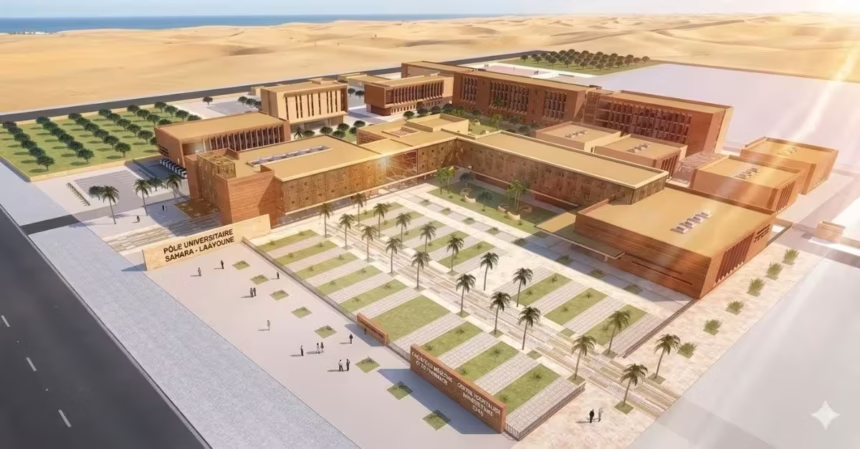
The visual aspect of the city has changed with the inauguration of modern campuses whose architecture combines modernity with respect for Sahrawi identity. The City of Trades and Skills (CMC) in Laâyoune is one of the most striking examples of this modernity. Spanning several hectares, it offers pedagogical platforms that realistically simulate the corporate world. It features high-tech workshops, language labs, and coworking spaces that rival European or American campuses.
Technological equipment is at the core of this strategy. Universities are equipped with fiber optics, exhaustive digital libraries, and the latest generation of simulation equipment. This robust infrastructure allows for active pedagogy where the student is the actor in their own learning. The quality of university residences and living spaces—including sports fields, cafeterias, and cultural centers—also participates in this quest for excellence by offering a healthy and stimulating living environment.
Maintenance and management of these spaces are rigorous, ensuring the longevity of equipment and premises. By investing in the “container,” Morocco has sent a strong message: academic excellence first requires respect for the learner and their environment. This attention to detail, from ergonomic furniture to solar-powered air conditioning systems, reinforces the idea that the South is the new frontier of Moroccan knowledge.
The Faculty of Medicine as a Spearhead of Excellence
If there is one establishment that symbolizes this renewal, it is undoubtedly the Faculty of Medicine and Pharmacy of Laâyoune. Opened to address the shortage of medical staff in the region, it has become a reference institution in record time. It welcomes hundreds of students supervised by renowned professors. The proximity to the future University Hospital Center (CHU) of Laâyoune creates a complete health ecosystem, allowing for clinical training of exceptional quality.
The impact of this faculty is twofold. On one hand, it trains future doctors who will practice in the Sahara, guaranteeing better health coverage for local populations. On the other hand, it attracts brilliant students from all regions of the Kingdom, creating an unprecedented cultural and intellectual mix. The faculty’s research labs are already working on medical themes specific to desert areas, giving the institution a unique scientific identity and undeniable added value.
A Diversified and Professional Academic Offer
To understand why Laâyoune is becoming a university hub of excellence, one must analyze the relevance of its training programs. The educational offer has been meticulously designed to match the needs of the local and international labor market. Ibn Zohr University, through its various branches (EST, ENCG, Poly-disciplinary Faculty), offers varied curricula ranging from management to engineering and social sciences.
The programs emphasize the region’s future sectors:
-
Renewable energies (solar and wind), a sector where Laâyoune is a national leader.
-
The fishing industry and the valorization of sea products.
-
Saharan tourism and luxury hospitality.
-
The digital sector and computer coding, with specialized schools.
-
Agriculture in saline environments and advanced desalination technologies.
-
Logistics and international trade, supported by the strategic Phosboucraa port.
This pragmatic approach guarantees graduates a high employability rate. Local companies are closely associated with the development of curricula. Immersive internships and applied end-of-study projects allow students to confront the realities of the field during their university career. This symbiosis between academia and industry is the foundation of the excellence promoted by the city.
A Bridge to South-South Cooperation
Laâyoune does not only aim to be a national hub but a true African platform. Thanks to its strategic geographical position and Morocco’s stability, the city attracts more and more students from sub-Saharan Africa. Partnership agreements have been signed with several African countries to grant scholarships and facilitate the integration of the continent’s youth into the city’s establishments.
This international dimension reinforces excellence through diversity. Academic debates are enriched by varied perspectives, and research centers collaborate on common continental issues, such as climate change and food security. Laâyoune is thus becoming a showcase for Moroccan expertise and a vehicle for “soft power” in Africa, proving that education is the best tool for bringing people together and building a shared future.
Socio-Economic Impact of the Campus
The settlement of thousands of students and hundreds of professors has generated unprecedented economic dynamics. The real estate, transport, and services sectors are experiencing rapid growth. New residential neighborhoods are emerging, while local shops are multiplying. This constant vitality transforms Laâyoune into a vibrant “university city,” where youth bring new energy and increased consumption of cultural goods.
On a social level, the university acts as a major social elevator. It allows youth from modest backgrounds to access prestigious careers without the prohibitive cost of moving far from family. Women, in particular, benefit greatly from this proximity, seeing their chances of pursuing higher education multiplied. The university thus becomes a place of empowerment and social progress for the entire Sahrawi community.
The city’s attractiveness to foreign investors is also significantly strengthened. Large companies are more inclined to settle in an area where they know they can find a qualified workforce and research centers capable of supporting their development. By becoming a hub of excellence, Laâyoune secures its economic future and gives itself the means to achieve its ambitions: to be the essential gateway to Atlantic Africa.
FAQ
What are the main schools currently available in Laâyoune? The city now houses the Faculty of Medicine and Pharmacy, the National School of Commerce and Management (ENCG), a Higher School of Technology (EST), and the City of Trades and Skills (CMC). It also benefits from the influence of Ibn Zohr University and the Mohammed VI Polytechnic University (UM6P) through its research poles.
Does a degree obtained in Laâyoune have the same value as elsewhere? Absolutely. The degrees awarded are State diplomas recognized nationally and internationally. The curricula are identical to those taught in Casablanca or Rabat, and often benefit from newer infrastructure and less crowded classes, favoring better learning.
Does Laâyoune welcome international students? Yes, the city welcomes hundreds of students every year, mainly from sub-Saharan Africa, as part of South-South cooperation. This international openness is one of the pillars of the city’s excellence strategy.
What are the career prospects after studying in Laâyoune? Prospects are numerous, especially in the growing sectors of the Moroccan South: medicine, renewable energy, mining engineering, logistics, business management, and the blue economy. The region’s strong growth guarantees a constant demand for qualified talent.