

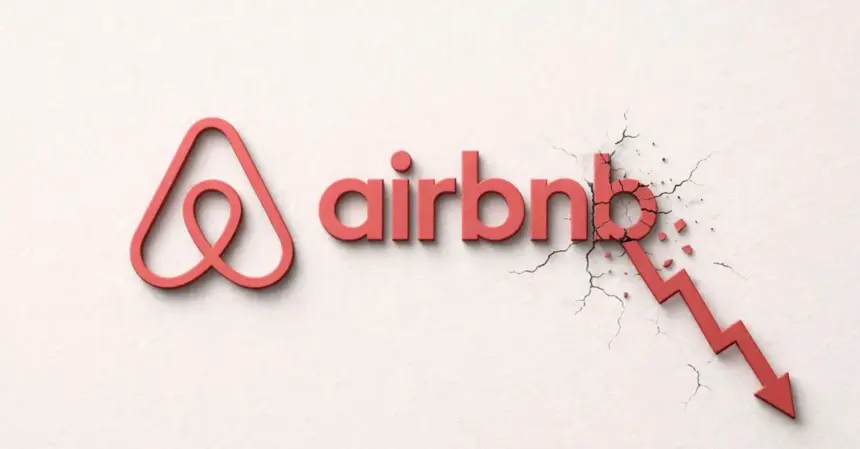
Imagine a property owner in London or New York. He refreshes his dashboard once, twice, ten times. The verdict is in: a 43% drop in bookings compared to last year. In the middle of July, where calendars used to be fully booked months in advance, only an icy void remains. This scenario is no longer an exception; it is the new reality of a staggering empire. The fall of Airbnb is not a simple accident; it is the result of a deliberate strategy where the giant ended up sacrificing its hosts on the altar of stock market profitability.
Airbnb was once the promise of a revolution. Renting out an air mattress to pay your rent, then turning your apartment into a source of financial independence. For over ten years, the platform reshaped global tourism, making traditional hotel chains like Hilton or Marriott look outdated. But today, the dream is crumbling. Between drastic municipal regulations, the anger of local residents, and an increasingly strict internal policy, the platform seems to have become what it fought against at the start: an impersonal, rigid, and expensive machine.
The Meteoric Rise of a Sharing Giant
It all began in 2007 in San Francisco. Brian Chesky and Joe Gebbia, unable to pay their rent, inflated three camping mattresses in their living room. The “AirBed & Breakfast” concept was born. At the time, Silicon Valley investors laughed: who would want to sleep at a total stranger’s house? Yet, after surviving by selling collector cereal boxes during the Obama campaign, the founders joined the Y Combinator accelerator. This was the start of an epic journey that would propel the company to a valuation of $85 billion during its IPO in 2020.
The appeal was simple and powerful. For travelers, it was access to authentic housing, often twice as cheap as a cramped hotel room. For owners, it was the “golden ticket” to real estate entrepreneurship without needing to own an entire hotel. The platform owns no walls; it is merely an interface, an intermediary that takes a commission on every night. This “zero inventory” model allowed for exponential growth, reaching more than 7 million listings in 220 countries.
However, this disproportionate growth carried the seeds of its own destruction. What started as a side income for individuals became a professional industry. Investors bought up entire buildings to turn them into “disguised hotels,” draining the local rental market and causing real estate prices to skyrocket for permanent residents. This mutation transformed Airbnb’s image: from a friendly start-up, it became a semi-urban predator, triggering unprecedented hostility from city halls around the world.
The War of Cities and the Turning Point of Regulations
The honeymoon between Airbnb and major metropolises is over. Cities like New York dealt the hardest blow with Local Law 18, which imposes mandatory registration for hosts and prohibits almost all rentals of less than 30 days if the owner is not present in the home. The result was immediate: thousands of listings vanished overnight. Barcelona followed with an even more radical announcement, planning to abolish all tourist licenses by 2028 to return housing to locals.
These regulations are not isolated cases. In Amsterdam, rentals are limited to 30 nights per year for primary residences. In Paris, the 120-day limit is strictly monitored by specialized task forces. The cost of compliance has become a burden for hosts. Between tourist taxes, administrative registrations, and record fines that can drop at any moment, the profitability of short-term rentals has collapsed. For many, the legal risk now far outweighs the potential financial gain.
In addition to legal pressure, the market itself is saturating. The post-Covid boom attracted a massive wave of new hosts, creating an oversupply in already dense areas. This fierce competition triggered a price war where margins melt away. Hosts find themselves forced to lower their rates while facing inflation in energy costs, linens, and especially cleaning. We are witnessing a striking paradox: while prices for travelers climb due to platform fees, the net income for owners is decreasing.
Why Airbnb Chose to Sacrifice Its Hosts
This is where the economic thriller takes a dark turn. To maintain its stock market growth and reassure shareholders, Airbnb had to make a strategic choice: prioritize the traveler experience at the expense of its historical partners. Since 2022, algorithm changes have systematically favored “Superhosts” and professional property managers capable of offering hotel standards. Small individuals, who were the soul of the platform, are relegated to page 10 of search results if they do not accept instant booking or ultra-flexible cancellation policies.
The platform has also tightened its refund rules. Numerous host testimonials report cases where Airbnb fully refunded travelers for minor reasons, leaving the owner without recourse or income. The “AirCover Guarantee,” sold as total protection against damage, is often described as a bureaucratic obstacle course where compensation is partial or refused. For the platform, an unhappy traveler is a lost customer, while an unhappy host is judged replaceable by the mass of newcomers.
Here are some key points that explain this sense of betrayal among owners:
-
Exploding service fees which can now exceed 15% for the host and a similar amount for the traveler.
-
Forced standardization: the obligation to provide hotel-worthy amenities (premium coffee, high-speed Wi-Fi, self-check-in) to remain visible.
-
Dispute management systematically in favor of the customer to avoid bad reviews on social media.
-
The end of authenticity: the algorithm favors magazine-style photos and “Instagrammable” decor over traditional charm.
This shift toward an industrial model has killed spontaneity. Travelers, for their part, complain about exorbitant cleaning fees (sometimes $100 for one night) while receiving a list of chores to complete before departure: wash the sheets, empty the bins, put away the dishes. This cocktail of high prices and rigid constraints is now pushing a portion of the clientele back to classic hotels, which often offer better value for money and a total absence of housework at checkout.
The Survival Dilemma vs. The Erosion of DNA
Is Airbnb doomed? Not necessarily, but it is mutating to survive. Brian Chesky recently admitted that the platform needs to “fix its foundations.” This includes greater transparency on total prices from the initial search and an effort to limit abusive cleaning fees. The company is also betting on long-term stays (more than 28 days), which now represent nearly 20% of bookings. This is a clever strategy to bypass short-term regulations while adapting to the rise of remote work and digital nomads.
Yet, this reinvention comes at a price: the permanent loss of its original identity. Airbnb is no longer a sharing community; it is a global marketplace. The transition from “renting a room from a local” to “managing a real estate portfolio optimized by AI” marks the end of an era. For entrepreneurs, the lesson is brutal: relying solely on a third-party platform for your business is like building your house on someone else’s land. When the rules of the land change to satisfy Wall Street, the foundations crumble.
The fall of Airbnb, as perceived by hosts, is actually a forced transition to economic maturity. The company sacrificed its pioneers to become a solid institution, capable of negotiating with governments and generating massive profits. But by losing the human connection and accessibility that made it successful, it leaves the field open to new, more local or specialized competitors, ready to pick up those disillusioned by a system that has grown too large for its own good.
FAQ: Understanding the Airbnb Crisis
Why have prices on Airbnb become more expensive than hotels? The increase is due to the accumulation of platform service fees, increasingly high local tourist taxes, and cleaning fees imposed by external providers. To remain profitable in the face of these charges, hosts have no choice but to increase their rates, making hotels competitive once again.
Can Airbnb disappear from major cities like Paris or New York? It will not disappear completely, but its offer will be drastically reduced and professionalized. Regulations aim to eliminate “wild” rentals to stabilize the permanent housing market. We are moving toward a model where only primary residents renting occasionally or licensed professionals can operate.
Is it still profitable to become an Airbnb host in 2026? Profitability now depends on location and strategy. “Classic” short-term rental is in decline, but niche sectors like unique accommodations (cabins, domes) or medium-term rentals for professionals remain promising. However, you must plan for a much larger management and compliance budget than before.
What are the alternatives for disappointed owners? Many hosts are turning to mobility leases (1 to 10 months), student rentals, or alternative platforms like Booking.com or Vrbo to diversify their income sources. Some even choose to return to classic long-term rentals to gain peace of mind away from incessant algorithm changes.