


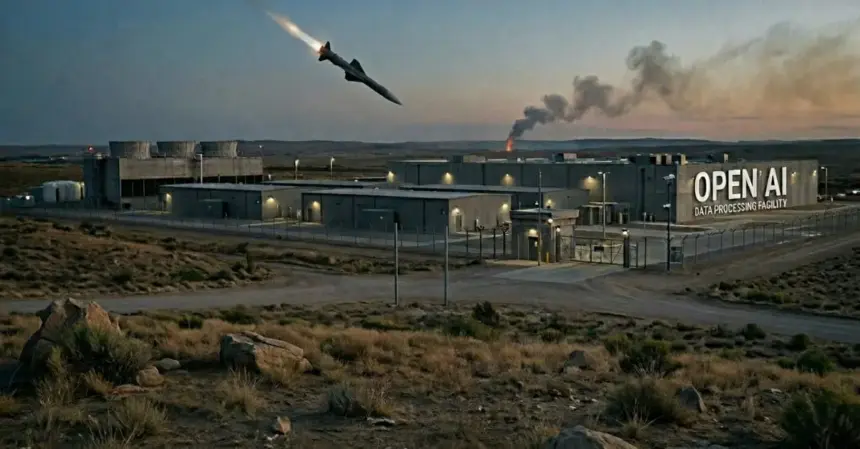
The world of technology and geopolitics was recently shaken by a chilling announcement from Tehran. The Iranian Islamic Revolutionary Guard Corps (IRGC) has officially designated a high-priority target in its sights: the Stargate AI data center. This titanic complex, the result of a strategic collaboration involving OpenAI and Microsoft, represents a colossal investment of $30 billion. Located in Abu Dhabi, at the heart of the United Arab Emirates, this 1-gigawatt facility is considered the brain of the next generation of artificial intelligence, but it is now at the center of an unprecedented military escalation.
Brigadier General Ebrahim Zolfaghari, spokesperson for the IRGC, spoke in a propaganda video broadcast across the regime’s official channels. His words leave no room for interpretation: he promises “total and absolute annihilation” of American and Israeli facilities if Washington were to strike Iran’s energy sector. These statements come as regional tensions reach a breaking point, transforming data centers—once simple server warehouses—into high-importance military objectives.
The video released by the Iranian regime utilizes precise satellite imagery to demonstrate its surveillance capabilities. It begins with an orbital view before zooming in on a desert expanse near the coast of Abu Dhabi. Although Google Maps appears to obscure or leave this area empty, Iran claims to have pierced the secret. “Nothing escapes us, even if Google hides it,” a caption superimposed over the desolate landscape reads. The sequence then switches to a night view revealing the thermal and luminous activity of the Stargate AI infrastructure, proving, according to Iran, that the site’s “stealth” is a total failure.
Strategic Stakes of the Stargate AI Project in Abu Dhabi
Why such an obsession with a data center? The Stargate AI project is not a simple server farm for storing emails. With 1 gigawatt of power, it is designed to train the world’s most sophisticated large language models, far exceeding the current capabilities of GPT-4. For Iran, the rise of American AI power in the Gulf is perceived as a direct threat to its national security. The algorithms developed on-site could be used for cyber warfare, high-end espionage, or the optimization of autonomous weapons systems for Western forces.
The $30 billion price tag underscores the vital importance of this installation. For comparison, this represents a significant portion of the GDP of many countries in the region. By targeting Stargate AI, Iran is not just looking to destroy machines, but to deal a fatal blow to the technological supremacy of the United States and its allies. The location in Abu Dhabi, theoretically neutral territory but a strategic partner of the West, places the UAE in an extremely uncomfortable position, turning them into a potential battlefield for high-tech warfare.
Iran has already shown that it does not stop at words. Recent reports indicate that rocket strikes managed to seriously disrupt several Amazon AWS data centers in the region. These incidents resulted in temporary closures and massive data losses for many local businesses. These attacks serve as a proof of concept: if Iran could hit Amazon’s servers, the Stargate AI complex, despite its defense systems, is technically within reach of its ballistic missiles and long-range suicide drones.
Iran leveling up
They released a video of threatening to strike 1GW Stargate AI datacenter in the UAE.The data center is hidden on Google maps they even shown that pic.twitter.com/LuOGIp3BVj
— Furkan Gözükara (@FurkanGozukara) April 3, 2026
Vulnerability of American Technological Infrastructure in the Gulf
The threat is not limited to OpenAI. General Zolfaghari explicitly mentioned that “all similar companies in the region with American shareholders” would be targeted. This includes giants like Nvidia, Microsoft, Apple, and Google. These companies have invested heavily in the Middle East to take advantage of abundant energy and the Gulf’s central geographic position. However, this proximity to conflict zones turns their assets into easy targets for regional powers seeking leverage through force.
Military experts are questioning the effectiveness of anti-missile shields deployed around these sites. While Patriot systems or THAAD batteries protect military bases, protecting civilian data centers—even strategic ones—is more complex. Iran could saturate defenses through swarm attacks, combining slow, inexpensive drones with precision missiles. A single hit on the cooling system or the dedicated power supply of a 1-gigawatt center would be enough to cause a catastrophic shutdown and irreversible physical damage to high-end processors.
-
Physical Destruction: Missiles can pulverize server infrastructure and dedicated power plants.
-
Human Loss: Thousands of engineers and technicians work at these sites 24/7.
-
Economic Impact: A successful attack on a $30 billion project would cause a global stock market shock.
-
Technological Disruption: Global AI development could be set back by several years.
Analysis of Strike Capabilities and the Credibility of the Iranian Bluff
Is this a bluff or an imminent threat? Recent history shows that Iran often prefers asymmetric warfare. However, the precision of the satellite images shown in the video suggests meticulous preparation. By designating Stargate AI as a “prime target,” Tehran is sending a clear message to investors and governments: Gulf stability is an illusion. The use of the term “total annihilation” reflects a desire for deterrence, but also frustration with the economic sanctions strangling the country.
One might legitimately wonder why Iran has not yet struck this center during the last month of hostilities. Several hypotheses are circulating among analysts. The first is diplomatic: a direct attack on UAE soil could trigger a coordinated regional response. The second is technical: the AWS centers hit previously may have been less protected targets, serving as a test for a larger operation against the OpenAI complex.
The psychological aspect of this video should not be overlooked. By claiming that “nothing escapes them,” the Revolutionary Guard seeks to instill doubt in the technological partners of the United States. If an infrastructure presented as “hidden” and ultra-secure is already mapped by the enemy, what is the real level of security for employees and data? This strategy aims to force American companies to reconsider their presence in the region, which would weaken Washington’s economic influence.
Escalation Toward Physical and Kinetic Cyberwar
We are entering an era where the distinction between digital war and physical war is blurring. Attacking data centers is the ultimate form of kinetic cyber warfare. Instead of trying to hack OpenAI’s firewalls to steal algorithms, Iran is choosing to destroy the physical medium of those algorithms. This approach is much more radical and devastating. It serves as a reminder that even the most “cloud-based” intelligence relies on vulnerable physical infrastructure: cables, silicon chips, and power turbines.
The risk of escalation is at its peak. If Iran carries out its threats, the United States would almost certainly be forced to retaliate on Iranian soil, perhaps targeting IRGC command centers or their own telecommunications infrastructure. It is a dangerous spiral where each side tries to demonstrate its capacity for harm. The technology sector, long shielded from classic territorial conflicts, is now on the front lines of global geopolitics.
The impact on public opinion and the AI market will be immense. OpenAI and Microsoft must now justify continuing their operations in a potential war zone. Employee safety, mentioned in reports as a major concern, could become the deciding factor. A data center can be rebuilt, but the loss of world-class AI experts in a missile strike would be irreparable for the industry.
FAQ on Threats Against Stargate AI
What is the Stargate AI project? The Stargate AI project is a major initiative by OpenAI and Microsoft to build the world’s largest data center dedicated to artificial intelligence. With a budget of $30 billion, this Abu Dhabi complex is meant to house millions of GPUs to train future AI models.
Why is Iran specifically targeting this center? Iran perceives Stargate AI as a tool of American military and technological power. By threatening this center, the regime seeks to deter the United States from striking its own energy infrastructure while targeting a high-value economic and symbolic asset.
Is the Stargate AI data center actually in danger? While protected by sophisticated defense systems, the center is within the operational range of Iranian ballistic missiles and drones. Previous successful attacks against Amazon AWS servers in the region prove the threat is technically credible.
What could be the consequences of a successful attack? The destruction of the site would lead to a colossal financial loss, a major slowdown in global AI development, and a direct military escalation between Iran, the United States, and potentially regional allies.










The growing tension around the Stargate AI data center highlights how closely technology, geopolitics, and national security are becoming connected. It is a powerful reminder that protecting critical digital infrastructure is increasingly important in today’s world.