


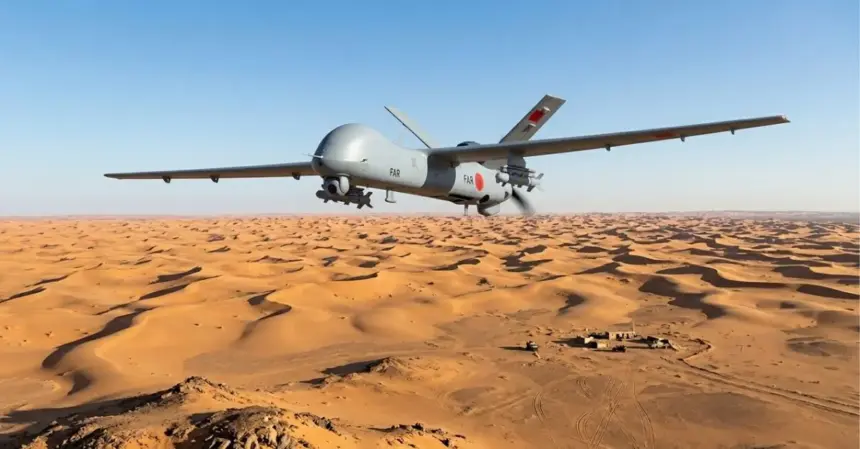
The continental security landscape is about to undergo a major technological shift. In fact, Morocco was chosen by the U.S. Army to host the first phase of a vast drone training program. This announcement, which resonates as a validation of the Kingdom’s military diplomacy, marks the beginning of a new era where aerial surveillance and artificial intelligence become the pillars of stability in Africa.
This ambitious project will be officially launched next April, in the midst of the African Lion 2026 exercise. This annual event, already considered the largest military maneuver on the continent, will serve as a launchpad for an unprecedented training program destined for African military officers. Behind this initiative lies a clear desire from Washington: to provide its partners with autonomous capabilities to face growing asymmetric threats, from the Sahel to the Atlantic coasts.
A Strategic Choice for Regional Stability
The choice of Morocco to host this first hub was not by chance. General Christopher Donahue, commander of U.S. Army Europe and Africa, highlighted the reliability of the Moroccan partner during the African Land Forces Summit. The Kingdom has established itself as a pole of stability capable of centralizing cutting-edge technologies. By installing this center, the U.S. Army validates Morocco’s modern defense doctrine, which has been investing heavily in the aerospace industry and unmanned systems for years.
The objective of this center goes beyond simple technical knowledge transfer. It aims to create a durable and sustainable capacity. Once the effectiveness of this model is proven on Moroccan soil, the Pentagon plans to extend this network to other geographical parts of Africa. This step-by-step approach allows for testing the integration of drone systems in real environments while strengthening interoperability between continental armies and NATO forces.
The deployment of these regional centers responds to an urgent demand. African nations face complex challenges such as transborder terrorism, intensive poaching, and illicit drug trafficking. Until now, access to surveillance technology was limited by cost barriers and lack of expertise. By anchoring this training in Morocco, the United States offers a local platform to democratize the military and security use of unmanned aerial vehicles.
African Lion Exercise as a Testing Ground
This year’s edition takes on an exceptional dimension with the participation of over 10,000 personnel from 20 different nations. While maneuvers unfold in Morocco, Tunisia, Senegal, and Ghana, it is on Moroccan soil that technological innovation will be most palpable. The first training module will welcome 16 carefully selected military personnel, divided into two distinct working groups.
The first group will focus on the doctrinal aspect: how to integrate drones into operational planning. It is not enough to fly a device; one must know how to process information in real-time to make crucial tactical decisions. The second group will dive into practice with the handling of four different aircraft systems. This eight-to-ten-day immersion aims to transform field officers into experts capable of deploying intelligence (ISR) solutions with surgical precision.
General Donahue insisted that this training is not limited to equipment. The idea is to focus on a problem-solving approach. For example, how to use a drone to secure a humanitarian convoy or detect suspicious movements in difficult-to-access desert areas? The African Lion 2026 exercise thus becomes an open-air laboratory where theory meets the reality of the African terrain, often marked by extreme weather conditions and significant geographical distances.
Technical and Financial Challenges of Armament
The transition to drones represents a colossal financial challenge for many states. During discussions at the Southern European Task Force Africa, Senegalese Brigadier General Simon Ndour raised a crucial point: the gap between low-cost commercial drones and high-performance military systems. While some countries manage to acquire modified civilian devices, these remain limited to purely tactical use and often lack robustness against electronic jamming.
High-performance systems, capable of staying airborne for dozens of hours and equipped with thermal sensors or weaponry, can cost several tens of millions of dollars. This is where the American initiative makes sense. By including tech companies and industry experts in the loop, the program seeks to reduce costs. Manufacturers are already working on less expensive solutions, allowing for the acquisition of advanced surveillance capabilities without exhausting national defense budgets.
Concrete Benefits for African Armies
The arrival of these training centers will transform security management on several levels:
-
Border Protection: Increased surveillance of porous zones to limit incursions by armed groups.
-
Anti-Poaching: Using infrared cameras to protect wildlife during the night.
-
Humanitarian Relief: Ability to assess damage after a natural disaster to direct aid.
-
Reduced Human Loss: Using drones for reconnaissance before sending ground troops into mined or risky areas.
-
Technological Sovereignty: Training local cadres capable of maintaining and operating these systems without systematic dependence on outside experts.
A Global Partnership for Innovation
The African Land Forces Summit demonstrated that security can no longer be the business of a few isolated specialists. The involvement of private companies and innovators is now essential. The goal is to bridge the gap between the urgent needs of African armies and industry production cycles. By fostering this collaboration, the Moroccan training center becomes a catalyst for local innovation.
One can imagine, in the near future, African engineers collaborating with American technicians to adapt flight software to the specificities of sandstorms or Saharan heat. This transferability of skills is the real engine of the initiative. Morocco, with its modern airport infrastructure and expertise in aeronautical maintenance, offers the ideal setting for these high-level exchanges.
The initiative also aims to stimulate collaboration between African countries themselves. By training military personnel of different nationalities within the same center, a common security culture is created. This greatly facilitates joint operations during African Union or UN peacekeeping missions. Sharing data from drones could eventually become a powerful diplomatic tool for stabilizing regions in conflict.
Perspectives for the Future of African Defense
While the first phase focuses on technical learning, subsequent phases could include modules on cybersecurity related to drones. As these machines become dependent on satellite links and the cloud, data protection becomes an issue of national sovereignty. Morocco, which has a high-performance cybersecurity monitoring center, can provide its expertise in this crucial area to protect military information flows.
The sustainability of the project will also depend on the capacity of states to integrate these tools into their command structures. The U.S. Army seems optimistic, seeing this first Moroccan phase as a proof of concept. If the first 16 trainees succeed in transforming their way of operating in the field, the program will scale up quickly. The final goal is for each region of Africa to have its own hub of excellence, creating an unprecedented technological security mesh.
In short, this project is not just another military announcement. It is the signal that Africa, with Morocco as the bridgehead, is ready to embrace the digital revolution of defense. The African Lion 2026 exercise will not just be a demonstration of force, but a demonstration of intelligence and strategic cooperation turned toward the future.
Frequently Asked Questions about the Drone Training Center in Morocco
Why was Morocco chosen for this program? Morocco has a robust military infrastructure, a historic partnership with the United States, and a strategic geographical position that makes it a natural crossroads for training African military cadres.
What types of drones will be used during the training? The program includes the handling of four different systems, ranging from light tactical drones to long-range surveillance systems, to cover all operational needs.
How long is the initial training? The training is divided into short, intensive modules of eight to ten days, allowing for a rapid skill upgrade for officers in strategic integration and technical maintenance.
What role does private industry play in this initiative? Private industry collaborates with the military to offer less expensive technological solutions better adapted to the budgetary realities of African countries, while ensuring the necessary transfer of know-how.








This is an insightful look at Morocco’s growing role in drone technology and African defense. The focus on training, cooperation, and technological development makes the initiative particularly interesting.