

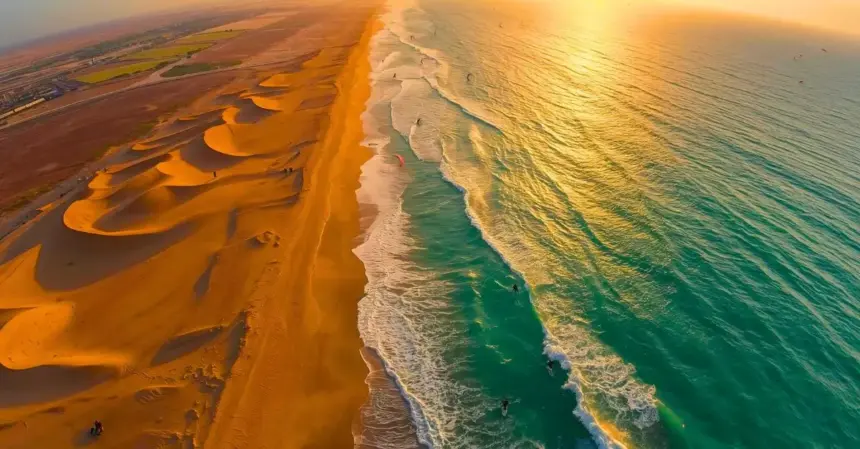
Dakhla has become, in the space of a decade, the world capital of kitesurfing. Located on a narrow sandy peninsula between the Atlantic and a turquoise lagoon, this Moroccan destination offers exceptional riding conditions 300 days a year. Whether you are taking your first steps or looking to perfect your “handle passes,” choosing the best kitesurfing spots in Dakhla according to your level is the key to a successful stay. The wind, mainly the North-East (the famous local Meltem), blows with disconcerting regularity, creating a varied playground where beginners, freestyle enthusiasts, and wave hunters meet.
- The Central Lagoon for Beginners and Freestyle
- Speed Spot the Paradise of Velocity
- The White Dune a Visually Stunning Kitesurfing Spot
- Oum Lambouoi the Wave Challenge for Experts
- Foum Labouir the Versatile Alternative
- Pointe de l’Or for a Wild Session
- Las Sarga the Southern Tip of the Peninsula
- FAQ on Kitesurfing in Dakhla
The appeal of Dakhla lies in its geographical duality. On one side, the lagoon offers flat, safe, and shallow waters, ideal for learning and rapid progression. On the other, the oceanic coast offers point breaks and powerful waves for experts seeking adrenaline. In 2026, statistics confirm that the region attracts over 100,000 visitors per year, the vast majority of whom are board sports enthusiasts. The atmosphere is unique, blending the harshness of the Sahara Desert with the gentleness of a modern kitesurf camp. Exploring Dakhla means accepting to live at the rhythm of the tides and the gusts.
The Central Lagoon for Beginners and Freestyle
The lagoon is the beating heart of kitesurfing in Dakhla. This is where the majority of schools and luxury infrastructures are concentrated. For a novice, it is undoubtedly one of the most educational places in the world. The wind is constant, generally between 15 and 25 knots, and the absence of waves allows you to focus solely on wing management and balance on the board. Local schools, IKO certified, take advantage of vast sandy areas where you can stand for several hundred meters, which considerably reduces the apprehension related to depth or current.
For intermediate or advanced riders, the lagoon transforms into a natural freestyle stadium. The water is often “flat” (smooth), which facilitates jumps and rotations. You regularly come across world champions in training, taking advantage of this mirror effect to refine their most complex tricks. Navigating in the middle of hundreds of colorful kites in water at 22°C offers an incomparable feeling of freedom, even if the crowds can be high in peak season, especially between May and September.
Speed Spot the Paradise of Velocity
Located a few minutes by tractor or boat south of the main camps, the Speed Spot is a geological marvel for thrill-seekers. At low tide, the receding water gives way to a sandbar that blocks even the smallest ripple. The result is absolutely smooth water, while the wind continues to blow strongly. It is the dream place to break your speed record or for foil practitioners who want to fly above a water mirror without any disturbance.
However, the Speed Spot requires a certain technical mastery. The wind is often “off-shore” (coming from the land), which means that in case of a technical problem, the wind pushes you towards the open lagoon. Most centers offer boat safety to monitor practitioners, but it is advisable to have a good upwind return before venturing there. It is an almost mystical place where the whistling of the fin in the water is the only noise that breaks the silence of the surrounding desert.
The White Dune a Visually Stunning Kitesurfing Spot
Impossible to talk about the best kitesurfing spots in Dakhla according to your level without mentioning the White Dune (Dune Blanche). It is not just a spot, but a true sensory experience. This immense dune of pristine white sand stands in the middle of the lagoon, creating an inner lagoon at high tide. The contrast between the white sand, the deep blue sky, and the crystal-clear water is worthy of a postcard. To get there, riders often organize downwinds of 15 to 20 kilometers from their hotels.
The White Dune spot suits everyone, but it is particularly appreciated by photographers and fans of contemplative “freeride.” At high tide, the most daring have fun jumping directly from the top of the dune into the water, an iconic figure of the region. However, navigation around the dune can be technical due to wind turbulence created by the relief. It is essential to know the tides well to take advantage of the deep water at the foot of the sand, at the risk of finding yourself on a mudbank if you arrive too late.
Oum Lambouoi the Wave Challenge for Experts
For kitesurfers who swear by “strapless” and waves, the Atlantic coast is the ultimate playground. The Oum Lambouoi spot, located at the entrance to the city, is famous for its regular long right hander. Here, the conditions change radically compared to the lagoon. The wind is “side-on” (lateral), which secures the session, and the Atlantic swell breaks cleanly on a bottom of sand and flat rocks. It is a spot reserved for advanced level riders, capable of managing the bar crossing and wave reading.
Navigating on the ocean coast requires suitable equipment, often a “wave” type wing with a fast drift and a directional surfboard. The atmosphere is wilder and less crowded than in the lagoon. Locals and “waveriding” enthusiasts meet there for memorable sessions at sunset. This is where you understand the full power of the ocean, contrasting with the apparent tranquility of the peninsula’s inland waters.
Key Elements to Prepare Your Dakhla Session
To fully enjoy the Dakhla spots, good logistical preparation is necessary. Here are the essential points to check before loading your boardbag:
-
Wing Choice: Plan for sizes ranging from 7m² to 12m². The wind can be light in the morning and strengthen suddenly in the afternoon.
-
Sun Protection: The Sahara sun is unforgiving. Use high-protection mineral sunscreen and wear a thermal top or a 3/2mm wetsuit, as the wind cools the air.
-
Tides: They govern access to many spots like the White Dune or the Speed Spot. Consult local tide tables every morning.
-
Transportation: Most spots require a 4×4 transfer. Check if your accommodation includes these daily shuttles.
-
Safety: Always wear a life jacket, especially during prolonged downwinds far from your base.
Foum Labouir the Versatile Alternative
Foum Labouir is often considered the “all-in-one” spot. Located on the west coast, it offers both a world-class wave zone and a calmer water area depending on the swell strength. It is the perfect place for those who want to start surfkiting without the violence of the big North Atlantic breaks. The wind is generally more constant here than at Oum Lambouoi, making it an excellent choice for a late afternoon session after spending the morning on the lagoon.
This spot is also a top surfing location when the wind drops. As a kitesurfer, having access to Foum Labouir allows you to diversify your activities. There are some nice beach restaurants where you can enjoy grilled fish between sessions. Access is easy and the spot is well known to local residents, which guarantees a friendly and authentic atmosphere, far from the purely tourist circuits of the large northern lagoon camps.
Pointe de l’Or for a Wild Session
If you are looking to escape the crowds and sail in a raw setting, the Pointe de l’Or is your destination. This spot is less documented than the others, making it a well-kept secret of the regulars. Located halfway between the lagoon and the open sea, it offers varied navigation conditions with small kickers for jumping and flat areas between the sandbanks. It is an ideal place for intermediate riders who want to step out of their comfort zone and explore new horizons.
The Pointe de l’Or is particularly beautiful at rising tide. The water rushes into small coves, creating natural pools perfect for working on your tacking technique. There is no infrastructure on site, so you must bring water and something to snack on. It is the very definition of kitesurfing adventure: loading the 4×4, driving on sand tracks, and finding a deserted sandbank to inflate your kite in total solitude facing the immensity of the desert.
Las Sarga the Southern Tip of the Peninsula
Las Sarga is located at the very end of the Dakhla point, where the lagoon finally meets the ocean. It is a technical spot where currents can be strong, but the reward is worth the effort. There you find one of the longest waves in Morocco during big North-West swells. It is a true paradise for surfkiting and windsurfing. The wind is often stronger than at the north of the lagoon, compressed by the relief of the point.
This spot is reserved for practitioners with excellent physical condition and perfect mastery of their wing. “Side-off” conditions (wind coming from the land and side) offer incredibly smooth wave faces for carving. However, the drift can be fast and the return to the beach requires experience. It is a radical, authentic spot, often frequented by local fishermen who watch these colorful wings pass with a curiosity that is always renewed.
FAQ on Kitesurfing in Dakhla
When is the best time to go to Dakhla? Although you can sail all year round, the windiest period is from May to September. During these months, the thermal wind strengthens and blows almost every day above 20 knots. For wave enthusiasts, winter (November to March) is preferable as the swell is more consistent.
What level is required to sail in Dakhla? Dakhla welcomes absolutely all levels. Beginners will find schools with certified instructors and shallow areas. Intermediates can progress safely on the lagoon, while experts can measure themselves against the Atlantic waves or the pure speed of the Speed Spot.
Should I bring my own kitesurfing gear? If you have your own equipment, it is advisable to bring it for comfort and cost reasons. However, the lagoon centers offer rentals of current year equipment (brands like Duotone, F-One, or North). This allows you to test the latest gear and avoid sports baggage fees on flights, especially with Royal Air Maroc.
Is the water cold in Dakhla? The lagoon water remains temperate, oscillating between 19°C in winter and 23°C in summer. A full 3/2mm wetsuit or a 4/3mm for the more cold-sensitive is recommended, especially because of the windchill effect which can be marked, even under a bright sun.