This stubbornness is not neutral: it selects, amplifies and repeats the most incriminating elements while pushing aside whatever undermines them.
The Spanish press’s relentless campaign
Since July 30 and 31, 2026, a section of the Spanish press has locked down its narrative on Ceuta and refuses to reopen it. More than 80,000 people entered the enclave in two days. On November 11, the Centro Nacional de Inteligencia submitted a report to Judge María Tardón of the Audiencia Nacional, in which it states that it has “obtained, so far, no evidence” allowing it to conclude that these events were “instigated, planned or coordinated by the Moroccan authorities.” The same agency explicitly contrasts this sequence with May 2021, which it had then described as an instrument of Moroccan diplomatic pressure.
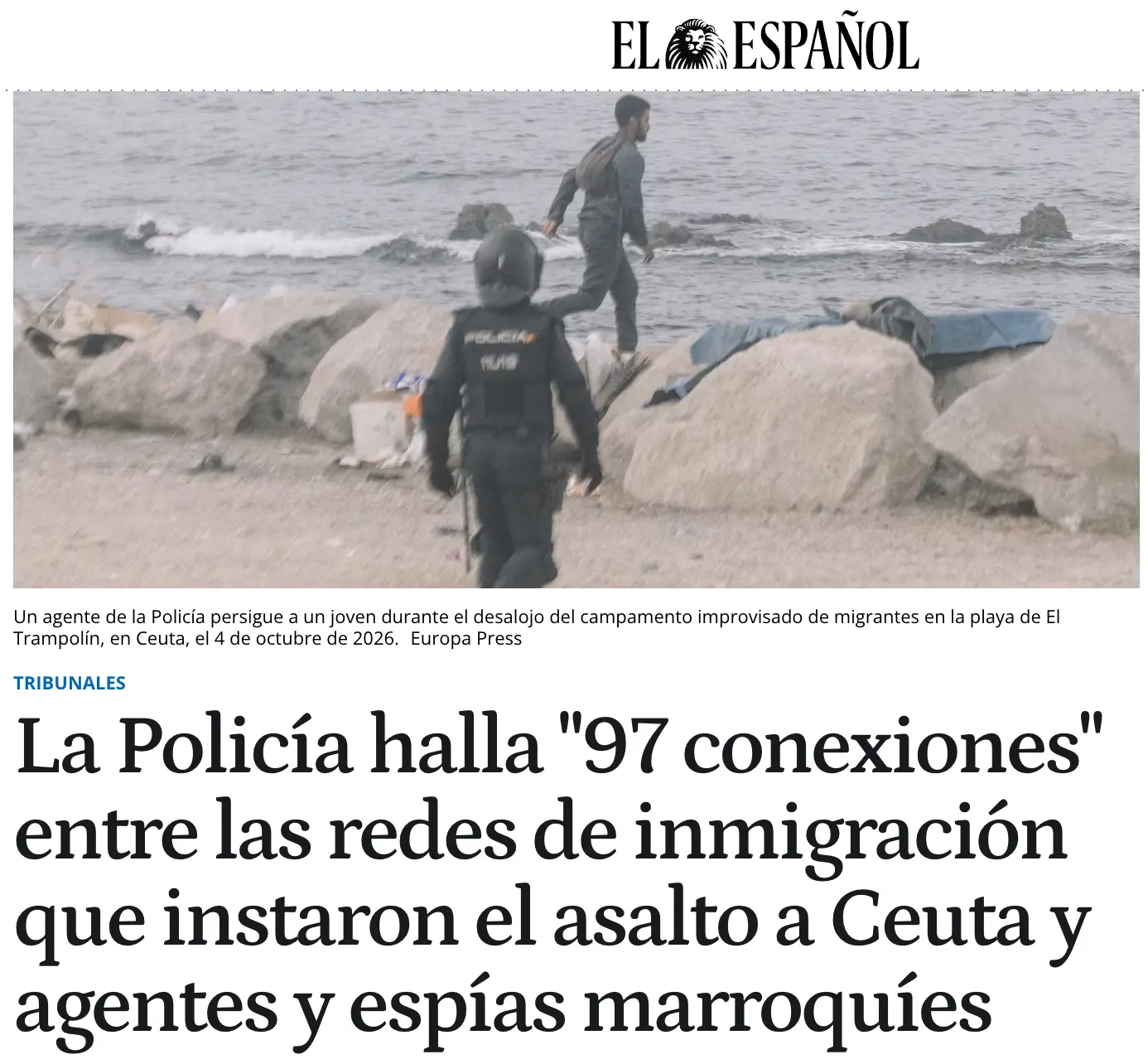
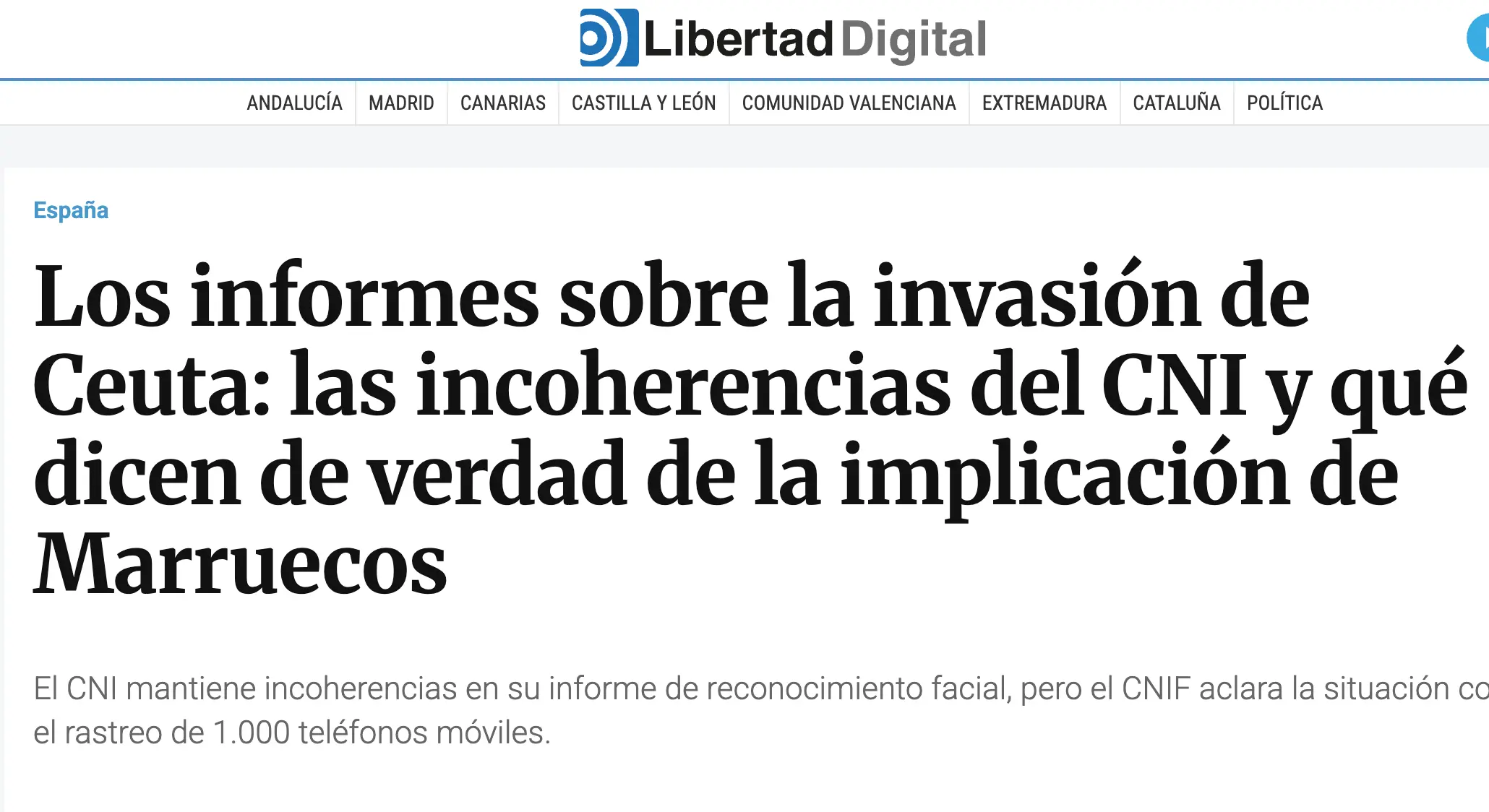
This document did not slow the flow. El Español, El País, ABC and others kept highlighting the harshest elements of the reports from the Centro Nacional de Inmigración y Fronteras: “active guidance” by Moroccan gendarmes, plainclothes agents on the ground, and 97 digital connections between WhatsApp group moderators and numbers associated with Moroccan security structures. These clues are treated as near-certainties of state orchestration, even though the CNI maintains that there is no proof. The hierarchy of sources has been inverted: the foreign intelligence service is pushed into the background as soon as it fails to confirm the dominant line.
This is no longer investigation. It is editorial persistence. Passages that allow the accusation to be maintained are selected, reservations and contradictions are minimized or glossed over, and the cycle starts again. The Sánchez government, for its part, has repeated that there is no evidence of organized involvement. In part of the press, this official position has been read as a political weakness rather than as a factual element to be taken into account.
Spain takes its cue from the Algerian press
Algerian media talk about Morocco every day, and almost always negatively. They did not need to invent the harshest elements: part of the Spanish press supplied them. What was, in Madrid, a choice of selective emphasis has become, in Algiers, a daily production of narratives about destabilization, migration blackmail and threats to the enclaves. Spain takes its cue from the Algerian press in the sense that it adopts, without saying so, the same stubbornness in favoring accusation and dismissing whatever weakens it.
This convergence does not require direct coordination. It is enough for certain Spanish outlets to prioritize the CENIF reports and downplay the CNI for Algerian media to have material they can use every day. The EFE agency circulated analyses on the massive use of dinghies of a single model, interpreted by some commentators as a sign of logistical preparation. ABC published elements linking a Moroccan official in charge of 2030 World Cup security to contacts within the mobilization networks.
These publications rely on data from Spanish police investigations. They persist after the publication of the CNI report of November 11. Algerian media have picked them up, amplified them and sometimes stripped them of context. The result, for the end reader, is a story in which Morocco appears as the certain organizer of an “invasion,” even though Spain’s main intelligence service says it has no proof of this for 2026.
This mutual inspiration does not absolve the Spanish press. It reveals its role as a supplier of raw material. A press that persists in this way does not merely publish documents; it chooses which ones to keep alive and in which frame to interpret them. The frame adopted for months is that of a Morocco that “tests,” “instrumentalizes” or “orchestrates,” even when the CNI rules out that conclusion for the July sequence.
A persistence that precedes the elections
The pre-election context, with Vox calling for a review of the naturalizations of people of Moroccan origin and for a reconsideration of the co-hosting of the 2030 World Cup, reinforces the phenomenon but does not fully explain it. The media campaign precedes and fuels the political instrumentalization. The Partido Popular has also hardened its tone on sovereignty and migration cooperation. This positioning responds to internal competition on the right and to an electoral demand on immigration and identity. But the work of certain media outlets came first: they select, amplify and repeat the harshest passages of the police reports while downplaying the opposing conclusions of the CNI.
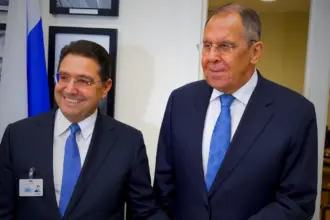
Moroccan reactions do exist. The Ministry of Foreign Affairs issued a statement formally rejecting the accusations, asserting that “no data, fact or report” established any involvement of the Moroccan authorities, and refusing to be instrumentalized in Spanish “political score-settling.” Le360 and Hespress highlighted the CNI’s conclusions and named certain Spanish journalistic treatments. These reactions are rarely treated, in the most critical Spanish press, as elements to be integrated into the case; they are more often read as a predictable denial.
- What the documents show and what the press makes of them: CNI report of November 11, 2026 (no proof of orchestration for July 2026, unlike 2021); CENIF reports citing active guidance and 97 digital connections; intensive and sustained coverage of the latter, more marginal treatment of the former’s conclusions; daily Algerian amplification of the harshest elements; more than 100 deaths according to NGOs; more than 80,000 entries in two days.
The cost of a locked-down narrative
What stands out, after following the case closely, is not the existence of criticism of Morocco. Such criticism is legitimate on border management or transparency. What stands out is the resistance to contradiction. When the CNI says it has no proof of orchestration for 2026, part of the press carries on as if this conclusion did not exist or were politically suspect. It prefers the reports that allow the accusatory line to be maintained. It leaves the field open to narratives that converge, intentionally or not, with the most hostile daily Algerian output.
The cost is both informational and political. A Spanish reader who follows mainly certain outlets can come away convinced that Morocco organized the July 2026 influx, when the intelligence service of their own country says it has no proof of it. This distortion is not trivial in a country where migration cooperation with Rabat is operationally indispensable, where electrical and commercial interconnections are real, and where the Moroccan Sahara issue remains a structural point of friction. As long as this practice remains dominant in part of the Spanish press, the public debate on Ceuta and on the relationship with Morocco will remain biased. The documents exist. The contradictions between agencies exist. The CNI’s conclusions exist. It is enough to read them in the order in which they were produced, and not in the order in which certain outlets prefer to present them.
Frequently asked questions
Did the CNI clear Morocco of all responsibility in the July 2026 crisis?
No. It concluded that there was no evidence of an action instigated, planned or coordinated by the Moroccan authorities, while noting awareness of the calls and an operational response deemed insufficient. It distinguished this sequence from that of 2021.
Why do some Spanish media keep insisting on Moroccan involvement despite the CNI report?
They rely mainly on the CENIF reports and present them as strong indications, while downplaying or relativizing the CNI’s opposing conclusions. The pre-election context reinforces this line.
Do Algerian media simply relay the Spanish press?
They speak ill of Morocco every day and amplify the most accusatory elements already circulated in Spain. The convergence exists, but Algerian output is more constant and more intense.
Has the Moroccan press responded?
Yes. Outlets such as Le360 and Hespress highlighted the CNI report and criticized certain Spanish treatments. The Ministry of Foreign Affairs issued an official statement rejecting the accusations.