
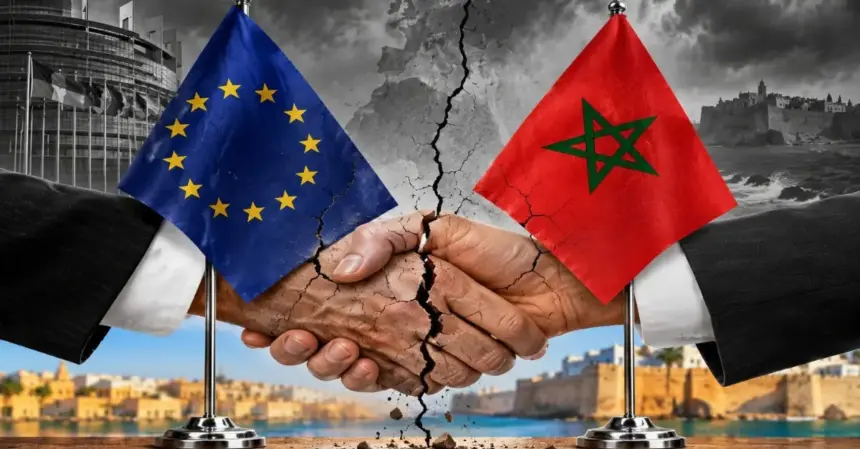
The Kingdom is no longer the junior partner that could be lectured without consequences. Today, it has an extensive network of alliances, concentrated economic leverage, and a geographic position that make any European policy of pressure risky — for Europe itself.
- A Network of Partnerships That Extends Far Beyond Brussels
- Even Within the EU, Not Everyone Will Follow Brussels
- Phosphate: A Card No One Else Holds
- A Defense Industry Rapidly Moving Up a Gear
- Geographic Position: Literally, the Key to the Strait
- What Europe Specifically Risks by Underestimating All This
A Network of Partnerships That Extends Far Beyond Brussels
Over the past decade, Morocco has diversified its strategic partners precisely to avoid depending on a single bloc.
With the United States, the relationship goes far beyond diplomatic appearances: Washington recognized Moroccan sovereignty over Western Sahara in 2020, a ten-year military cooperation agreement is in force, and the Kingdom is among the major buyers of U.S. weaponry on the continent. At the very moment the Trump administration is increasing trade and tariff tensions with the European Union, Rabat is cultivating a direct and privileged bilateral relationship with Washington — access that Europe itself is finding increasingly difficult to preserve.
With Israel, cooperation has moved from the symbolic to the structural: Abraham Accords, a joint military committee, technology transfers, and the construction of combat-drone factories on Moroccan soil — an industrial privilege that Israel grants to only a handful of partners in the Arab world.
With Russia, the relationship, more than 65 years old, remains solid despite the international context: Moscow considers Morocco one of its major trading partners in Africa, with bilateral trade continuing despite Western sanctions against Russia. Cooperation in fishing, the presence of Russian industrial companies such as Kamaz, and declared convergence on the Western Sahara issue: Moscow has no interest in seeing Rabat align itself with a hard European line, and makes that position known.
With China, Morocco has established itself as a gateway to the European and African markets, attracting major industrial investments in batteries and automotive manufacturing, while leveraging its position outside the EU to attract capital that Brussels would sometimes prefer to screen.
With India, defense cooperation has been strengthened, particularly through the establishment of armored-vehicle factories, turning Morocco into a gateway for Indian military know-how into Africa.
And across the African continent, through its Atlantic initiative for Sahel countries and massive agricultural and banking investments, Morocco has built an influence that European diplomacy can hardly match on the ground.
Even Within the EU, Not Everyone Will Follow Brussels
This is the point that the European Parliament’s resolution completely overlooks: the unanimity displayed in Strasbourg will not survive contact with national economic interests. France, Morocco’s largest foreign investor and the Kingdom’s leading trading partner, has built around Renault and an entire automotive subcontracting chain an industrial ecosystem that no French government will sacrifice for a symbolic text adopted by a relative majority. Germany, whose automotive suppliers have massively relocated part of their production to Tangier and Kenitra, faces the same calculation. Even Spain, despite being the source of the diplomatic offensive, remains trapped in an interdependence that cannot be broken overnight: its farmers, fishermen, and part of its textile industry depend directly on economic cooperation with Morocco, while its border security depends on cooperation with Moroccan law enforcement. Brussels can vote for whatever it wants: it is the capitals, one by one, that will negotiate afterward according to what they actually stand to lose — and many have far more to lose than to gain in a confrontation with Rabat.
Phosphate: A Card No One Else Holds
This is undoubtedly the leverage most underestimated by European policymakers. Morocco holds around 70% of the world’s known phosphate reserves — the essential raw material for fertilizers, and therefore for global food production. Through OCP, the country alone accounts for around 31% of the global market for phosphate and its derivatives, supplying Europe, Brazil, India, and a large part of African agriculture.
In a world where tensions in the Middle East have already demonstrated the fragility of fertilizer supply chains, a country controlling such a concentrated and vital resource is not a partner that can be angered without thinking twice.
A Defense Industry Rapidly Moving Up a Gear
Morocco’s military budget reaches record levels year after year, and the Kingdom is no longer simply buying: it is building. An armored-vehicle factory with India in Berrechid, a regional maintenance center for military aircraft in Benslimane with Lockheed Martin, and an emerging combat-drone industry with Israel — Morocco is deliberately diversifying its suppliers (the United States, Israel, China, Russia, Turkey, and India) to avoid depending on any single bloc, including Europe.
Geographic Position: Literally, the Key to the Strait
Morocco controls the southern shore of the Strait of Gibraltar, a critical passage between the Atlantic and the Mediterranean, as well as the gateway to West Africa through its Atlantic initiative for landlocked Sahel countries. Any European migration, security, or trade policy toward Africa passes, in one way or another, through some form of Moroccan cooperation.
What Europe Specifically Risks by Underestimating All This
- Poorly negotiated food dependence: weakening relations with the world’s leading phosphate supplier at a time when European food security already depends on strained supply chains.
- A loss of migration leverage: without active Moroccan cooperation, Europe loses its main operational partner on the Atlantic and Mediterranean fronts.
- A partner that pivots elsewhere faster than expected: every European pressure mechanically pushes Rabat to deepen its alliances with Washington, Tel Aviv, Moscow, Beijing, and New Delhi — relationships that are already well established and ready to absorb the vacuum left by a more distant Europe.
- A façade of European unity: the resolution creates the illusion of a common front, when France, Germany, and even Spain have interests in Morocco that are too substantial to implement a hard line in practice — Brussels risks adopting a text that its own member states will subsequently strip of its substance.
- A transatlantic vulnerability window: at a time when Europe is already facing trade tensions with the Trump administration, it risks pushing a strategic partner in the South directly into Washington’s arms, which may welcome such an opening.
- A loss of influence in Africa: as Morocco consolidates its position as a gateway to the Sahel and West Africa, every new tension with Rabat moves Europe a little further away from a continent where it is already competing with China, Russia, and Turkey.
- A diplomatic boomerang: by relying on a non-binding resolution perceived as disproportionate outside Europe, Brussels risks lending credibility to the idea that it is acting reflexively rather than strategically — an image that may not serve it well in future negotiations.